Prescription for Uproar
The coffee at the Kriminaldirektion, Ecke Tempelhofer Weg, had tasted the same for fifteen years: burnt, too strong, in cups that never got properly clean. Kalle stared into his cup as if it held the answer to why he’d been dragged out of bed at four in the morning for a raid that yielded nothing but a hundred and forty soaked protesters and a bloke who called himself a “pharmacist” despite not having a licence to practise.
“The case is thin,” said the boss. Kriminaldirektorin Brandt. Fifty-five, short hair, glasses she kept pushing up her nose. She sat behind her desk, surrounded by stacks of paper that never seemed to shrink. “Section 95 AMG. Medicines Act. Not the Narcotics Act. No provable organised structure. The prosecutor won’t sign a warrant. She says: No flight risk, no risk of reoffending, the man runs a corner shop.”
“A corner shop that flogs fentanyl,” said Kalle. He didn’t drink. Just stared. “With prescriptions printed cleaner than our warrant cards. With crypto wallets leading to Tallinn. With a Croatian connection reaching Zagreb, to a clinic that officially doesn’t exist.”
“The clinic exists,” Leni put in. She stood at the window, looking out over Tempelhofer Weg where the streetlamps still burned. “Dubrovnik Clinic. Specialised in pain therapy. Officially closed for two years. Unofficially: supplier for the Eastern European market. The drives we seized yesterday — encrypted. AES-256. Phones: wiped. But the cloud backups — they run through a server in Riga. We’ve got that.”
“Have we not,” Brandt corrected. “The server in Riga belongs to a shell company of a shell company. By the time we crack that, Mende’s retired. Or dead. Or both.” She took off her glasses, rubbed the bridge of her nose. “Rieger. Weber. I need something solid. A witness who’ll talk. A delivery we can intercept. A mistake Mende makes. No philosophy. No social study. Evidence.”
“The hundred and forty people outside,” said Leni, without turning round. “They’re not evidence. They’re a symptom.”
“We don’t treat symptoms,” said Brandt. “We pursue crimes. Bring me something a judge will sign a warrant for. Until then: surveillance. Low-key. No big operation. No headlines. We’ve got enough grief from the press after yesterday. Police clear corner shop — residents stand by dealer. The headline writes itself.”
Kalle put the cup down. Untouched. “Boss. The man’s not a dealer. He’s something worse. He’s a true believer.”
“True believers are the most dangerous,” said Brandt. “Because you can’t buy them. And you can’t scare them. Out now. Work.”
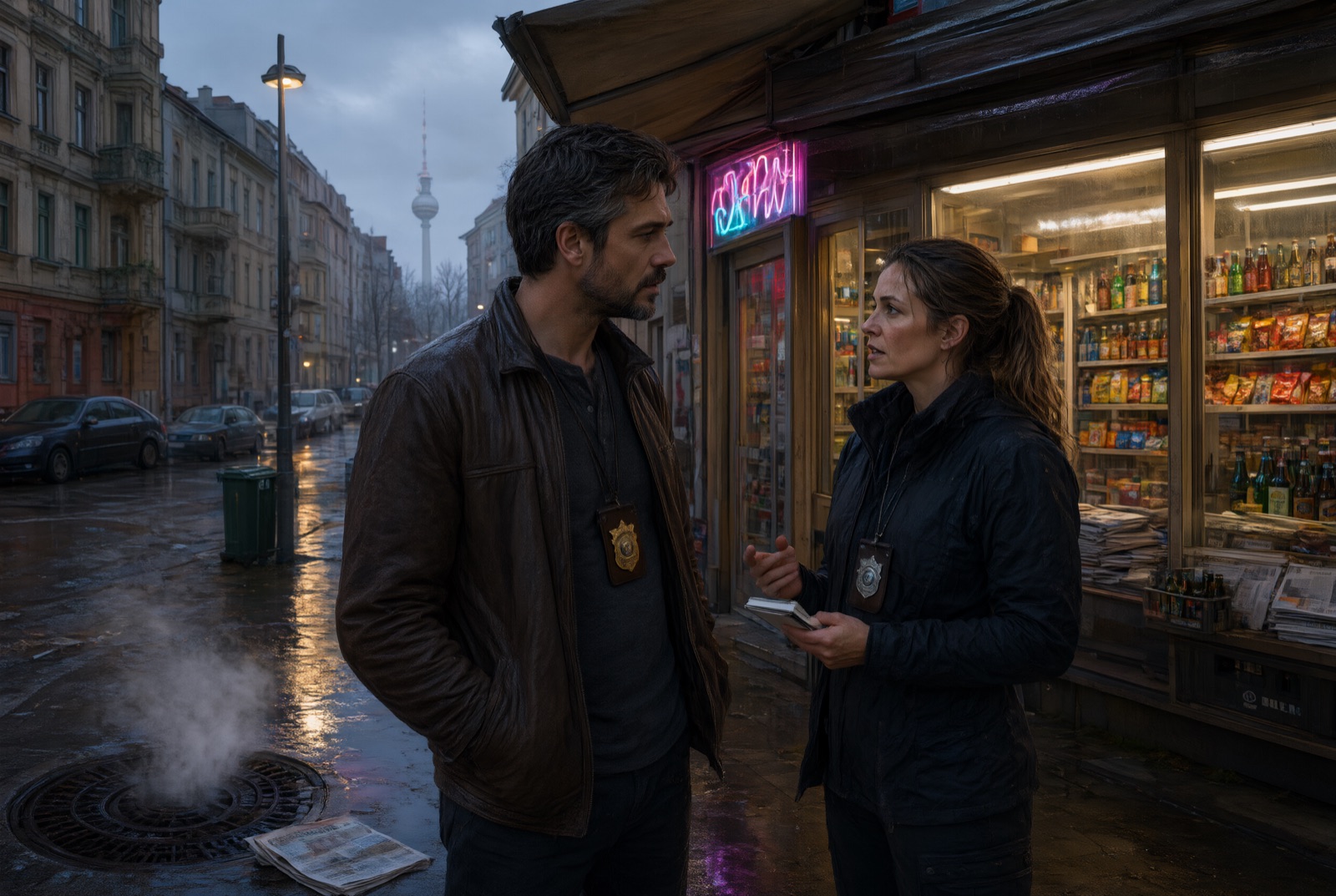
The corner shop on the corner of Nelkenzeile and Ankerzeile had seen better days. The neon tube above the entrance flickered like a dodgy heartbeat, and the sticker on the door — We don’t sell here, we help — was faded at the edges, the letters half-washed away by rain. Inside it stank of fag smoke, cheap coffee, and that specific mix of desperation and everyday life only Berlin corner shops manage: stale booze, damp concrete, the smell of people who’d been up all night and now, at half-six in the morning, needed their first or last coffee. A radio behind the counter warbled some old NDW tune, Major Tom, completely out of place between energy drink shelves and the fag machine.
Kalle leant against the counter, hands wrapped around a paper cup that held more warmth than coffee. Thirty-nine, grey streaks at the temples, a beard that looked like three days’ growth but was deliberate. His grey-blue eyes scanned the shop systematically: shelves of energy drinks in screaming colours, the beer cooler, the tobacco corner, the box of cheap brollies by the door, the worn bench against the wall where a homeless bloke slept curled up, tolerated by staff. And then the bloke behind the counter.
Fifty-five, maybe sixty. Grey hair, cut short. Checked shirt, top button undone. A gold chain that flashed every time he reached for the till. Hands — manicured, not working hands. Pharmacist hands. Or pharma rep hands. Fine line, but Kalle knew it. He’d questioned enough pharmacists, watched enough reps. Ones counted pills, the others counted commissions. End of the day, both counted the money.
“Mr Mende,” said Kalle. No greeting. No small talk. Not his style. “Karlheinz Mende. Born sixty-one. Former pharma rep. Last legit job: eighteen years ago for a Croatian clinic chain in Zagreb. Debts: allegedly two hundred thousand quid. Creditors: the sort who calculate interest not in percentages, but in limbs.”
The bloke behind the counter — Mende — didn’t move. His eyes stayed on the till, on the display showing a sale of two fag packets and an energy drink. Fingers rested loose on the keys. Routine. “I sell fags, coffee, and lately hope as well. What d’you want, copper?”
“Hope,” Kalle repeated. The word tasted of ash. “Nice word for prescription forgery, black market trading in oxycodone, fentanyl patches, tilidine, tramadol, and whatever the Eastern European market pays. Yesterday’s raid — LKA, riot squad, prosecutor — turned up drives, four-figure cash, and medicines nobody in Germany gets without a script. And d’you know what the best bit was?”
Mende shrugged. A tiny, barely noticeable movement. “That you didn’t find everything?”
“That a hundred and forty people stood outside. Chanting. Banners. Health isn’t a commodity — but Kalle Mende is our pharmacist. A hundred and forty people demonstrating for a bloke who supplies them with prescription drugs. In Kreuzberg. At half-seven in the morning. In the rain.”
“People need their meds,” Mende said quietly. “The insurance doesn’t pay for everything. Doctors don’t prescribe everything. I just help.”
“Help,” said Kalle. He set the cup down on the sticky counter. “Lovely word. Tell that to the bloke who died last week from a fentanyl patch your supply chain moved. Or the woman blowing her pension on your ‘hope’. Or the junkie who switched from your oxycodone tabs to heroin because it’s cheaper and hits faster. Helping has consequences, Mende. You just don’t see them on your till receipt.”
The door opened. Wind dragged in rain, cold and sharp, smelling of asphalt and exhaust. Leni stepped in, shook out her brolly, let her gaze sweep the shop — corner shop, counter, Mende, Kalle, the sleeping homeless bloke, the energy drink shelves — and settle on Kalle. Forty-two. Hazel eyes that registered everything, sorted it, weighed it. Hair in a ponytail. Dark jacket, practical shoes. The sort of woman who walks into a room and immediately knows where the exits are, who’s standing where, who’s lying, who’s telling the truth, and who’s mixing both.
“Prosecutor’s confirmed the seizure,” she said. Her voice was calm, controlled, the precise counterpoint to Kalle’s Berlin roughness. No dialect, no faff. Just facts. “Drives are being analysed. Medicines sent to LKA. But Mende isn’t being remanded — no flight risk, prosecutor sees no reoffending risk with ‘simple’ pharmaceutical crime. Section 95 AMG, not the Narcotics Act. Different sentencing. Different rules.”
Kalle snorted. “Simple pharmaceutical crime. Sounds like a parking ticket with a prescription.”
“Evidence is thin,” Leni carried on, unbothered. She pulled a notebook from her jacket, flipped it open, didn’t write. Just the motion, the suggestion of protocol. “Prescriptions are forged but the printers are clean. Crypto wallets lead to Estonia, Latvia, on to Ukraine. The cash — four thousand euros — isn’t enough for organised trafficking. And those hundred and forty people outside? They all say the same: He helps us. Nobody incriminates him. Not even Frau Müller, seventy, rheumatism, the one you mentioned. We summoned her. She said: Mr Mende saved my life.”
“Because they’re scared,” said Kalle. “Or they need their pills. Or both.”
“Or because he actually helps them,” Mende cut in. He hadn’t turned round. Still eyes on the till. “Inspector. You see the files. You see the numbers. But you don’t see Frau Müller, seventy, rheumatism, insurance only pays ibuprofen that rots her stomach. Or Mr Kowalski, can’t sleep since the war in Ukraine, can’t get a script for what helps. Or the single mum on the third floor choosing between rent and medicine. I’m not a dealer. I’m a distributor.”
“A distributor with a gold chain and connections to the Croatian mafia,” said Kalle. He stepped closer to the counter till the neon’s reflection danced on his face. “And the hundred and forty people? They’re your alibi machine. Your human shield. Proper clever. Proper Kreuzberg. Almost art.”
Mende finally turned. His face was lined, eyes tired but awake. Something in them Kalle couldn’t place: no fear, no anger. A sort of sad determination. Eyes of a man who’d lost everything and had nothing left to lose but his principles. “I was a pharma rep, copper. Twenty years. Know the studies, the side effects, the prices, the lobbying. Know how the system works. And know who it breaks. Not the corporations. Not the doctors. The patients.” He laid his hands flat on the counter. Nails trimmed clean. On the little finger of his right hand, a ring, plain, gold. Wedding ring? Or something else? “Call me what you like. But don’t call me a dealer.”
Leni just watched. The way Mende spoke — not defensive, not aggressive. Convinced. The way he said patients, not customers. The way he looked at Kalle: not with fear. With a sort of sad patience. Like he saw something Kalle didn’t want to see. Or wasn’t allowed to see.
“Mr Mende,” she said. “The raid was just the start. The drives will yield traces. The crypto wallets will crack — maybe not today, but eventually. The Croatian connection — Zagreb, the clinic chain — we’ll get that through Europol. And then we’ll be back here. Or at your door in Neukölln. Or the flat you rent above a betting shop on Sonnenallee. Or your daughter in Hamburg who thinks her dad’s retired.”
Mende smiled. A small, crooked smile deepening the lines round his eyes. “My daughter in Hamburg thinks I sell dietary supplements online. Vitamin D, magnesium, that sort of thing. She’d kill me if she knew I’m standing in a corner shop chatting to two coppers about fentanyl.” He reached under the counter, pulled out an energy drink can, set it in front of Kalle. The can was sweating. “On the house. For the trip back to the station.”
Kalle stared at the can. Then Mende. Then Leni. “Bribery in an ongoing investigation. Brave.”
“Not a bribe,” said Mende. “An energy drink. For a bloke who’s been up since four working a case nobody believes in. Not even his boss.”
Leni raised an eyebrow. A millimetre. “You’re well informed.”
“I read the papers. I listen. I know the structure. You two —” He gestured between Kalle and Leni. “— you’re the team that doesn’t give up. That’s your strength. And your weakness.” Mende leant back, folded his arms. The gold chain flashed. “You’ll carry on. You’ll crack the wallets. You’ll find the Zagreb link. You’ll get me eventually. But until then —” He pointed at the door, the wet street, the empty banners. “— a hundred and forty people will be back outside. Next week two hundred. Week after four hundred. Because the system’s knackered. And I’m just the plaster on it.”
“A plaster that sells fentanyl,” Kalle said quietly.
“A plaster that eases pain,” Mende corrected. “Sometimes they’re the same thing.”
Outside the crowd had dispersed. A few banners lay scrunched on the wet pavement, colours running. A copper poured the dregs of his coffee down the drain, pulled his hood up, glanced briefly at the corner shop windows. The rain got harder, lashing the panes, blurring the neon into a long yellow streak.
Kalle took the energy drink can. Didn’t open it. “Right then,” he said. “Coffee first. Proper coffee. Not this corner shop swill. And not that chemical cocktail.”
“Good job today,” said Leni, as they walked side by side towards the U-Bahn, through the rain, under the elevated railway where steel girders sliced the light into yellow strips and trains rumbled through the night like thunder.
Kalle said nothing. He pulled his leather collar higher, slipped the can into his inside pocket. His fingers brushed the cold aluminium rim. But at the corner of his mouth something twitched — not a smile. Just a line. Not as deep as yesterday.
The Tube rattled into the station. A train, grey, packed, knackered. Like the city. Like the pair of them. Doors hissed open. They got in. Not another word. Didn’t need one.
Note: All persons, places and events in this story are fictitious. It was inspired by a public police report but does not depict any real events, persons or circumstances. Further information: Legal Notice.