The Bouquet Bandit
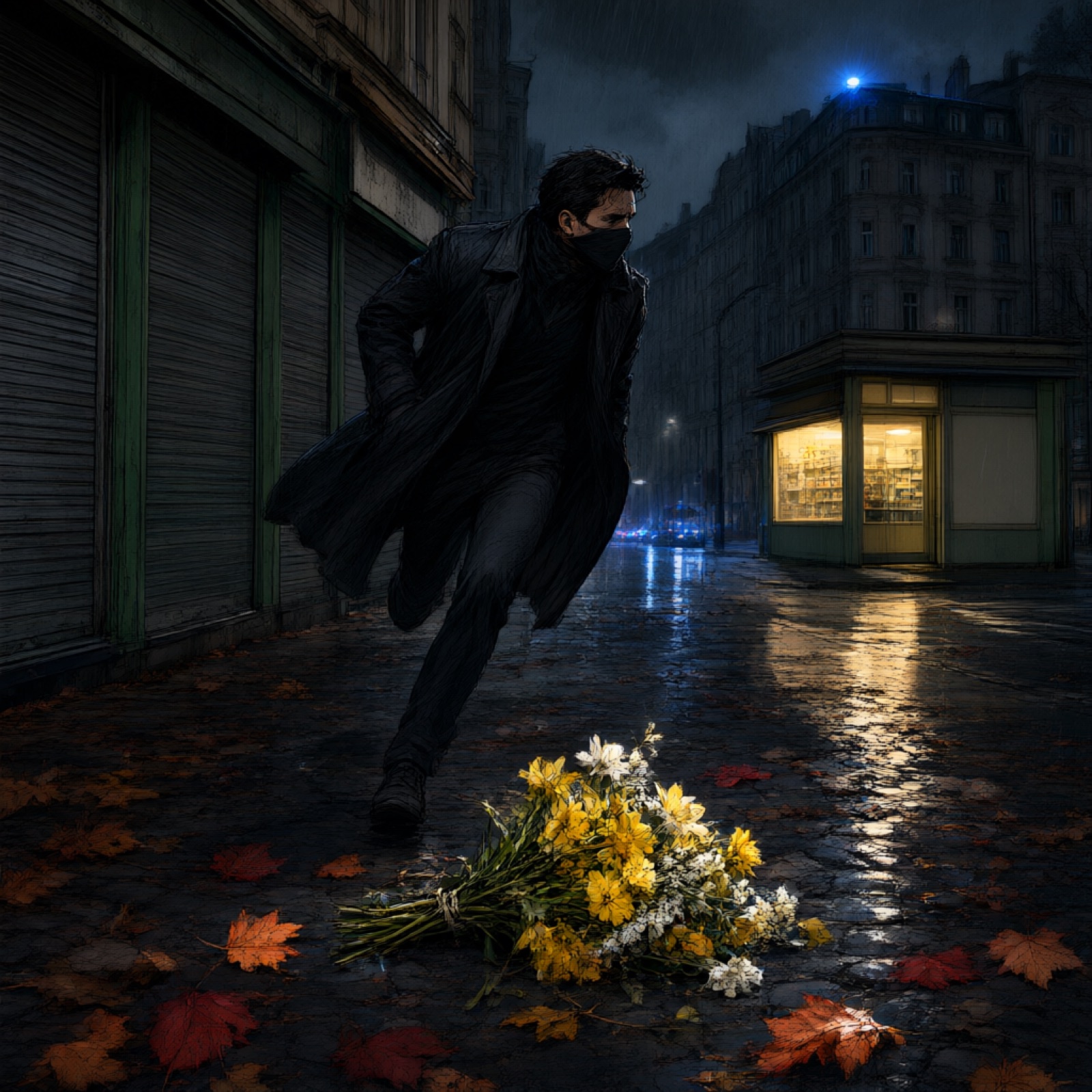
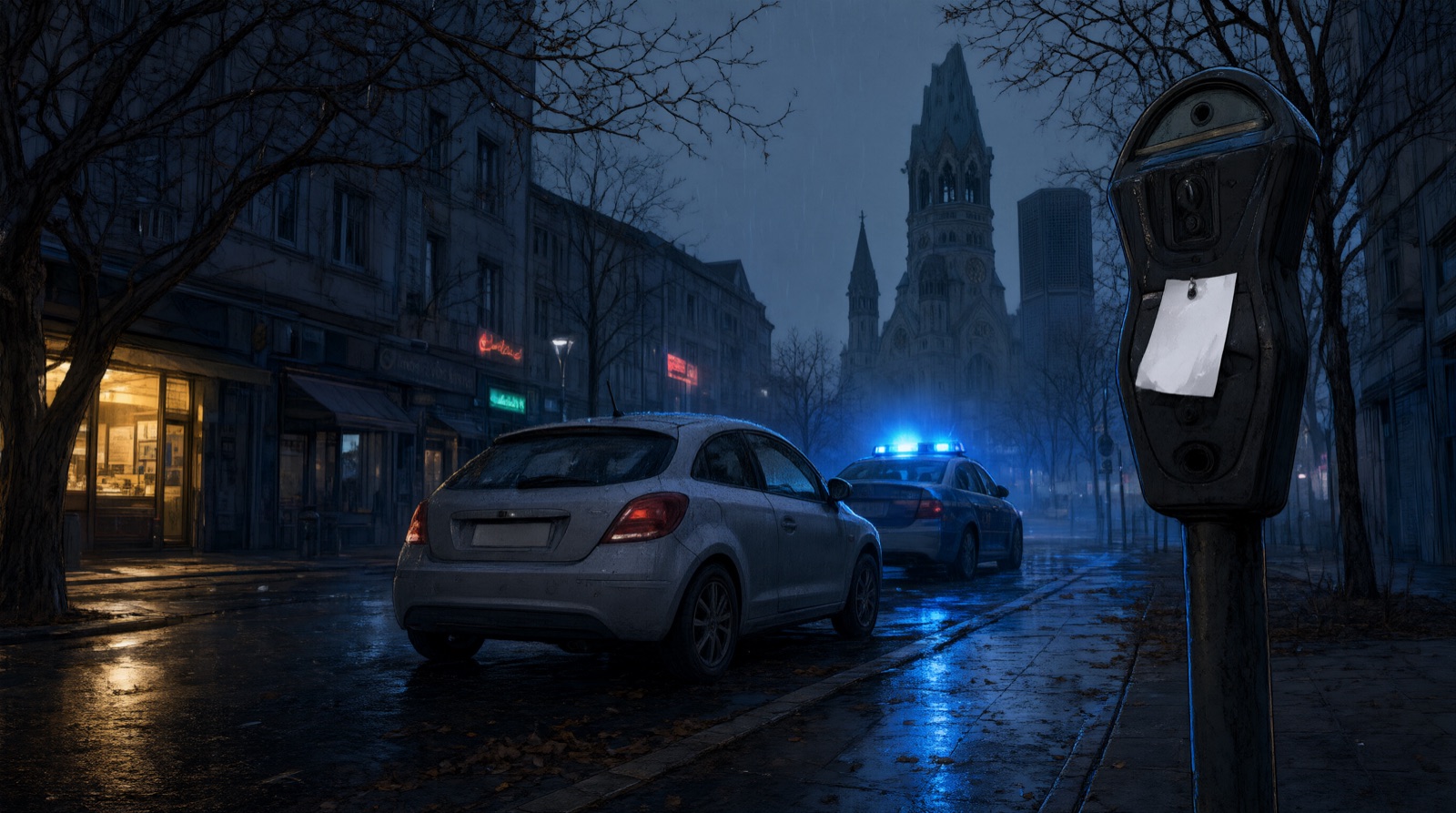
Evening shift, Charlottenburg. The rain stopped an hour ago, but the streets are still wet, leaves sticking to the tarmac, the lights from Wilmersdorfer Strasse U-Bahn station mirrored in the puddles. Kalle sits in the passenger seat, radio turned low, third coffee, a case that should’ve been wrapped up before it even got going.
The call came in at twenty past eight. Four robberies. One suspect. Arrested in the back courtyard of Schillerstrasse. Sounds like routine — one bloke too greedy, too quick, too dim. Shut the file, tick the box, next.
Then the second call came.
“Kalle, you need to look at his shoes.”
Leni’s voice. No hello, no preamble. Just the shoes.
“What about ’em?”
“The man we’ve got in custody — his shoes are clean.”
Kalle puts his coffee down. The Schillerstrasse courtyard, November, after three hours of rain — there’s no such thing as clean shoes back there. There’s mud, there’s puddles, there’s dog mess, there’s leaves. But there aren’t any clean shoes.
“I’ll be there in ten.”
The courtyard behind Schillerstrasse is a rectangle of five-storey tenement blocks, wheelie bins against the back wall, bike racks full of bicycles nobody’s moved since last summer. The entrance: a passageway so narrow two people have to squeeze past each other, the ground churned up, the walls damp. Anyone running through there takes the courtyard home on their soles.
Kalle crouches down, shines his torch across the ground. Tyre tracks, fag ends, an empty beer bottle. Among them: footprints, fresh, sunk in deep. Size 9 or 10, trainer tread, the pattern smudged by rain.
“Who entered the courtyard first?”
“The uniforms,” Leni says. She’s standing against the wall, tablet under her arm, torch in hand. “The suspect was already in here. Sitting on the steps, hands on his knees, like he’d been waiting for us.”
“Sitting in the muck?”
“No. On the second step. That one’s dry.”
Kalle straightens up, dusts off his knees. “So our man comes through the passage, sits down on the steps, waits for the cops. But his shoes are clean.”
“And his trousers,” Leni says. “No dirt, no damp. Just the knees of his jacket — he’d been on the ground before, somewhere else. But the courtyard — it wasn’t here.”
Kalle nods slowly. The picture is coming into focus, and he doesn’t like what he’s seeing. “The yard door off the front building — was that open?”
“It was,” Leni says. “That’s how the uniforms found it. The hallway’s dry, the steps are swept. You walk through there, you come into the yard with clean soles.”
“So he came in the front way, up the stairwell, sat himself down on the steps and waited.” Kalle looks across the yard again. “‘Cause he didn’t come through the passage. And if he wasn’t on his own — who did use the passage then?”
The nick, Interview Room 3, twenty-two seventeen. The suspect sits on the other side of the table, hands flat on the surface, eyes fixed on his own fingernails. Twenty-five years old, lean, close-cropped hair, a face that’s trying to look hard and only looks knackered. Not a word since the arrest. No solicitor, no demand, no reaction.
Kalle slides a water across. The man doesn’t drink.
“Name?”
Nothing.
“I asked you a question — name?”
Nothing.
“Right then.” Kalle leans back. “I’ll tell you what I know. You did four shops — three florists, one kebab stand. In thirty minutes. Masked. First one, you got nowt. Second one, you nicked the till. Third one, you got nowt. Fourth one — Savignystrasse, just before eight — you got the day’s takings. And then you scarpered.”
No reaction.
“Trouble is: the loot from Savignystrasse wasn’t found on you. The mask you were wearing — not on you neither. And the courtyard where you were sitting? You weren’t in there. Leastways not through the passage. ‘Cause the passage is full of filth, and your shoes are clean.”
A blink. Barely there. But there.
“You wanted to be caught,” Kalle says. “You wanted us to nick you. Why?”
The man raises his eyes for the first time. They’re grey, watery, the eyes of someone who hasn’t slept in days. But he says nothing.
Kalle leans forward. “Who was with you at the fourth shop? Who went through the passage? And who’s got the loot?”
Silence. The strip light hums. From outside, through the door, footsteps in the corridor, a printer spitting out a page, a brief laugh from a colleague on nights.
“I’ll be back,” Kalle says, standing up. “Maybe you’ll have remembered a name by then.”
“He’s scared.”
Leni’s at her desk, laptop open, the files from the four robberies laid out like an index-card landscape. She’s wearing her glasses now, the sign that the shift’s going to run long.
“Not of us,” Kalle says. “Of whoever’s waiting outside.”
“Exactly.” Leni taps the screen. “The four robberies — look at the timing. Job one: 19:15, Wilmersdorfer Strasse, florist. No takings, witness cries for help. Job two: 19:35, Wilmersdorfer Strasse, florist. Takings from the till. Job three: 19:45, Kaiser-Friedrich-Strasse, florist. Tried to open the till, customer screams, no takings. Job four: 19:50, Savignystrasse, likely the kebab stand. Takings: the day’s cash.”
“Five minutes between three and four. That’s too tight.”
“Way too tight. Kaiser-Friedrich-Strasse to Savignystrasse is at least seven minutes on foot, running flat out. But our witness says the man ran towards Schillerstrasse — the wrong direction.”
“They split up,” Kalle says. “Two blokes. One doing the robberies, one waiting.”
“Or: one does the robberies, the other collects the takings. And when it got too hot — "
" — the second man left the first one swinging.” Kalle reaches for his coffee, stone cold by now, and drinks it anyway. “Our man in the interview room’s the decoy. The other one’s got the money.”
The flower shop on Kaiser-Friedrich-Strasse is called “Rosenzeit.” A narrow shop squeezed between a dry cleaner’s and a mobile-phone shop, the window display full of autumn bouquets — dahlias, chrysanthemums, eucalyptus. It’s closed at this hour, but the owner, a woman called Herrmann, has agreed to reopen.
She’s mid-fifties, short grey hair, a colourful apron, hands covered in little cuts from tying bouquets. She doesn’t look frightened. She looks — annoyed.
“Come in. I shut up early today. But if it helps the police, go ahead.”
She leads Kalle and Leni into the back room, a tiny office full of catalogues, a wobbly table, a Thermos of coffee she pours without asking.
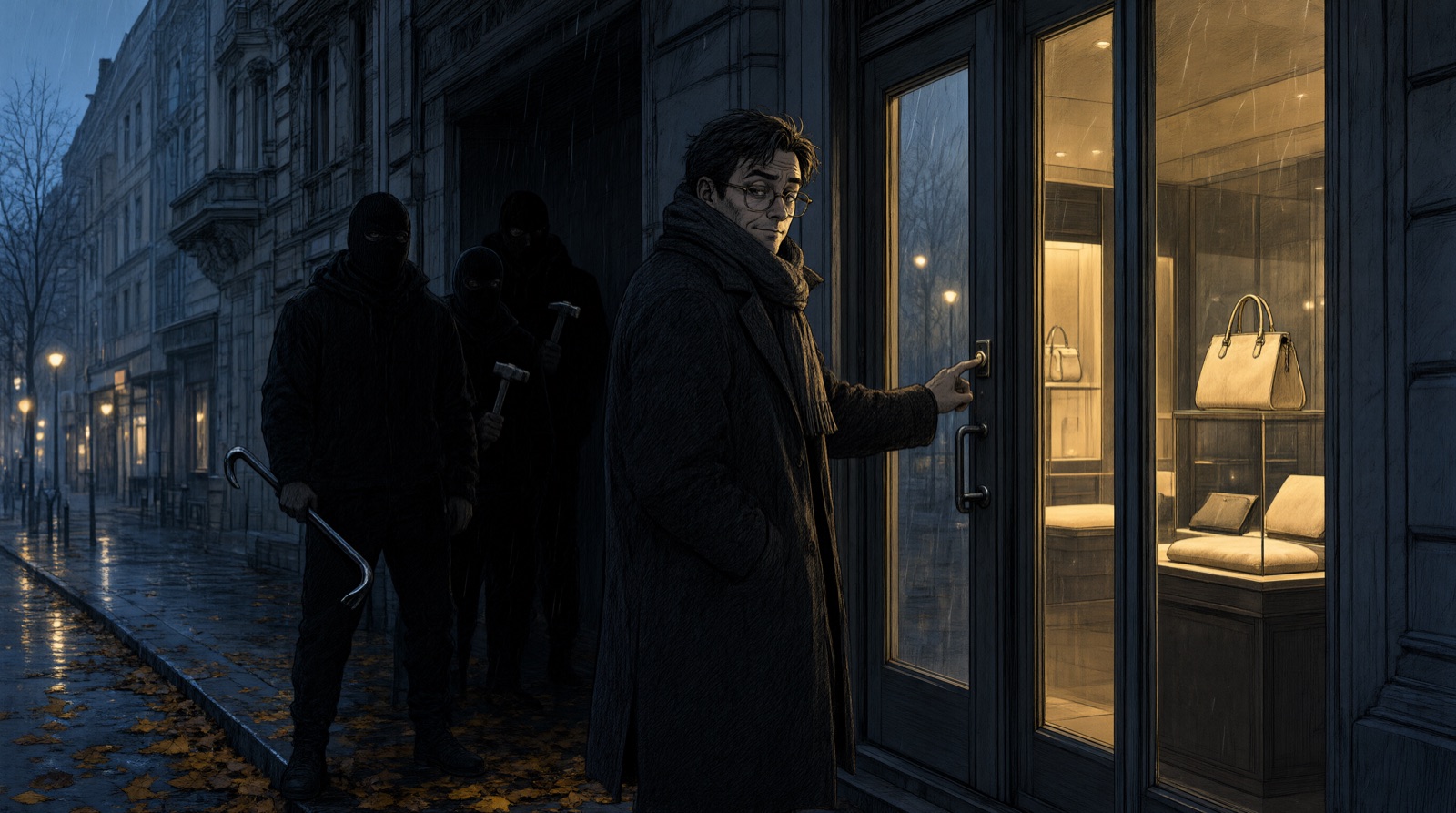
“So, this bloke came in, round quarter to eight. Masked, some black thing, homemade by the look of it. Not a balaclava — more like fabric, cut to fit.”
“Homemade?” Leni’s writing notes.
“The stitching,” Frau Herrmann says, pointing at her own apron. “I trained as a seamstress before I took over the shop. The seams on that mask — that wasn’t factory work. That was someone who knows how to work a sewing machine but isn’t a pro. Uneven stitches, the fabric curling at the edges. Someone sat at their kitchen table and cobbled it together.”
Kalle glances at Leni. Leni keeps writing.
“Did he say anything?”
“Nah. Just: ‘Open the till.’ Dead calm, almost shy. And then the customer — young woman, standing at the counter — started screaming, and he ran off. No money, no flowers, nothing.” Frau Herrmann takes a sip of coffee. “To be honest, I felt more sorry for him than scared.”
“Sorry for him?”
“Well, he couldn’t do it, could he? He weren’t a robber. He were an errand boy.”
The corner shop on the corner of Bismarckstrasse is called “Bismarck-Eck,” and it belongs to a bloke everyone calls “the Turk,” even though he was born in Berlin, even though his name is Kemal and his old man ran the shop before him. The bell jangles as Kalle walks in. Inside: strip lights, a fridge humming as loudly as a nineties model, and Kemal behind the counter, arms folded, face as shut as the steel shutters after closing time.
“Evening, Kemal.”
“Inspector.” No smile. Kemal knows Kalle. Not well, but long enough to know a visit just before midnight isn’t a courtesy call.
“See anything this evening? Wilmersdorfer, towards Schillerstrasse?”
“I heard there was an arrest.”
“There was. But there’s still a bit missing. Among other things, a second bloke.”
Kemal says nothing. His eyes flick to the window, to the street, then back to Kalle. It’s the look of a man who knows he knows more than he should say and is weighing up what it’ll cost him to say it anyway.
“Kemal. I don’t need a name. I just need a direction.”
“The masks,” Kemal says quietly. “The young lad made them.”
“Young lad?”
“Benny. Benny Schröder. They call him Lightning Benny ‘cause he gets everything done in thirty minutes. Lives on Schillerstrasse, third floor, rear building. Got a sewing machine by his window. Everyone on the estate knows it.”
“And how’s he connected to the man we’ve arrested?”
Kemal shrugs. “Ask him yourself.”
Kalle puts a hand on the counter. “Kemal. Which one of them’s got the takings?”
The corner shop owner hesitates. His hand, resting on the cigarette shelf, trembles slightly. “Not the one you’ve got,” he says at last. “And now do me a favour and leave. I’m closing up.”
Schillerstrasse at half twelve. A narrow building, five storeys, peeling façade, the same back courtyard where the arrested man sat on the steps four hours earlier. But this time Kalle and Leni go through the front entrance, up the stairs, third floor, left-hand door.
No name on the bell. Just a strip of tape with “Schröder” written on it in biro.
Leni knocks. Twice, three times. Inside: a chair scraping across floorboards, then footsteps, then silence.
“Police. Open up.”
Nothing.
“Mr Schröder. We know you stitched the masks. We know one of your masks was worn this evening. And we know the takings from the fourth shop are still in your possession. Open the door now and we’ll talk. If not — we’ll come in with a warrant.”
Ten seconds. Fifteen. Then: a key turning in the lock, a chain sliding back. The door opens.
Benny Schröder is twenty-two, slight, greasy hair, a T-shirt that’s seen better days. Behind him, in the living room, there really is a sewing machine by the window. Next to it: scraps of black fabric, the same quality Frau Herrmann described.
“I didn’t do it,” Benny says. His voice is shaking. “The robberies. That was — I only did the masks. Nothing else.”
The living room’s a cross between a sewing workshop and a bachelor pad. A sofa buried under piles of laundry, a telly running for hours with no sound, the sewing machine — a seventies Singer — with a desk lamp aimed at the fabric like an interrogation light.
Benny sits on the sofa, hands clamped between his knees, face pale. Kalle and Leni remain standing.
“From the beginning,” Leni says. Calm, matter-of-fact, the voice of a woman who’s heard a thousand confessions and knows the first one is never the whole story.
“I’ve known the bloke — the one you’ve arrested — since school. Name’s Mike. Mike Reimann. Never held down a job, always getting into bother. Two weeks ago he turns up at my door, says he’s got an idea. Flower shops, he says — they’ve still got the day’s takings in the till in the evening, because they sort the flowers out before they go to the bank. Easy pickings.”
“And you were supposed to make the masks.”
Benny nods. “Offered me a hundred euros. I — I needed the money. The rent, the leccy, I can’t get out from under the debt. I thought, all right, making masks — that’s not illegal. For carnival or whatever, he said.”
“And the plan?”
“Mike does the robberies. I wait in the back courtyard — it runs through from Schillerstrasse to Savignystrasse. Once Mike’s done the fourth shop, he comes into the courtyard, hands me the takings, I go out through Savignystrasse. He’s meant to go back through Schillerstrasse and hide somewhere.”
“But it didn’t work out.”
Benny swallows. “It didn’t work out. I was in the courtyard. Pitch dark, soaking wet. And then — then I hear sirens. And Mike doesn’t show. Instead, some bloke comes running through the passage, out of breath, and shoves the takings into my hands. ‘Take this, I’ll be back later.’ And then he was gone.”
“Who was it?”
“No idea. I didn’t see his face.”
“You weren’t wearing a mask?”
“I was. One of mine. That was the whole point of the fourth — in case someone’s standing about in the yard, he doesn’t get a look at me.” Benny swallows. “He shoved the bag into my hands. He saw my face. I never saw his.”
Kalle and Leni exchange a glance. That changes everything.
“Hang about,” Kalle says. “You’re saying the man who gave you the loot — that wasn’t Mike? Not the one we nicked?”
“No. It wasn’t Mike. This bloke was taller. Older. And he ran like someone who does it a lot.”
“And where’s the takings now?”
Benny points at a rucksack lying next to the sewing machine. Leni opens it: bundles of cash rolled up with rubber bands, sixteen hundred euros.
Kalle lets out a low whistle. “And he handed you all that? The masked man?”
“Yeah. I didn’t take none of it,” Benny says. “I swear. I never even counted it.”
Kalle looks at the bundles of cash, the rubber bands, the sewing machine, the fabric scraps. “Mike Reimann spent thirty minutes robbing flower shops — but the money from the fourth job was collected by someone else. Someone who knew the route, knew the courtyard, and knew when you’d be standing in it. And used Mike as the decoy.”
“A third man,” Leni says.
“Lightning Benny makes the masks. Mike does the robberies. And someone else does the till — and leaves Mike holding the bag.”
Benny stares at them. “Who? I’ve got no idea who it was. I’d never seen him before.”
“But you gave him the masks. All the masks you stitched. How many were there?”
“Four. Mike said, four of ’em. Three for him — one for the night, one spare, one in case the first one tears — and one for me.”
“For you?”
“In case someone’s standing about in the yard,” Benny says. “So they don’t clock me. I had it on tonight, when he came.”
Kalle and Leni look at each other. Four masks, and not one of them on the man they’d nicked.
“Sixteen hundred euros,” Leni says. “Three flower shops, and he came away empty-handed twice. That money can’t have come out of a florist’s till.”
“Savignystrasse,” Kalle says. “The kebab. Day’s takings must have been in there — and nobody’s asked him a single question yet.” He heads for the door. “Come on, Leni. Let’s go and ask the man how much was in his till.”
The kebab stand’s called “Mangal-Express.” Just before one in the morning it’s dark, the shutters down, a single lamp burning in the back room. Kalle hammers on the door until a man in a vest opens up, mid-thirties, half-asleep, suspicious.
“Police. You the owner?”
“Yeah. Oi, what’s this about? It’s the middle of the night.”
“This evening, just before eight, your shop was robbed. Takings from the till, that right?”
The man rubs his eyes. “Yeah, yeah. The bloke with the mask. Demanded the till, I gave it to him. It’s all been taken down, you’ve got the report.”
“And how much was in the till?”
“Three hundred. Maybe three fifty. Slow evening.”
Kalle looks at Leni. Three hundred and fifty euros in the till — but the rucksack from Benny’s flat held sixteen hundred.
“You’re lying,” Leni says. “There was more in this shop. A lot more. And you know who’s got it.”
The owner hesitates. Then he sits down on the doorstep, shoulders slumped, face tired. “My brother. Erdal. He rang me, round half seven. Says he’s coming round, bringing me something. I thought he meant money — he’s owed me two months’ rent for the flat above the shop. But then — then the robbery happened.”
“Your brother knew about the robbery?”
“Nah. Nah, that was coincidence. He came through the back, through the passage, ‘cause he’s got a key for the back door. When he came in, the robber had just left. He’d taken the till with him. But the second cash box under the counter, he never saw it — that’s where the money from the two wedding orders was. And Erdal — he opened the box and pocketed the cash.”
“How much?”
The owner swallows. “Sixteen hundred. Two wedding orders, paid in cash. That’s why it was under the counter and not in the till.”
“And why didn’t he call the police?”
“Because he’s got form. Burglary, eight years ago. He thought nobody’d believe it wasn’t him.”
Kalle leans against the doorframe. The picture coming together isn’t the one he expected. No planned accomplice, no clever scheme. Just a chance thief who went through the wrong courtyard at the wrong time, and a failed robber left alone at the wrong moment.
“We need your brother’s address.”
Erdal Demir’s flat is on Savignystrasse, two doors down from the kebab stand. Kalle and Leni ring the bell at quarter to two. Erdal opens straight away, as if he’d been expecting them.
He’s forty-one, lean, restless hands. On the kitchen table stands a cold cup of tea, next to it an ashtray with the fag ends piled over the rim.
“My brother rang me ten minutes ago,” he says before Kalle can even open his mouth. “Said the police had been round. I know, I know, I should’ve reported it. But I — I just shut it and got out.”
“And then you shoved it into Benny’s hands, the lad waiting in the courtyard.”
Erdal nods. “The kid was standing there in the dark, wearing a mask. I thought he was the robber. I shoved the money at him so he’d leave me alone. Only later did I clock he was just an accomplice.”
“And why didn’t you say anything? We’d have had the money off him the same night.”
“‘Cause I was bricking it. The kid saw my face — I never saw his, he was masked up. And I — I’m a convicted man. I thought they’d pin the whole robbery on me. If I’d reported it, I’d have put the rope round my own neck.”
“Your brother told us the same thing before we’d even rung your bell,” Kalle says. “And the money’s where you say it is. The sums add up.”
Then neither of them says anything. The kitchen clock ticks. Sixteen hundred euros that caused more trouble than the three other robberies put together — and that are sitting in a rucksack on Schillerstrasse.
“Nobody’s going to believe this,” Kalle says at last. “But it’s the truth, innit?”
Erdal nods.
Dawn breaks over Charlottenburg as Kalle and Leni leave the station. Mike Reimann has started talking — the lads had put it to him that Benny had confessed to the masks and the takings had been found in Benny’s rucksack. That’s when the resistance crumbled. No professional, no master plan. Just a poorly thought-out idea that spiralled further out of control by the minute.
Decoy, my arse. Mike heard the sirens on his way into Schillerstrasse, shoved the change from the till into a bin and just wanted out — in through the front entrance, where the hallway was dry. He didn’t dare go into the courtyard. So he sat down on the dry steps and waited for the street to clear. It hadn’t been fear of some third man. It was a bloke who hadn’t slept for days and in the end just stayed put.
And the seven minutes the whole accomplice theory stood on? The 19:45 was Frau Herrmann’s estimate — “round quarter to eight,” she’d said. That’s exactly how it went into the robbery report. The emergency call from her shop was logged at the control room at 19:38. Twelve minutes to Savignystrasse: enough for a man running flat out. Kalle had got it wrong. His mistake wasn’t in the report, and Leni made sure he knew it.
Leni’s holding the closing report, three pages she reads as she walks. “Mike Reimann: four counts of robbery, going before the custody magistrate. Benny Schröder: aiding and abetting, likely to get a suspended sentence if the judge counts the sewing machine as a mitigating factor. Erdal Demir: misappropriation, but the money’s been recovered in full, the CPS is considering dropping the case as de minimis.”
“And the flower shops?”
“Getting their money back. Frau Herrmann from Kaiser-Friedrich-Strasse asked if she should do us a bouquet for the office.”
“Tell her we’ll have dahlias. They’re in season.”
Kalle lights a fag, even though he’d been meaning to pack it in. The sky over Charlottenburg is still dark, but the rain’s stopped, and the city lights are mirrored in the puddles like a second, brighter world.
“Know what gets my goat most about all this?” Kalle says.
“That the whole case turned on a pair of clean shoes?”
“Nah. That none of ’em were really bent. Mike was dim. Benny was desperate. Erdal just had rotten luck. And still — three lives up the spout, all because of an idea knocked together in thirty minutes.”
Leni shuts the folder. “Not entirely up the spout. Benny’s got a first-class education on that sewing machine. Maybe Frau Herrmann can offer him a job.”
Kalle looks at her. “You’re giving me hope, Leni. That’s dangerous.”
“I’m not giving you hope. I’m giving you coffee. That place over there’s open.”
She points at the corner shop on the corner of Bismarckstrasse. Kemal’s behind the counter, early shift, tea steaming, waving at them through the glass.
“Right you are, mate,” Kalle says. “First a coffee, then we’ll see what the day brings.”
Note: All persons, places and events in this story are fictional. It was inspired by a public police report but does not depict real events, persons or situations. Further information: Legal Notice.