The Böller-Bene of Leipziger Straße
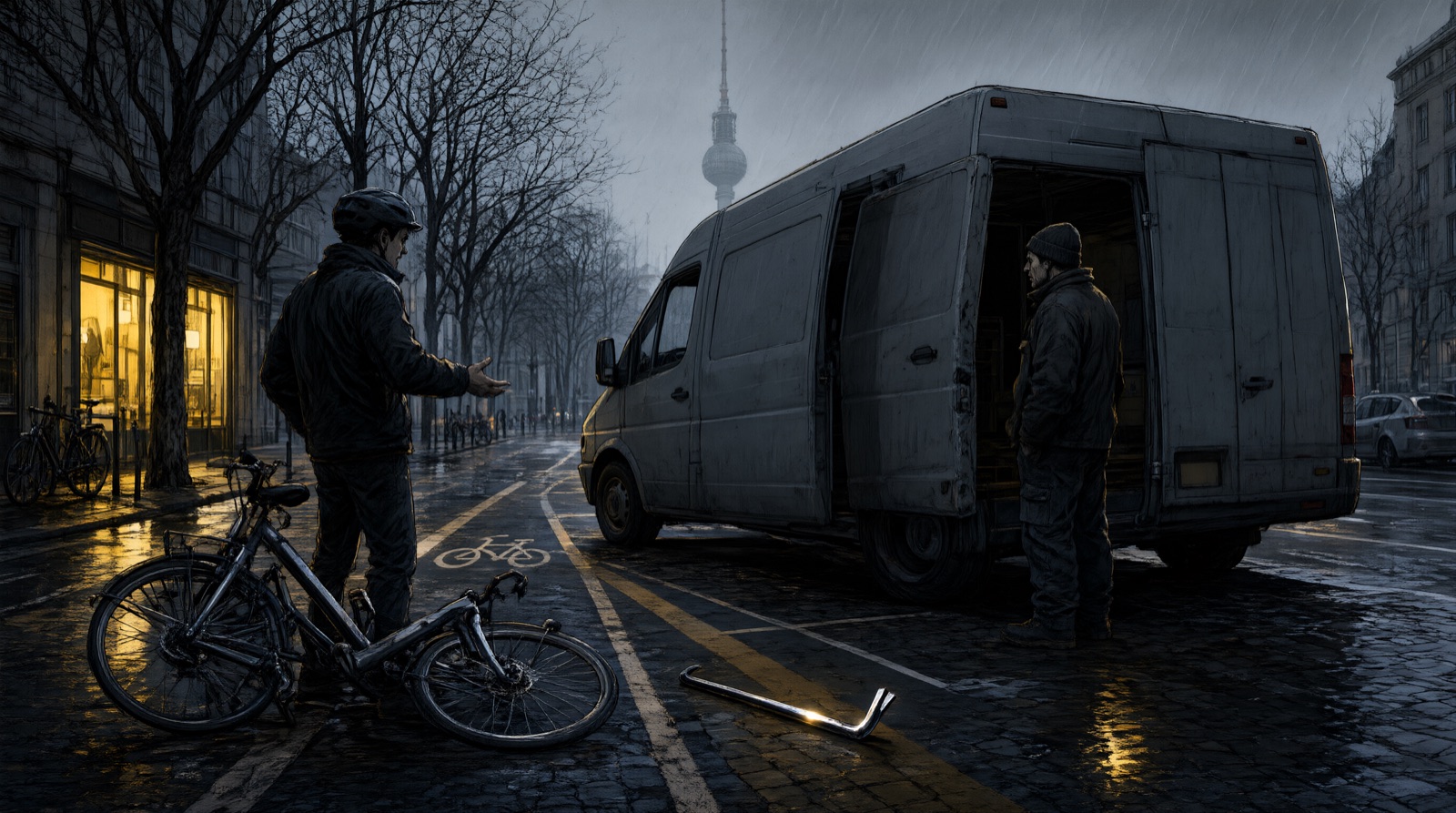
The call comes at ten to seven. Karl Rieger is stood at the window of his Altbau flat on Yorckstraße, fag in the corner of his mouth, staring down at the wet street. Autumn in Berlin — the linden leaves gone yellow, the tarmac gleaming, and the U7 rumbling underneath bang on time. Direction Rudow. Always on time, always loud.
“Rieger.”
“Kalle, arrest at Axel-Springer-Platz. Attempted assault. Juvenile, pepper-sprayed two plainclothes officers.” Lena Weber’s voice is calm, precise, not a trace of kip in it. “Here’s the interesting bit: the lad’s rucksack — two blank-firing pistols, a knife, six forged passports. And a corner shop address.”
“A corner shop.” Kalle flicks the fag out the window. Hits the wet pavement, sizzles brief. “Always the bleedin’ corner shops. What road?”
“Leipziger. I’m sending you the address. Get dressed, I’ll get coffees.”
“Black, strong, no nonsense.”
“Exactly.”
Axel-Springer-Platz at quarter past seven is what Kalle calls the “Berlin morning after”: paper lads chucking stacks of Springer broadsheets into delivery vans, a cleaning crew sweeping last night’s broken glass off the kerb, some dosser on a bench shielding his bottle of Sternburg from the morning sun. Two squad cars, tape, blue lights flickering in the drizzle like the last gasp of a knackered disco ball.
Leni waits under the awning of the Pressecafé, a cup in each hand. Dark jacket, hair in a ponytail, hazel eyes scanning the square. Forty-two, but the lines round her eyes come from too many night shifts and too little kip — not from age.
“Mornin’, Leni.” Kalle takes the cup, has a sip. Hot, bitter, spot on. “What’ve we got?”
She nods toward the cordon. “Benedikt Gräser, nineteen. Mum lives in Lichtenberg, the lad himself hasn’t been registered at any address for six months. They clocked him because around five in the morning he pepper-sprayed two plainclothes officers at the U-Bahn entrance — they were there for pickpockets, chance hit. A passerby brought him down before he could leg it into the U2.”
“A passerby took him down?” Kalle raises an eyebrow. “Fair play.”
“Berlin gob, late forties, ripped the rucksack clean off his back and screamed at him till the lad stood rooted to the spot. The officers say they’d have had no chance without her.” Leni slides her phone across to him. “Photo of the rucksack contents.”
Kalle looks at the screen. Twenty-two thunderflashes — the chunky Polish ones that look like hand grenades. Blank-firing pistol, black, not a toy. A flick knife with a mother-of-pearl handle. The pepper spray. And next to it, neatly sorted in clear plastic sleeves: six forged passports. Belgian, Polish, Czech. All same face, different names.
“Six passports at nineteen,” Kalle says. “Lad’s planning ahead. What about the corner shop?”
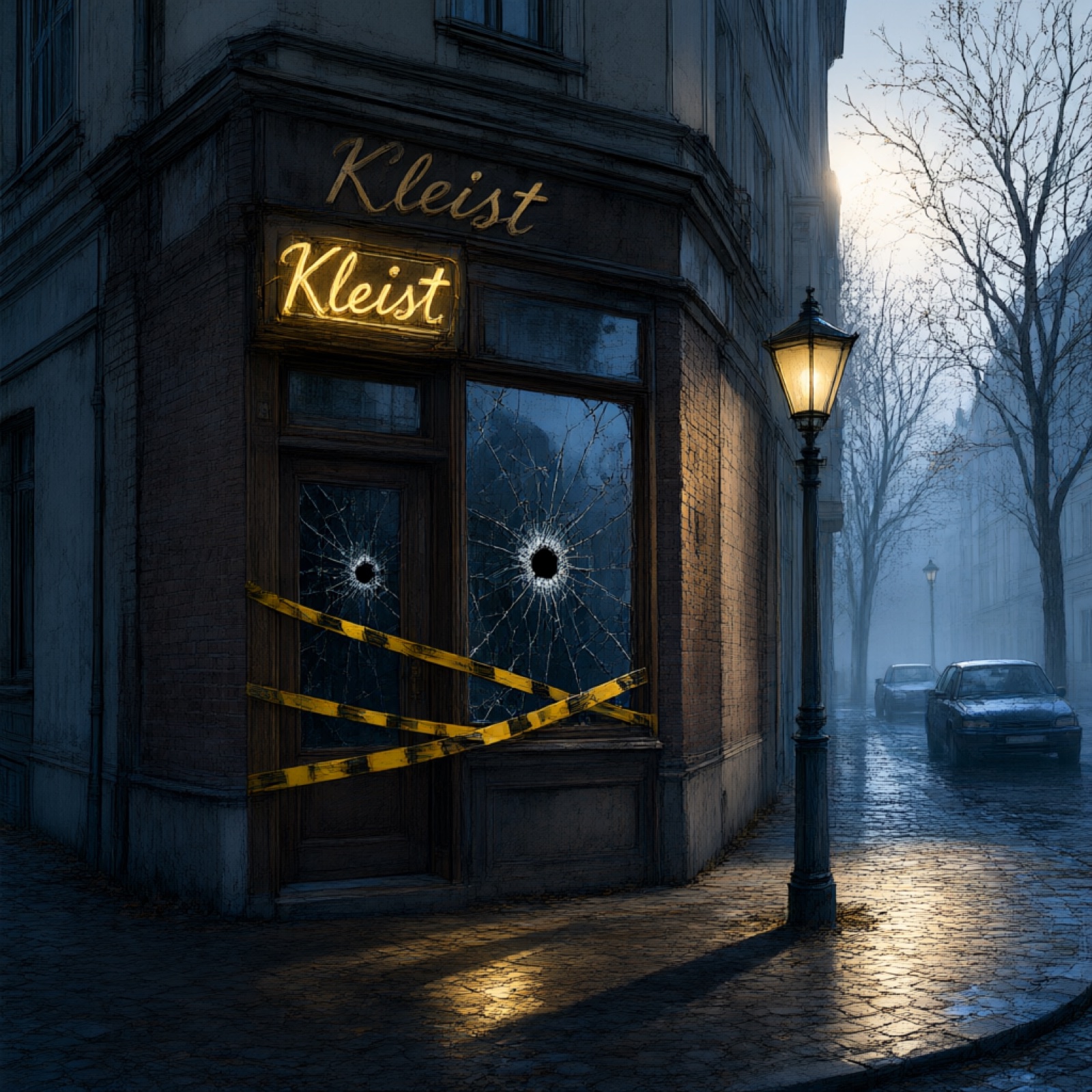
“Leipziger Straße, just before the Charlottenstraße corner. Owner’s called Igor — Igor Demtschenko, fifty-six, came over from Kharkiv twelve years ago. Little fella, dead suspicious, knows everyone round here who buys pyrotechnics at night, according to the neighbours. Two priors: handling stolen goods 2018, breach of the Explosives Act 2022.”
“Explosives Act.” Kalle puts the cup on the bonnet of the nearest squad car, lights the next fag. “So no coincidence the lad stashes his gear there.”
“That’s the question.” Leni takes her phone back. “Either Igor’s in the know and taking a cut — or the lad’s using the backroom without Igor knowing. We need to find out how deep the corner shop’s in it. And whether the lad’s just some mug with too much pyro or there’s more to it.”
“Clans?” Kalle blows smoke into the drizzle.
“Could be. The forged passports point to commissioned work. No-one needs six passports to flog rockets to New Year’s Eve punters.”
“Right you are, mate.”
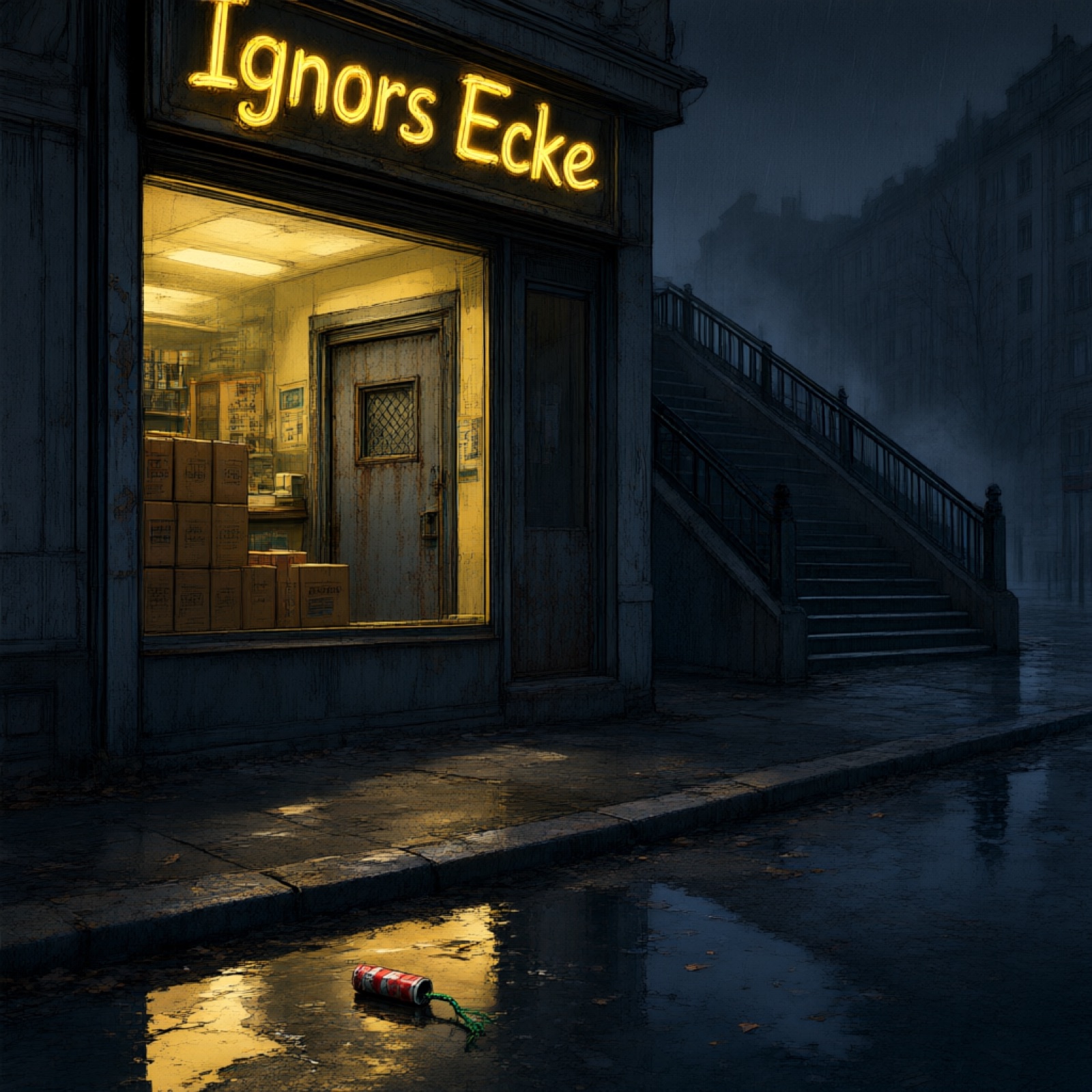
The corner shop on Leipziger Straße is called “Igor’s Corner.” The sign’s taped to the window with Sellotape, neon light flickers irregular, and a bell on the door jangles like it last had good days twenty years ago. Window display: crates of Sternburg, Haribo bags, a poster for prepaid mobiles that expired three years back.
Kalle shoves the door open. Bell jangles, once, shrill, short.
Igor stands behind the counter. Just like described: short, wiry, shirt under a grey cardie, glasses lenses thick as ashtray bottoms. He lifts his head, clocks Kalle, then Leni, then the door, like he’s working out if there’s still time to yank the shutters down.
“Morning.” Kalle holds up his warrant card. “Detective Chief Inspector Rieger. This is my colleague Weber. You Demtschenko?”
“Igor.” The corner shop owner leans back, folds his arms. “What d’you want? No illegal booze, no dodgy fags. All above board here.”
“Good for you.” Kalle puts the card away, leans against the counter. “Lad name of Benedikt Gräser. Nineteen. Calls himself Böller-Bene. Ring any bells?”
Igor’s eyes narrow. A pause that’s too long for a simple no. Then: “Never heard of him.”
“We pulled twenty-two thunderflashes out of his rucksack. Plus a blank-firer, knife, six forged passports. The bangers — Polish gear, not DIY shop rubbish. You know who in Mitte can sort Polish bangers, Igor?”
A twitch round Igor’s left mouth-corner. Kalle clocks it, Leni clocks it.
“How should I know where kids get their bangers?” Igor’s voice is steady, but his hands, resting on the counter, aren’t. “I sell fags and beer. No bangers.”
“Open up your backroom then, Igor.”
“Haven’t got a backroom.”
Kalle sighs, a deep, heavy sigh. Then he pulls his mobile out, taps a number, holds it up for Igor. Screen reads: Mitte Trade Standards — unannounced food hygiene inspection.
“Rieger, what’re you playing at.” Igor goes pale under the neon strip.
“I’ve got a snap of your kebab spit from last month, Igor. Date stamp on it, cold chain questionable. One call and you’ll have Trade Standards round, they’re happy to stay till closing time.”
Igor’s hand shakes. He stares at the screen, then at Kalle, then at Leni. “You can’t — "
“Can’t I? Look me in the eye, Igor. Tell me I can’t.”
Three seconds of silence. Then Igor goes to the door behind the counter, pushes the handle down, shoves it open.
The backroom reeks of sulphur. Not the rotten-egg sulphur of decay — the sharp, metallic sulphur of burned pyrotechnics, mixed with black-powder residue hanging in the air like a storm that never went off. Stacks of cardboard boxes along the wall, partly torn open, the labels Polish: Petardy, Rakiety, Fontanny. In between: a mattress, a camping stove, a laptop whose fan buzzes against the silence.
“The lad lived here,” Leni says, more statement than question.
Igor nods slowly. “Since April. He had nothing. No flat, no money, no family except his mum, and she’s — " He breaks off.
“She’s what?”
“She’s in rehab. Since February. The lad was on his own.” Igor shrugs, a tired, resigned motion. “I told him: you can have the backroom, but no drugs, no thieving, no punters in the shop. He nodded. Then he started getting parcels.”
“Parcels.” Kalle steps closer to the boxes, reads the labels. “Polish delivery. Who’s sending them?”
“Dunno. Always different senders. Courier, pick-up points. No fixed address.” Igor wipes his forehead with the back of his hand. “I never said nothing because — "
“Because you were bricking it.”
Igor says nothing. The silence answers.
“And the gun? The passports?” Leni photographs the boxes, the mattress, the laptop.
“Knew nothing about those.” Igor looks at her, properly, for the first time. “The lad’s no gangster. He’s a kid nobody wanted. The bangers — yeah, I knew about those. But guns? Passports? That’s new. Must be new.”
Kalle looks at the laptop. The screensaver shows a photo: a boy, maybe seventeen, short hair, crooked smile, arms round a woman who looks younger than she probably is. Mother and son.
“Where is he now, Igor? The lad.”
“I don’t know.” Igor’s voice firms up, almost defiant. “Truly. He was here last night, took the rucksack, said: ‘Thanks for everything, Igor. I’m doing my own thing now.’ Then he was gone. An hour later the sirens at Springer.”
Kalle swaps a look with Leni. She gives an almost imperceptible nod — Igor’s account fits the timeline.
“Right.” Kalle taps the counter, once, short. “You stay here, Igor. Don’t touch anything. If the lad rings you — you ring us. Understood?”
Igor nods, and in his eyes is something Kalle rarely sees: genuine grief. Not the fear of an accomplice. The grief of a witness.
While Forensics pull the backroom apart, Kalle and Leni sit in the café on the corner, third coffee, second shift. Leni’s got her laptop open, screen mirrored in the wet window.
“Right then.” Leni types. “Benedikt Gräser, known as Böller-Bene. Mother: alcohol-dependent, in residential treatment. Father: unknown, never showed up in the lad’s life. Left school at sixteen. No priors — till today.”
“No priors,” Kalle repeats. “So no career criminal. Just a lad who’s pyro-gifted and hasn’t got a future.”
“Question is: why the escalation?” Leni scrolls further. “Last night he wasn’t just selling bangers. He had the gun on him, the pepper spray, the forged passports. That’s not New Year’s trade any more. That’s — "
“Escape prep,” Kalle says. “The lad was about to do a runner. Not from us — from whoever’s forcing him into something bigger.”
Leni stops. “The passports. You’re saying someone hired him.”
“Someone who needs a nineteen-year-old with forged papers and pyrotechnics as cannon fodder.” Kalle stares into his coffee like the answer might swim up from the black mirror. “Clans, Eastern Europe, arms dealers — take your pick. The lad’s not a suspect, Leni. He’s merchandise.”
Silence. Rain drums against the window. Outside a BVG bus rumbles past, sprays water over the pavement.
“We need to find him,” Leni says finally. “Before the others do.”
“Yeah.” Kalle stands up, grabs his jacket. “Start with the U-Bahn. If the lad was at Springer last night and hasn’t been picked up by now, he’s gone under the city.”
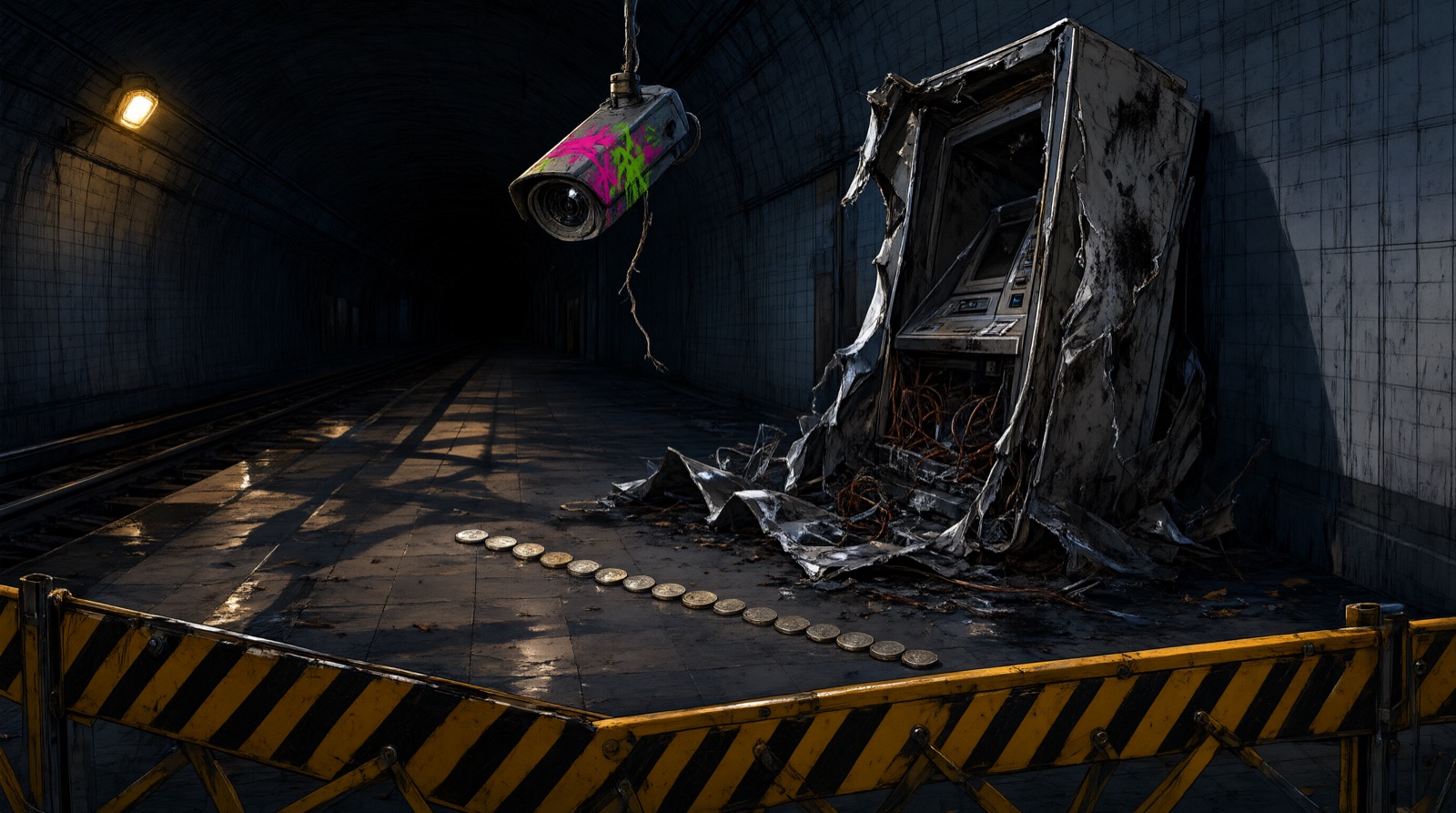
U-Bahnhof Stadtmitte just before ten is a maze. U2 above, U6 below, the connecting passages a tangle of grey tiles, neon glare and the sour whiff of old piss, cleaning fluid and brake dust. Kalle knows every corner — not because he works cases here, but because once, twelve years back, he chased a fleeing thief three stops through the tunnel till they both stood gasping at the trackside and the lad, nineteen then too, gave up.
Leni’s got the building plans on her tablet: maintenance shafts, ventilation ducts, old Cold War bunker systems that were never decommissioned.
“Stadtmitte’s a hub,” she says. “U2 and U6 cross here, the maintenance tunnels connect both levels. Plus the access points to supply shafts — you can get from here to Potsdamer Platz without ever seeing daylight.”
“What’ve you got from cleaning services?”
“BVG night shift spotted a man. Around four thirty. Young, rucksack, ran down the stairs to the U6, then left into the maintenance tunnel towards Kochstraße.”
“Left towards Kochstraße.” Kalle nods slowly. “That’s the old bunker section. Storage rooms the engineers use. Warm, dry, nobody checks. Perfect bolt-hole.”
They head down the stairs to the U6. Kalle’s steps are quick, deliberate, taking two at a time, rubber soles squeaking on the tiled floor. Leni follows, calmer, eyes on the tablet, navigating him through the first connecting passage.
“Here.” She stops in front of an inconspicuous metal door, grey, no sign, just a number-code lock dangling loose from the handle. “Maintenance access. Officially engineers only, but it’s been broken three years. BVG locksmiths know, cleaning crews know, and — "
“And anyone who needs to disappear knows too.” Kalle pushes the door open, slow, listening. Beyond: darkness, damp air, the hum of transformers.
They go in. The concrete passage is narrow, wet, neon tubes flickering on a fifteen-second cycle as if the power’s about to give out any moment. The walls are covered in cable trays, water pipes, layers of graffiti — Fuck Cops, ACAB, Berlin bleibt hart.
Fifty metres in, the passage opens into a larger room: storage, single-tier shelves of spare parts, a rusted locker, and in the corner —
A mattress. A sleeping bag. A half-eaten kebab wrapped in foil, the smell of onions still fresh. And against the wall, neatly stacked: four cardboard boxes. Polish labels.
“Bingo,” Kalle says.
He steps closer, opens the first box. Blank cartridges. The second: more bangers, the really big ones this time, the kind that’ll blow your hand clean off. The third —
A notebook. Kalle flips it open. Handwriting, tight, neat. Names, dates, sums. A list: Order 14 October — 1,200 units, Kolja. Order 16 October — 500 units, Vadim. Order 18 October — weapon + passports, client ? — payment on collection.
“Who’s Kolja?” Kalle holds up the notebook, shows Leni.
Leni zooms on her tablet, runs the police database. “Kolja Danilow, thirty-one, works for a Remmo clan offshoot in Mitte. Three priors: GBH, illegal firearms possession, protection racketeering. Last known location: Lichtenberg.”
“Remmo,” Kalle says, and the word drops like a stone into the damp concrete room. “Clans after all. The lad was playing in the wrong league, Leni. They give him the orders, the passports, the bangers — then leave him to rot on Axel-Springer-Platz while they keep their hands clean.”
That’s when they hear the footsteps. Not from outside, not from above — from the lower tunnel. Someone running. Trainers on concrete, rushed, panicked.
Kalle reacts on instinct: “Stay here,” he tells Leni, and he’s already at the door, through the passage, down the stairs, deeper into the tunnel.
The tunnel to Kochstraße is a concrete pipe, narrow, dark, just the odd emergency light every twenty metres. The footsteps ahead slow, grow heavier, then stop altogether. Kalle halts, listens. From somewhere he can hear breathing, shallow, fast — the breathing of someone terrified, not someone fighting.
“Benedikt.” Kalle’s voice echoes through the tunnel. “I’m Detective Chief Inspector Rieger. I’ve not drawn a weapon. I just want to talk.”
No answer.
“I was at Igor’s corner shop. I saw your mattress, your notebook, your photo with your mum. I know you’re no gangster. But the people sending you the gear — they are.”
A sound — a quiet sniffle, barely distinct from the drip of the tunnel ceiling.
“They gave you the gun and the passports and the orders from Kolja and Vadim, and they told you: do this, Benni, and you’ll get money and respect. But what they didn’t tell you: they’ll drop you the second things get dicey. That’s how it always goes.”
He hears a movement, twenty, twenty-five metres ahead, behind a maintenance hatch.
“Your mum, Benni. What would she say if she saw you now? In a U-Bahn tunnel, chased by the Old Bill and the clans?”
And then something breaks. Not the maintenance hatch — the lad. A sob that comes out of the darkness, young, shattered, hopeless.
Kalle waits. Doesn’t move, doesn’t make any quick steps. The waiting matters just as much as the talking.
“I’ve got no chance left.” The lad’s voice is thin, trembling, the words echoing through the tunnel like lost pigeons. “Kolja’s lot are coming for me. Tonight. I heard them — they said I’m a danger, I know too much, I’ve got to disappear.”
“What d’you mean, disappear?”
A long pause. “They’ve got a bunker in Lichtenberg. People disappear there. Never come back out.”
Kalle breathes in deep. This isn’t a case any more. This is a ticking clock.
“Benedikt. Listen. You can do two things now. You can carry on running into that tunnel till they find you, and then you’re history. Or — you come with me. You give evidence. Against Kolja, against Vadim, against all of them. And I’ll make sure you get the best shot the system can give you.”
“The system.” The lad laughs, a bitter, quiet laugh. “The system’s never helped me.”
Kalle thinks for a moment. Then he says something he doesn’t often say: “The system ain’t my department. I’m just a copper doing his job. But what I can promise you: if you come with me, you walk out of this as a witness, not a body. And that’s more than Kolja would ever offer you.”
Silence. The neon tubes flicker. Somewhere above them a U6 rumbles toward Alt-Tegel.
Then, quiet, a step. Another one. And then he’s stood in the light: Benedikt Gräser, nineteen, thin, pale, jeans three sizes too big, a bomber jacket even bigger, and eyes that have seen more than any nineteen-year-old ever should.
“Alright,” he says, and his voice breaks. “Alright.”
Kalle nods, once, short. No smile, no grand gesture. Just a nod that says: Good job today.
Up top at the Stadtmitte U-Bahn exit, Leni’s waiting with two squad cars. The cuffs stay on the belt.
Note: All persons, places and events in this story are fictional. It was inspired by a public police report but does not depict real events, persons or situations. Further information: Legal Notice.