The Parcel Is Late
Kalle’s coffee had gone cold, but he drank it anyway. Outside the window of their nick in Pankow, the rain fell in that fine, stubborn way Berlin adores in October. Not dramatic enough for umbrellas, just damp enough to grind everyone’s mood down a peg.
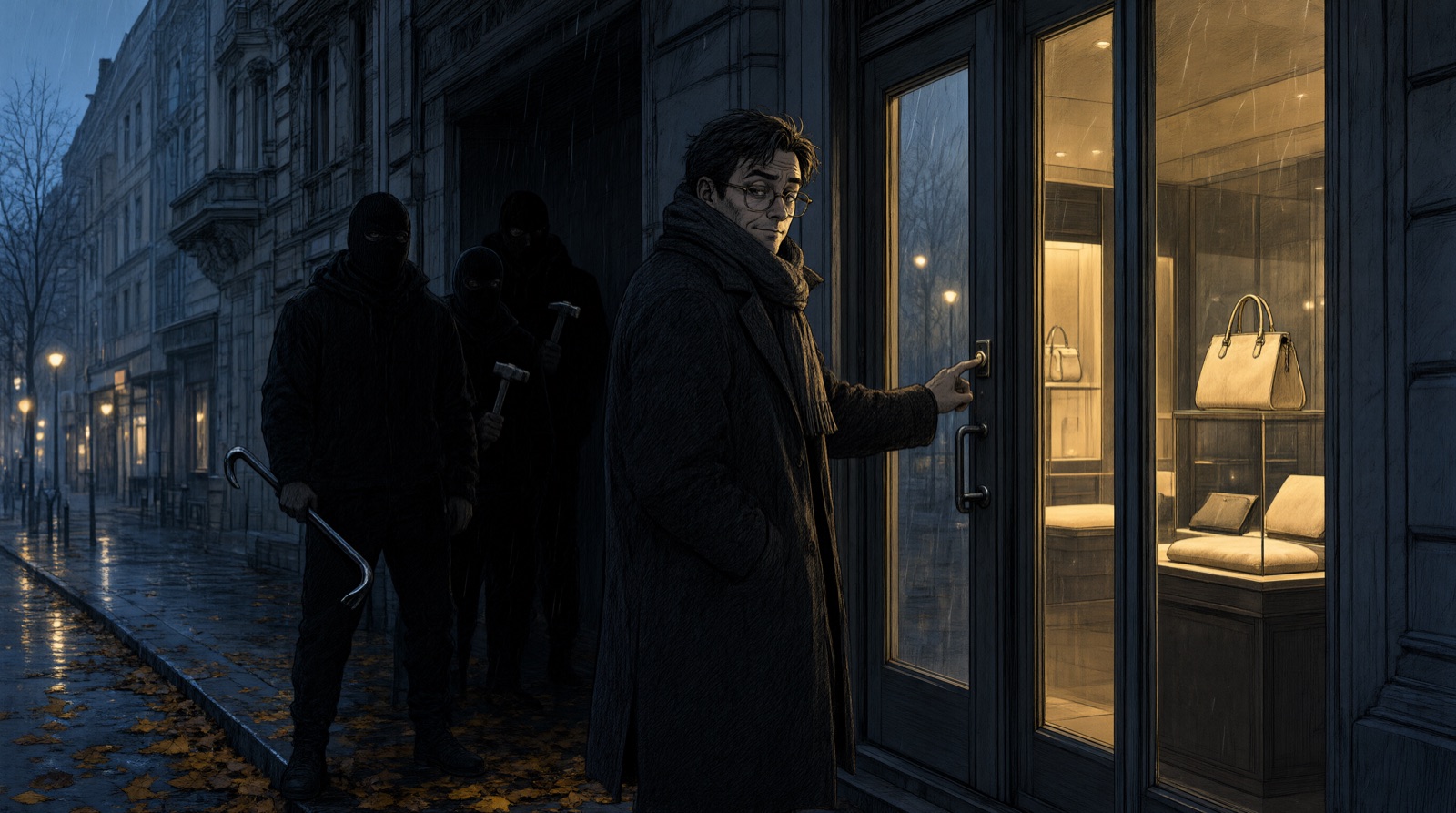
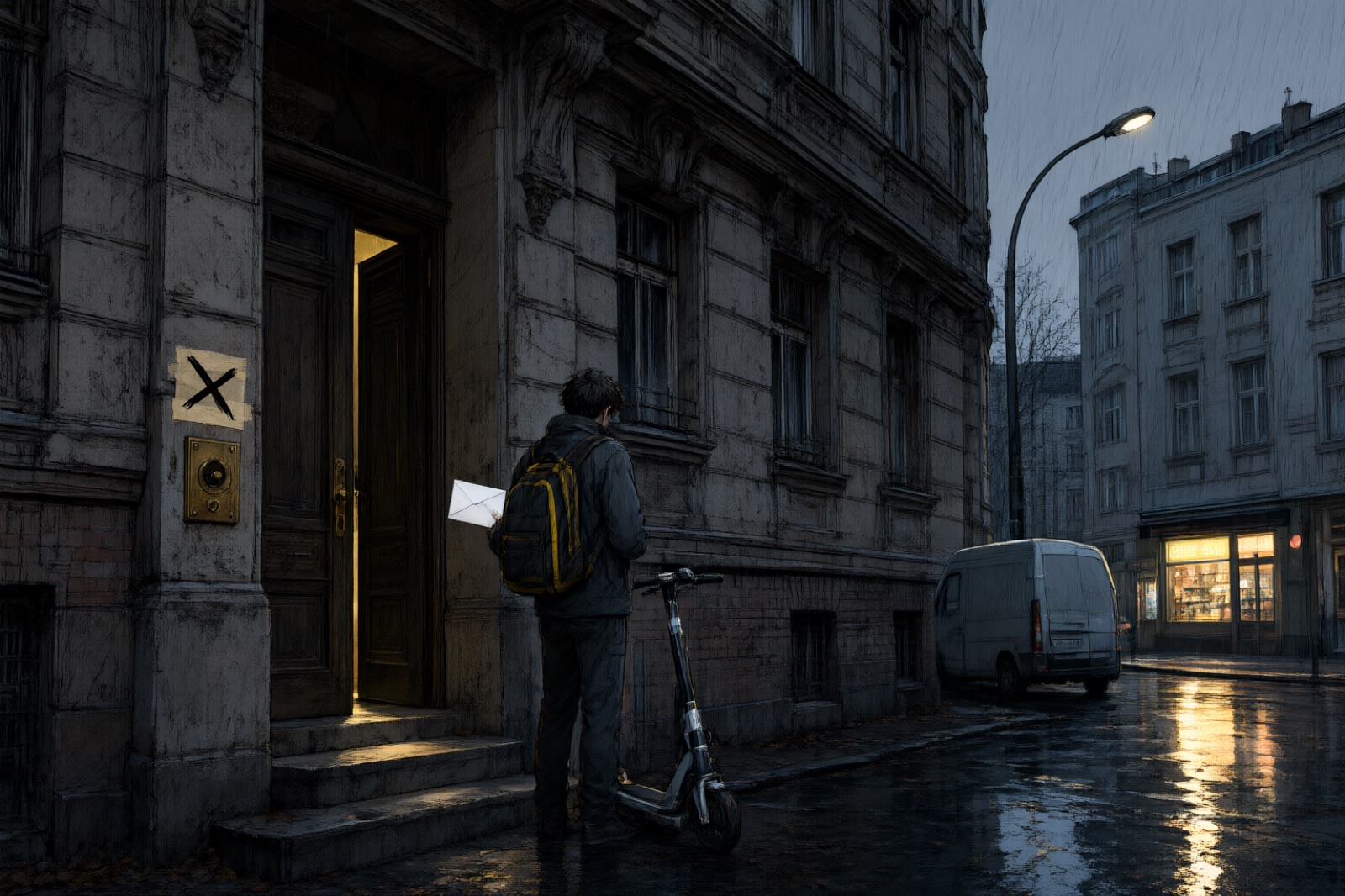
„Elsterweg," said Leni, laying the report on the table between them. „Seventy-four-year-old woman, name of Hartmann, second floor on the left. Yesterday, 17:20. A man rings the bell, says he’s got a parcel. She opens up. He shoves the door in her face, knocks her flat, pins her down, threatens her. While that’s happening, two more get in and empty the jewellery box. Then all three scarper. Heading towards Pasewalker Straße, most likely into a waiting car."
Kalle put the cup down. „Jewellery. No cash, no electronics?"
„Nothing she noticed. The lady was… shaken. Sore neck, but she wouldn’t go to hospital. Rubbed on some Voltaren and made a pot of tea."
„Berlin grit," muttered Kalle. „Or just no appetite for a waiting room."
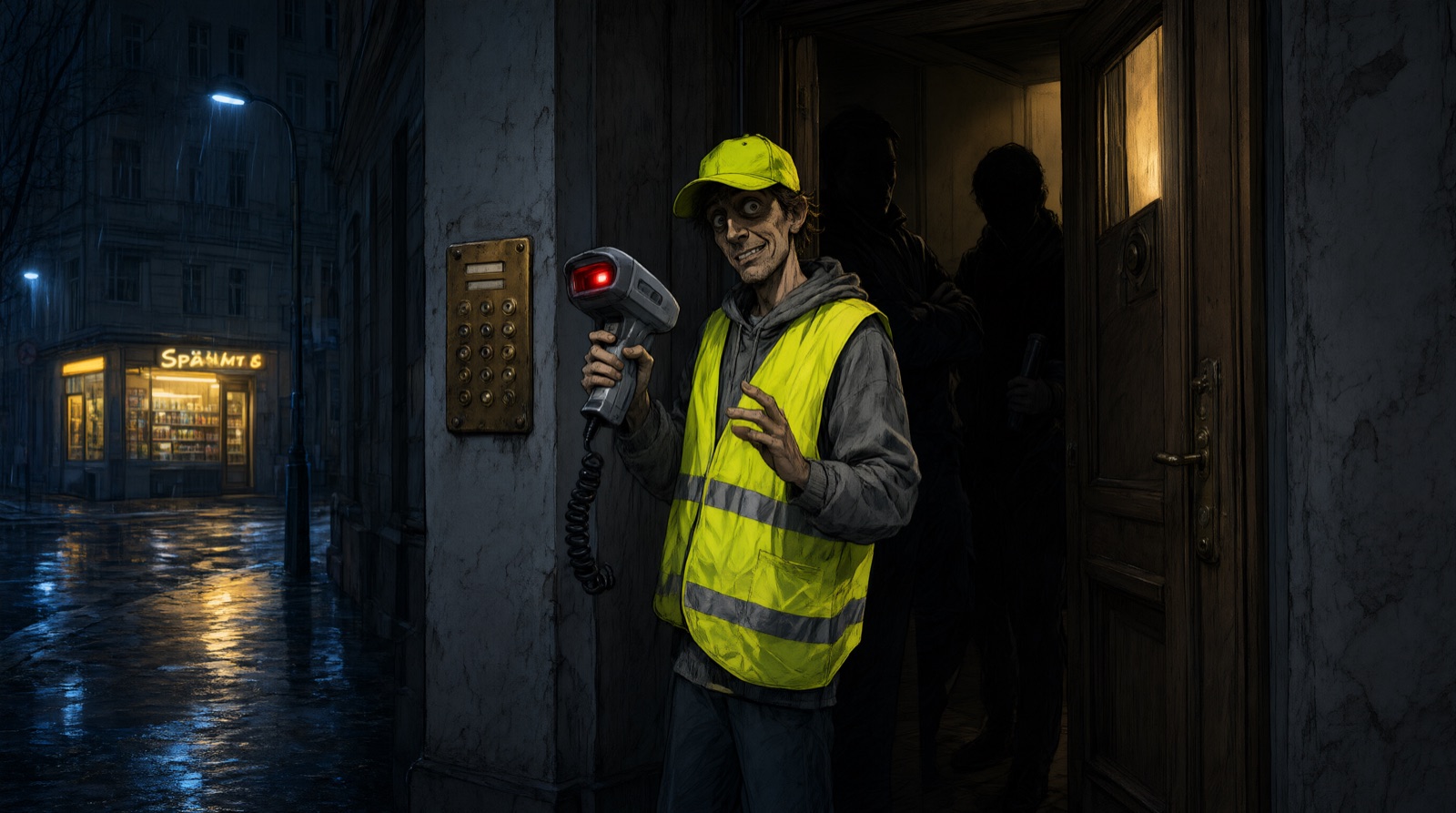
„The crime-scene lads were out. Nothing usable on the door, no prints on the bell. The delivery man wore gloves – yellow hi-vis, a fake scanner, cap pulled low. The other two: dark clothes, hoods, gloves as well. Professional. Or at least: not their first time."
Kalle pulled out his phone, swiped through it. „Bell plate. Name on it?"
„Hartmann. Top of the list, second floor left. No first name. Just the surname."
„Pre-war block. High ceilings, floorboards, them heavy doors with the round knobs. You shove one of them open, the old girl doesn’t just fall – she goes flying down the hall." He leaned back. „Three blokes. One for the door, two for the haul. Division of labour. The one at the door – he’s the organ grinder. The other two: muscle. Rent-a-mob."
„Or a regular crew," said Leni. „The fake scanner – we’ve seen that before. Three months ago in Prenzlauer Berg, six months back in Mitte. Always pensioners, always pre-war blocks, always jewellery."
Kalle looked up. „And?"
„Always the same routine. Fake delivery driver, two minders. But never the same man at the door. Different descriptions every time. Sometimes mid-thirties, sometimes late twenties. Sometimes fair, sometimes dark. Once he was said to speak accent-free, once with an Eastern-European twang."
„Changing actors. Same script." Kalle stood up, grabbed his leather jacket. „Right then, let’s go and have a shufty at the scene. Elsterweg."
The flat on the second floor smelled of lavender, old paper and that peculiar Berlin dust that only settles in rooms where nobody’s done a proper wipe for thirty years. Mrs Hartmann sat at the kitchen table, hands wrapped around a cup that sent steam into the cold morning air. She was smaller than Kalle had expected. The sort of woman you don’t notice unless you look.
„Mrs Hartmann," said Leni, sitting down opposite her. Her voice was soft, but not pitying. „Thank you for letting us come back. Yesterday was… a lot."
Mrs Hartmann nodded. Her eyes were clear, alert. „The police were already here. Yesterday evening. The young men with the cases. They dusted everything, took photos. Told me not to worry."
„We’re not worried either," said Kalle. He stayed standing, leaned against the door frame. „We just want to understand. How he got in. What he said. What he looked like. That helps us find him."
„He didn’t say much at all." Mrs Hartmann smiled, a dry, almost humourless twitch at the corner of her mouth. „‚Parcel for Hartmann,’ he shouted. Through the door. I asked: ‘What parcel? I haven’t ordered anything.’ He said: ‘Signature required. Registered item.’ So I opened up."
„And then?"
„Then he was in. Fast. Like a shadow. Shoved me aside – not rough, but firm. I went over. Onto the carpet there." She pointed at the Persian runner in the hall. „Then he knelt on me. One knee in my back. Whispered in my ear: ‘Quiet, love. No drama.’ His voice… calm. Not loud. Not angry. Just… done."
Kalle felt something tighten in him. Not anger. Something colder. More calculating.
„The other two," Mrs Hartmann went on, „they were straight in. Knew their way around. Not a word. Off to the bedroom, ripped the wardrobe open. My pearl necklace. My husband’s cufflinks. The watch. Nothing else. No cash, no cards. Just the jewellery."
„Did they know where it stood?"
„The wardrobe’s been in the same spot for forty years. But…" She hesitated. „The one fella didn’t search long. Went straight to it. As if he knew: second floor left, bedroom, big wardrobe against the courtyard wall."
Leni made a note. „Did they have a key? Or did they just shove the door open?"
„Shoved it. But…" Mrs Hartmann looked at Kalle. „The man on top of me – he had something in his hand. A thing. Like one of those… card readers. He held it against the door before he rang. One beep. Then he rang."
Kalle exchanged a glance with Leni. „A transponder. Or a copied key."
„Or he has someone who hands him the lock system," Leni said quietly.
„Or he knows someone," Kalle corrected. „Someone who works in that building. Caretaker. Carer. Postie. Someone who knows: second floor left, Mrs Hartmann, jewellery in the bedroom."
„The Parcel Marco," he muttered, more to himself than to Leni.
„Who?"
„Nobody. Yet." He straightened up. „Mrs Hartmann, one last thing. The man who held you down. Did you notice anything peculiar? Voice? Hands? Smell?"
She thought about it. „The hands. Big. Rough. But the fingernails… clean. Manicured. Not like someone who works on a site. Or in a factory. More like… someone who sits at a desk. But the skin on his palms – hard. Calluses. On the sides. Like he carries heavy things. Over and over."
„Parcels," said Kalle. „Or tools."
„Or both."
Out on the pavement in front of the building, Kalle took out a cigarette, lit it, drew deep. The rain had stopped, but the air was heavy, soaked with damp and exhaust.
„Parcel Marco," repeated Leni, stepping up beside him. „You’ve got a name in your head."
„Not a name. A label." Kalle blew the smoke sideways. „Three years back. A case in Wedding. A bloke who called himself a ’logistics consultant’. Helped people organise ‘difficult deliveries’. Parcels nobody ordered. Addresses nobody knew. Turned out he was the middleman for burglary crews. Photographed bell plates, scouted lock systems, drew up schedules. Who’s home when. Who isn’t. Who’s got jewellery. Who hoards cash."
„And?"
„We got him. For receiving stolen goods. Not the burglaries themselves – the thieves were always someone else. Rotating crews. He was the interface. The brains." Kalle ground the cigarette into the wall. „At the interview he said: ‘I only deliver. What they do with it ain’t my parcel.’"
„Hence the name."
„Hence the name." Kalle looked at her. „He did eighteen months. Came out four months ago. Parole. Address: Wedding. Weekly sign-in at the station."
„And now?"
„Now we find out if his ‘delivery service’ is up and running again." Kalle pulled out his phone, dialled. „Kalle here. Need a favour. Marco Voss. Last known address. And: has he been acting up lately? Photographing bell plates. Loitering outside blocks. That sort of thing."
He listened, nodded, hung up.
„Wedding," he said. „A mate at the LKA saw him two days ago on the Müllerstraße. Outside a pre-war block. Phone in hand. Taking photos. Of bell plates."
„Evidence?"
„None. But: same routine. Same bloke. Same borough." Kalle got into the car, Leni in the passenger seat. „Let’s go to Wedding. Müllerstraße. See if Parcel Marco’s tying up a new parcel."
The Müllerstraße was what it had always been that morning: a jumble of corner shops, betting offices, barbers that called themselves ‘gentlemen’s groomers’ but cut everyone, and snack bars selling currywurst that was more sauce than sausage. Between it all: people. Lots. Fast. Purposeful.
Kalle parked in a driveway nobody was officially allowed to use, but everyone did unofficially. „Wait here," he told Leni. „I’m popping into the corner shop. The owner knows me – and he owes me a favour. He knows who rings where, when."
„And me?"
„You take the back yard. Check the bins. The letterboxes. Look for fresh scratch marks on the locks. Stickers that don’t belong. Anything that screams ‘I was here and I was looking’."
Leni nodded, got out.
Kalle entered the corner shop. The bell above the door didn’t ring – it clattered, a tinny sound that hadn’t annoyed anyone in years. Behind the counter stood Ahmet, mid-fifties, grey hair, a T-shirt that had once been white, and a look that took in everything without ever seeming curious.
„Morning, Kalle," said Ahmet. „The usual?"
„Morning, Ahmet. Not today. I’m looking for someone. Marco Voss. Big bloke, dark, late thirties. Sometimes wears a yellow hi-vis. Looks like a delivery driver. Round here lately? Bought a coffee? Fags?"
Ahmet dried a glass, put it away. His look had shuttered close. „Kalle. I know nothing. I see nothing. I hear nothing. Mind you, no one comes running when someone slings a brick through my window or clears out the stock room."
„That’s why I’m here, Ahmet. Two years back I kept your lad out of trouble over those knocked-off branded T-shirts. You knew how to talk to the police then." Kalle leaned over the counter. „You owe me one. I’ve come to collect. What about Marco?"
Ahmet sighed, put the glass down for good. „Marco. The one with the scanner thing. The handheld scanner that isn’t one. He hasn’t been in here for weeks – not since I told him to take his little act somewhere else. Brings trouble. And nobody wants trouble."
„He was still there. Three days ago."
„He didn’t come in. He came past." Ahmet leaned on the counter, dropping his voice. „Around noon. Bought a coffee. Black. Then stood outside on the pavement, staring at his phone. Taking photos. Of the house opposite. The yellow one with the green shutters." He looked at Kalle for a long moment. „If word gets round I told you this – I told you nothing. And you were never here. Deal?"
„Deal."
„And one more thing," Ahmet said, quieter still, „he was on the phone. Loud. ‘The old girl on the second floor left. Jewellery box in the bedroom. No dog. Daughter only comes Sundays.’ Something like that."
Kalle felt the cold inside him condense into something sharper. „Thanks, Ahmet. I won’t forget it."
„I hope not," said Ahmet. „For both our sakes."
„Take care of yourself, Kalle."
Outside, Leni was already waiting. She held up a phone with a picture on it: a letterbox lock, freshly scratched, tiny metal filings on the ground beneath.
„Back yard," she said. „Third house on the left. Second floor. Name on the plate: ‘Schmidt’. Single occupant. Older. No second name."
„Lovely timing," muttered Kalle. „Marco was here three days ago, casing the house opposite. Today he’s probably on the next one."
„Or already inside it."
Kalle glanced at his watch. 10:42. „Then let’s get a move on."
The arrest was not spectacular. No rooftop chase, no gunfire, no dramatic lines in smoky interview rooms.
Marco Voss sat in a bakery near Nauener Platz, eating a chocolate croissant and drinking a large latte. No yellow hi-vis, no scanner. Just a grey jacket, jeans, trainers. Looked like a handyman on his break. Or a dad picking his kids up from nursery.
Kalle sat down opposite him. Leni took the seat next to him. No handcuffs. Not yet.
„Alright, Marco," said Kalle. „Chocolate croissant. Classy."
Marco looked up. His face stayed calm. No start. No anger. Just that one look: Ah. Work again.
„Kalle," he said. „Leni. Want one? They’re fresh."
„No," said Kalle. „We want to know what you were doing on the Elsterweg yesterday."
Marco took a bite, chewed slowly, swallowed. „Yesterday? I was here. All day. The girl at the counter can vouch for me. So can the camera over the till."
„The camera sees the till. Not the Elsterweg."
„Then ask the girl. She saw me here the whole time."
„The girl saw you here at 17:15. And again at 17:45. In between: thirty minutes. Plenty of time for Pankow. Elsterweg. Second floor left."
Marco wiped chocolate from the corner of his mouth. „Kalle, you know how it is. I’m on parole. I don’t do anything no more. I… advise. Logistics. Delivery optimisation. I help small firms plan their routes. That’s legal. That’s honest."
„Logistics," repeated Kalle. „Delivery optimisation. For who? For the two blokes who went into the flat with you? Who knew the jewellery box without looking for it?"
Marco said nothing. His eyes drifted to the door, the counter, Leni.
„Marco," said Leni quietly. „The woman is 74. She’s at home now with a sore neck. She’s lost the pearl necklace her husband gave her on their wedding day. The watch he wore until he died. Those aren’t ‘parcels’. Those are memories. And you sold them. For what? Gambling debts? Gear? New trainers?"
Marco laughed. A short, dry sound. „You don’t get it. I don’t sell nothing. I deliver. Addresses. Information. Time windows. What they do with it – that’s their decision. I’m just the… middleman."
„Middleman," said Kalle. „For robbery. With violence. Against a 74-year-old. That’s five years minimum. Revoked parole. All in, you’re looking at seven, eight years inside."
„Then it’s about time I changed my ways," said Marco. „Maybe I’ll write a book. ‘Logistics for Beginners.’"
Kalle stood up. „On your feet, Marco. You’re coming with us."
„And if I don’t want to?"
„Then I fetch the cuffs. And then I’ll tell the judge how you whispered to the old lady: ‘Quiet, love. No drama.’ Sounds lovely at sentencing."
Marco looked at him. A long time. Then he stood up. Put a ten-euro note on the table. „For the croissant. And the coffee. It was good."
In the interview room it was quiet. Just the hum of the ventilation, the scratch of Leni’s pen on paper.
Marco Voss had started talking. Not everything. Not at once. But bit by bit.
The crew: rotating. Usually two, sometimes three. Recruited via a mate inside, via betting-office debts, via gear. ‘Muscle’, he called them. A hundred quid a job, plus a cut of the haul. He got the addresses, the plans, the time windows. Sold the jewellery to a fence in Neukölln – ‘a nice gentleman, pays fair, doesn’t ask questions’.
„And the scanner?" asked Kalle.
„A prop. Ten quid, off the internet. Hi-vis: DIY shop. Cap: a present from my ex." Marco shrugged. „Theatre. Costume. People see the vest, hear ‘parcel’, and the brain switches to ‘harmless’. They open. Always."
„How do you pick the flats?"
„Bell plates. Names. Age. Single occupants. Women. No plates with two names – that means a couple, someone’s in. No first names like ‘Kevin’ or ‘Chantelle’ – they’re young, they’re fit. I look for: ‘Müller’, ‘Schmidt’, ‘Schneider’. Second floor, third floor. Pre-war block. No lift. They don’t take the jewellery down to the cellar."
„And the Elsterweg?"
„A tip from a mate. Care service. He told me: ‘Elsterweg, second floor left. 74, lives alone, daughter Sundays. Jewellery in the bedroom.’ A hundred quid for the tip. Five hundred for the crew. The rest…" He fell silent.
„The rest was your profit," said Leni.
„The rest was my rent. My debts. My life."
Kalle leaned against the wall. „The care service. Name."
„Don’t know. Just: ‘Thomas’. Calls me from a withheld number. I call back on a burner. That’s all I know."
„Thomas," repeated Kalle. „Care service. Elsterweg. We’ll find him."
„Maybe," said Marco. „Maybe not. Thomas is careful. Never met me. Only called. I never saw him."
„But you had his number."
„The burner? Gone. Burned. After every job."
Kalle nodded. „Right. Then let’s carry on. Leni, you take the care service. I’ll go and see the fence in Neukölln."
„On your own?"
„I’m not on my own. And I’ve got Ahmet, who owes me one. And I’ve got the file." Kalle looked at Marco. „And you, Marco. You’re staying here. Until we’ve got it all. Then the prosecutor decides whether you stay a delivery driver – or whether you spend the next few years packing parcels inside."
The fence in Neukölln was called Mr Özkan. He ran a shop for ‘Antiques & Watches’ on the Sonnenallee, smelled of cigar smoke and old wood, and had the calmest hands Kalle had ever seen.
„Karl," he said, as Kalle walked in, laying his newspaper aside. „Rare. Usually you send the young one." He nodded towards the door, where Leni was waiting. „She’s good. Asks the right questions. Not like you – you ask the awkward ones."
„I ask the ones that bring answers," said Kalle. „Today: Marco Voss. Where’s the jewellery?"
Mr Özkan opened a drawer, took out a small velvet pouch, emptied it onto the counter. Pearl necklace. Gold earrings. A watch, yellowed face, worn strap. „Bought two hours ago. Marco brought them in. Five hundred. Fair price. The pearls are real. The watch… sentimental. Not much gold."
„And the other stuff? From the other jobs?"
„This is my shop, Karl. What comes in and goes out is my business. Say what you’ve come to say, then make room for the next customer."
„I want Marco Voss, Özkan. And that jewellery on your counter is stolen goods. That watch belongs to a 74-year-old who was robbed yesterday. You’ve just shown it to me of your own accord – that’s handling stolen goods, and it’s enough for tonight." Kalle reached for his phone. „Or I take the file to the prosecutor, with a search warrant for the second set of books. Your choice."
Mr Özkan looked at him for a long time. Then he slid the pouch slowly back into the drawer. „Karl. I don’t bargain with threats. I bargain with arrangements. You want information. I want my shop to stay open, and for you to leave me alone after today." He took out a small notebook, leafed through it. „Marco gave me something three weeks ago. An address. A name. ‘Thomas, care service.’ Said: ‘He delivers good addresses. Pays well.’ I noted the number down. In case something ever comes up. – It’s yours now. And then we’re square."
Kalle took the book. A number. A name. „Thomas. Care service. Elsterweg."
„That’s all. No surname. No firm. Just: ‘Thomas, care.’ And you never heard the name from me. Understood?"
„Understood." Kalle put the book away. „Thanks, Özkan. I’ll leave you in peace. Today."
„Karl…" The fence hesitated. „Watch yourself. Marco… he’s got friends. Not the nice kind. The kind who aren’t afraid of handcuffs."
„Neither am I," said Kalle. „But I’ve got the file." He turned around. „Come on, Leni. We’ve got a Thomas to find."
That evening they sat back at the nick in Pankow. The coffee was fresh, hot, black. Outside it had gone dark; the streetlights cast yellow circles on the wet tarmac.
„Thomas Müller," said Leni, tapping her laptop. „Care service ‘Müller & Son’. Small firm. Five staff. One of them is Thomas Müller. 42. Lives in Pankow. No record. But…" She turned the screen towards Kalle. „His brother. Stefan Müller. 38. Record: theft, receiving, GBH. Currently inside at Tegel. Eight months left."
„Brother feeds addresses to Marco. Marco delivers to the crew. Crew knocks over the flat. Fence pays. Money flows to the brother – or to Thomas, who passes it on."
„Or both," said Leni. „Thomas has access to the patient data. He knows who’s alone when. Who’s got jewellery. Who’s got no family nearby. He sells the data. Marco works it."
„And we’ve got the proof," said Kalle. „The number from Özkan’s book. Marco’s burner. The call logs. Thomas’s phone. Linking it up – that’s just work now. No magic. Just work."
„Work," repeated Leni. „Observation. Conversation. Interviews. Research. Teamwork."
„No wonder weapons," said Kalle. He took a sip of coffee. This time it was hot. „Tomorrow, six o’clock. We pick up Thomas Müller at his front door. Before his early shift."
„And Marco?"
„Marco’s inside. Parole revoked. Receiving. Aiding a robbery. Three years minimum. More if the prosecutor’s in a good mood."
„And the crew?"
„We’ll find them. Through the phones. Through the contacts. Through the betting-office debts. Berlin isn’t a village – but the underworld is a small shop. Everyone knows everyone. Or knows someone who knows someone."
Leni packed up her laptop. „Then tomorrow. Six o’clock."
„Tomorrow," said Kalle. „And Leni?"
„Yes?"
„Good work today. With the old lady. With the corner shop. With the fence."
She smiled. A small, tired, genuine smile. „You too, Kalle. You too."
Note: All characters, places and events in this story are fictional. It was inspired by a public police report but does not depict real events, persons or circumstances. More: Legal notice.