The Machine Man
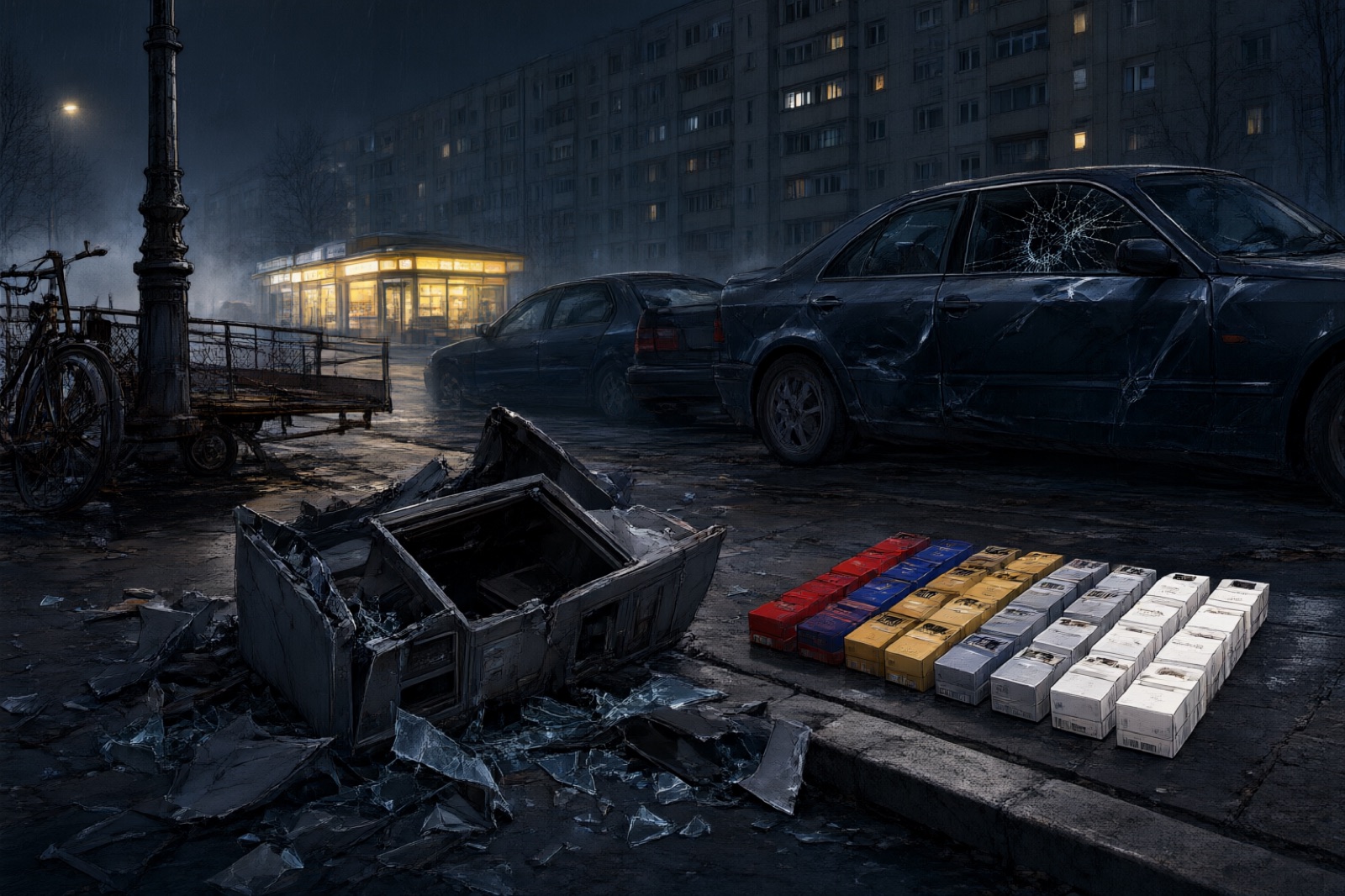
The machine lay on the pavement like something that had fallen out of a window and decided on the way down to come apart. The back panel was still standing, crooked, with four bare screw holes in it. The rest was spread over twenty metres: sheet metal, a chunk of the front panel with the price list still on it, glass grit.
It was half eleven, four degrees, and the drizzle was so fine you only noticed it once your jacket was soaked through. Kalle stood at the tape with a paper cup of coffee from the station machine, didn’t drink it, sniffed it, and put it on the bonnet of a patrol car.
Leni was already down in the debris. Gloves on, a torch between her teeth, a folding rule in her hand. The tape measure bothered Kalle less than what she was doing with it: she was measuring the gaps between the cartons of cigarettes.
They were standing on the kerb. Upright. Sorted by brand. Five cartons side by side, then a gap exactly one carton wide, then the next five. Brand by brand, price by price, from the cheap own-label at the bottom left up to the dear stuff at the top right, like a shop counter — except the counter was a pavement in Marzahn and the only light on it came from a street lamp.
“Eighteen centimetres,” Leni said. “Every time. Eighteen.”
“That’s not a thief,” said Kalle.
“No.”
“A thief drops things. This one tidies up.”
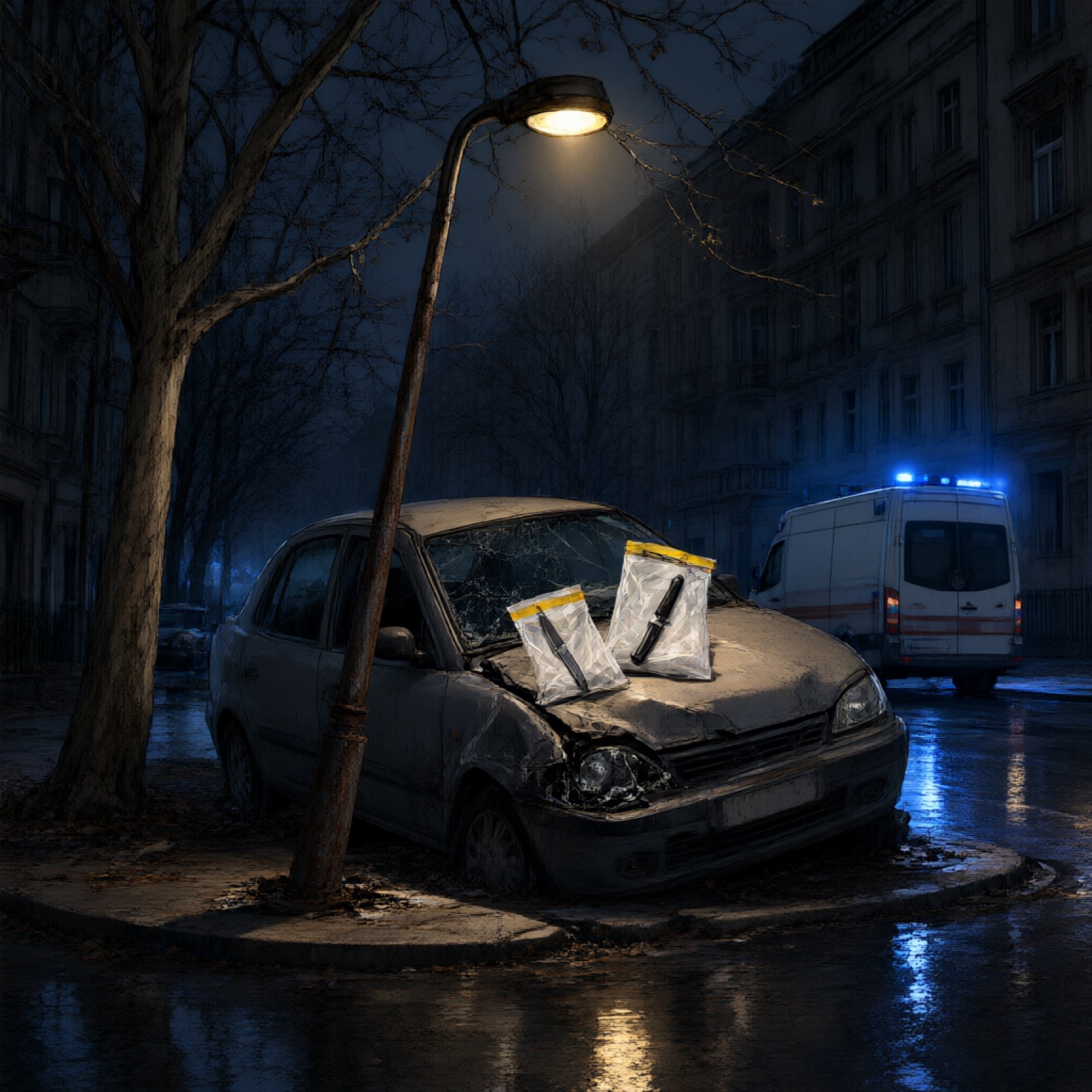
The first car was an Opel Corsa, 2004, silver, with a dent in the rear wing that looked like a fist in dough. The second was a Mercedes estate with its back window cracked in a pattern like a road map. The third was a BMW with the roof pushed in slightly, as if someone had hit it from above with a flat hand.
Nobody hurt. That was the first thing the duty officer had said, and Kalle had nodded as though it were good news. It was. It just wasn’t all of it.
The caller stood behind the tape in a padded jacket with reflective stripes, though he wasn’t working, and had been talking for fifteen minutes without a full stop. Roland Petschke, sixty-one, retired, fifth floor, window on the street.
“I sit at the window because I don’t sleep, I never sleep before half two, and I see the flash, and then I hear the bang, but the bang comes later, that’s normal, sound and light and all that, and I think, that’s fireworks, in November, people do that, but then I see the metal flying, and I knew then, that’s not fireworks, that’s a machine.”
“How much later?” Leni asked, without looking up.
“Two seconds. Tops.”
“You saw the flash. Where exactly?”
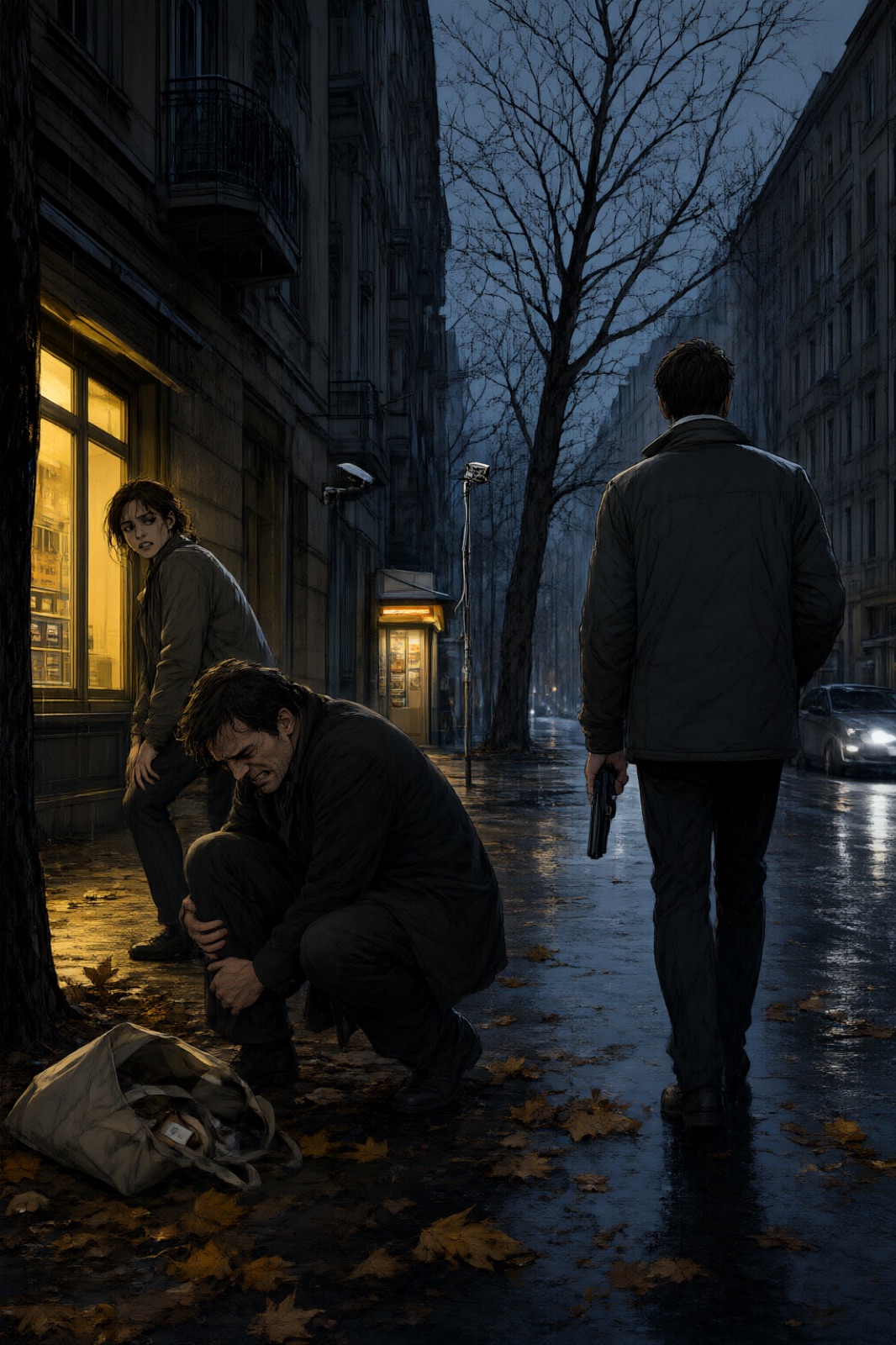
“There.” Petschke pointed with his whole arm, as if he had to do the sum again. “Straight across, next to the postbox. And then someone ran off with a bike trailer, big fella, six foot two at least, grey jacket, hat. He went towards the S-Bahn, I think. Or the other way. It was dark.”
Kalle looked at him. “Big and six foot two, or dark, or both?”
“Big,” said Petschke firmly. “Definitely big.”
Four minutes later a woman came along the pavement who owned the Opel. She was still in her work clothes, pale blue scrubs, trainers, a bag on her shoulder with a clinic pass in the window. Danuta Kamińska, forty-seven, care worker, six years in Marzahn, night shift at the home on Allee der Kosmonauten, just got in.
She looked at the wing. Then she looked at the machine. Then she looked at Kalle.
“That’s my car,” she said. “Since 2009. I bought it second-hand with eighty thousand on it, and now it’s got three hundred and twelve. It still runs. It’s just got a dent.” She said it quietly, with that small Polish lilt in it and the tiredness still there. “Proszę, I have to be out again at seven. Can I do this? The insurance?”
Leni took her details, patiently, asked about the garage, the parking spot, whether she’d seen anyone. Frau Kamińska had seen no one. She’d stood in the car park at ten to eleven looking at her phone, because her daughter had sent her a voice note, and then she’d gone inside. Twenty minutes later, the bang. “I thought, an accident. But an accident doesn’t make a hole like that, does it?”
“No,” said Kalle. “An accident doesn’t make a hole.”
Leni had finished with the machine and was looking at it from five metres away, arms folded.
“It wasn’t forced,” she said.
“It’s in bits.”
“Yes. But look at the service hatch. That’s been unlocked, not levered. Small lock, turned clean, not a scratch on it. He knew where the key goes.”
She crouched and pointed with her biro. Under the coin slot, where everybody looks, the door was buckled. Below it, at knee height, a second hatch, no handle, with a square hole the size of a fingernail.
“All the smoke came out through the coin door. Two gas cartridges, that’s standard on these things — butane, camping shop, three fifty a go. But that was too much. Can you hear it?”
Kalle couldn’t hear anything. He rarely heard what Leni meant by “can you hear it”.
“The metal’s black outside and bright inside. That means the pressure wave was long. If it’s dosed right, the machine cuts out once and opens like a door. This one went off like a safe. That was three times too much gas.”
“Three times too much gas on a pavement with three parked cars, and nobody gets a scratch.”
“Because the cars are parked and the people are asleep,” said Leni. “That’s not luck. That’s a time window.”
She straightened up and brushed off her knees, which were dry. “And because he doesn’t clear up like a thief. He clears up like a man cashing up a till. The cartons are in price order.”
Kalle took the paper cup off the bonnet. The coffee was cold. He drank some anyway, because he didn’t want to start by throwing it away.
By half twelve they were sitting in the car with the heater on. The corner shop on the corner was still open, a woman in a hoodie stood outside eating a currywurst out of her hand. Kalle watched the steam drift past her and thought about nothing he’d have put in a report.
“The machine belongs to a firm called Nordost Automaten Service,” said Leni, holding her phone so he could read it. “Five hundred and sixty machines in Berlin, mostly the east. The machine flagged itself as out of order at ten past eleven — their system reported it. Nobody read it.”
“Because at ten past eleven there’s nobody in the office.”
“Because at ten past eleven the system writes a message that somebody clicks away in the morning. They sacked a technician. Two years ago. Kettler, Wolfgang, fifty-eight, twenty-six years with the firm, last job area driver on route seven.”
“And?”
“And the firm said he’d been helping himself. Shrinkage, fags, loose change. He denied it, labour court, settlement, four thousand one hundred euros. It’s all in a file my colleague got off the insolvency administrator. The firm folded in August.”
“Four grand for twenty-six years.”
“That’s what you get when you ask the software.”
The next morning was grey and dry, and Kalle drove the route from the file with Leni. Nine machines in Marzahn, Hellersdorf and Hohenschönhausen had been opened in the past five weeks — not all of them reported, because the operator was broke and the reports went to an address where nobody sat any more. All nine had been on Kettler’s old round. All nine had been opened days after their last refill, when they were at their fullest.
“He’s not waiting for the money,” Leni said in the car. “He’s waiting for the delivery.”
At ten they stood outside a corner shop on Marzahner Promenade, between a hairdresser with notes in the window and a phone shop where three men waited for one of them to find a cable. The owner was called Tuncay Aslan, forty-four, and he didn’t know Kalle, which didn’t stop him shrugging straight away.
“Cigarettes? I sell cigarettes. With the tax stamp. All legal.”
“With the tax stamp,” said Kalle. “The cartons at the back of the shelf, under the newspapers — those haven’t got a stamp. They’ve got a band from 2019 and they taste like carpet.”
He looked past Kalle at Leni, as if she might help. Leni looked back, friendly, and said nothing, which was worse than any threat.
“I’ve got two kids,” said Tuncay. “One at school, one small. If you shut the shop on me, then—”
“Then your landlord’s got a problem,” said Kalle. “Not you. You’ll have time for the kids.”
“I don’t talk about customers.”
“I’m not asking about customers. I’m asking about the man who brings you the cartons. Bike, trailer, grey jacket.”
Tuncay stared at the counter for a while, at a lighter lying next to somebody else’s lighter. Then he said: “Wolle. That’s what they call him. He comes Fridays, about four, with two boxes. He adds up what he’s brought and wants it exact. No discount, no percentage. He wants a receipt.”
Kalle looked at Leni. “A receipt.”
“He writes it down himself,” said Tuncay. “Date, brand, how many. He says he needs it for the books. I thought, the man’s mad, but the stuff’s good and the price is five fifty, and in January my son—”
He stopped. “Anyway. I kept it.”
He brought out a pad from under the till, a squared school exercise book with an electricity supplier’s sticker on it. Every page full of figures in even handwriting: date, brand, quantity, total, tick. The last page was half full.
Leni leafed through it, stopped, leafed back. “He counts in fives. And he writes down what they cost in the machine, not what he charges you.”
“He’s squaring it up,” said Tuncay. “He says that’s the value. I’m to give him the difference. I said, you’re a nutter, and he says: ‘A man has to know what his work is worth.’”
“Wolle,” said Kalle. “Wolfgang Kettler.”
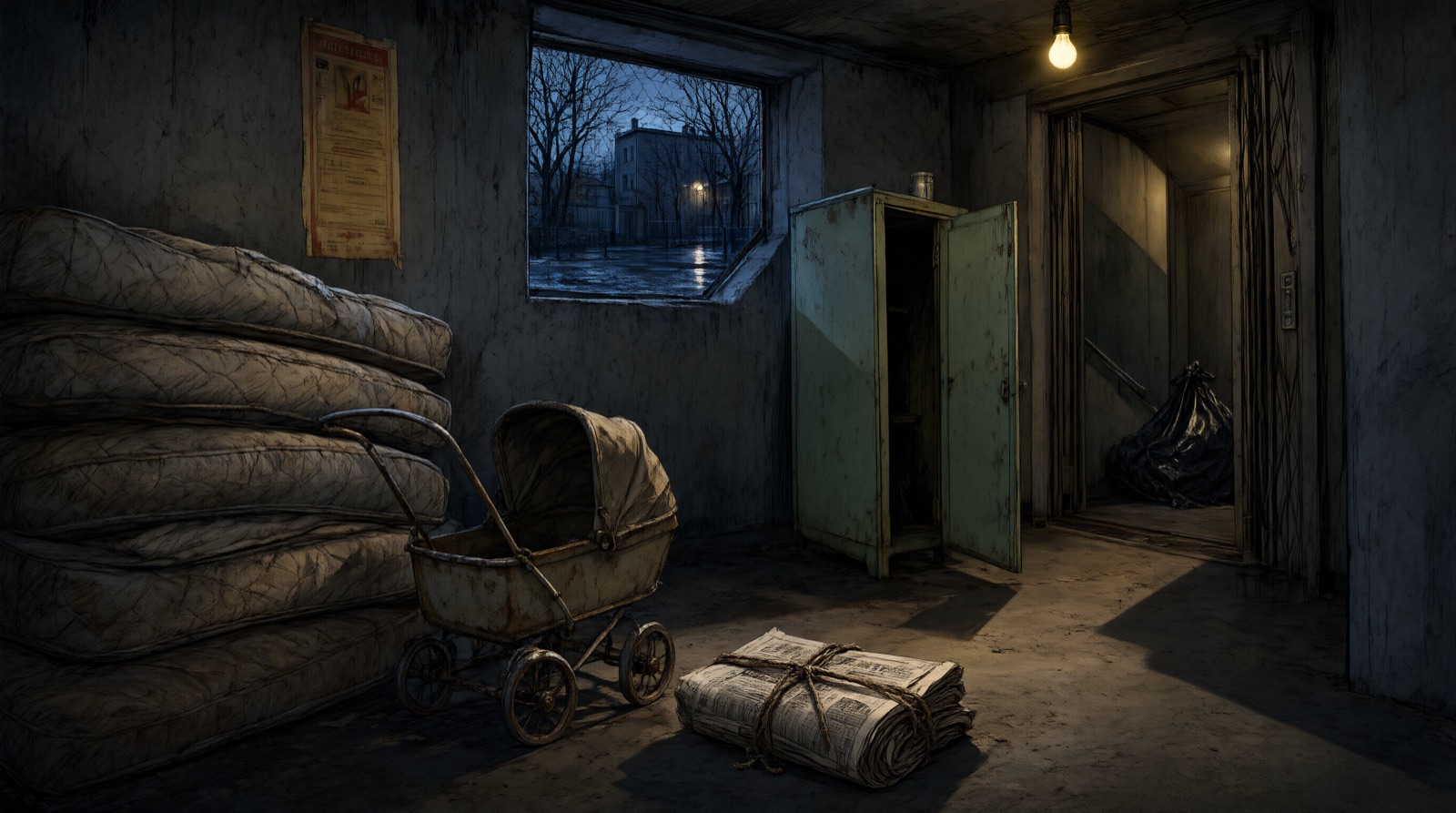
The basement was the cleanest workshop Kalle had seen in fourteen years in Marzahn. Two strip lights, one of them replaced and not flickering. A stainless steel bench, three vices in a row, soft jaws labelled with tape. Shelves of boxes, each with a label and an inventory number. Top left, a carton of igniters, next to it a cardboard box marked “MINE ONLY”, next to that, in a row like the cigarettes, eleven canisters of butane.
Wolfgang Kettler sat at the table drinking coffee from a mug with a company logo that no longer existed, and looked up as if he’d been expecting them and had merely got the day wrong.
“You’re four days early,” he said. “I’m not finished.”
“Then we’ll do it now,” said Kalle. “Detective Chief Inspector Rieger, this is my colleague Weber. You’re Wolfgang Kettler, right?”
“Right you are. Three t’s, yeah.” He put the mug down, turned the handle to the left. “Round here everyone says Kettler with two. Nice to hear it proper.” The mug stood on a beer mat, which stood on a coaster, as if the mat needed a mat.
“You blew open the machine on the Promenade. You gave it too much gas. Three cars are wrecked.”
Kettler thought about it. “The Opel, the silver one, 04 plate? That had a dent on it already. Back left. I saw it that night before I started.”
Kalle dropped into the chair opposite. “That’s your best argument? That the car already had a dent?”
“No. My best argument is that I didn’t blow the machine up.” Kettler didn’t sound like a man lying. He sounded like a man explaining for the hundredth time why the level crossing wasn’t his fault. “I opened it. There’s a difference. A machine is a cupboard with an opinion. You blow it open, you break it, and then you’ve got a box of scrap and a hundred fags that taste of smoke. You open it, you’ve got a machine that works.”
“You didn’t put the machine back, though.”
“That’s the van’s job. I only opened it.”
Leni had stopped by the shelves, read one label, then a second, and her face had lost the kindness it had for victims. “The gas figure is in your book. Every job: six grams of butane, eight grams, twelve.”
“The numbers aren’t quite right. In the cold it needs more, the metal contracts, the—”
“You used the winter setting in November.”
Kettler looked at her. Then he nodded, once, like a man checking a sum and accepting the answer. “That was the mistake. The only one. In the cold the thing needs more pressure, in summer the summer setting’s enough. I worked it out in November the way I work it out in January. That was too much. I noticed when it was too late.”
“Why the rows?” asked Leni. “The cigarettes on the kerb. Price after price.”
“So I know what I’ve got.” Kettler said it without hesitating. “If I’m taking it, I want to be able to count it. The fags themselves, I don’t care. I don’t smoke. I never touched one, twenty-six years at those machines, not once.”
“Your firm’s system says you helped yourself.”
“My firm’s system? That’s software. I didn’t write it. The firm built a list, with routes and fill levels and times, and then I’m standing in Neuenhagen on a Friday night and the list wants me to go to Marzahn because some hero in the office moved a boundary. I had that round in my head for twenty-six years. With the list I’m ten per cent slower.”
He got up, went to the wall where a map of east Berlin hung, pins in the street grid, and tapped four spots. “Nine machines. All off my round. All nine, each a few days after a refill. I didn’t make that up. Anyone can check it.”
“Did you tell anyone?” asked Kalle. “Two years ago? A works council? A newspaper?”
Kettler hesitated just long enough for it to be a mistake. “I wrote to the labour court. They never read it. They saw the shrinkage figure and a bit of software, and the software said the figure was too high.”
Leni held up an A5 notebook from the shelf, a waxed cover that looked like 1978. “This. Service log. Route seven, 1998 to 2024. Every run, every machine, every fill, by hand. You’ve got the locations in your head because you wrote them down.”
“I’ve got them in my head because I drove them,” said Kettler. “The writing’s for the day the head gives out. My father did the same. He worked for the zoo. Wrote down every day what he’d carried. At the end he’d take the book and say: ‘Son, look what we hauled up between us.’”
He sat down again. Turned the mug handle to the right. “I haven’t seen a cent of that settlement.”
“That’s right,” said Leni. “The firm’s insolvent.”
“I know. That’s why I started in October.”
Kalle laughed, short and joyless. “So you didn’t steal. You collected your settlement from cigarette machines. With gas and a square key. And receipts.”
“Said like that, it sounds wrong.”
“It is wrong, Mr Kettler. It’s wrong with dents in three cars.”
Kettler looked at his hands, lying on the table, clean, short nails, not a scratch. “I should have started in winter. December, January, February — it’s dark then, fewer people walk past the thing. In November people are out. The McDonald’s opposite is open till one, the kids come through.”
“You shouldn’t have been working at all,” said Kalle. “You should have handed it over. To the firm, to us, to a solicitor. You played the statistics until it went bang.”
Upstairs a door went, someone crossed the hall in heels, then it was as quiet as only a Marzahn basement gets in November.
Leni said: “Where’s last night’s haul?”
Kettler pointed with his chin. “Box behind you. Sorted. Thirty-one cartons. The other side of the round goes Friday, Marzahner Promenade 43. I had it down for Thursday.”
Kalle looked at Leni. “Note it.”
“Already have.”
They took him out while he still wanted to finish his coffee. He didn’t complain out loud, but he hesitated on the handle. Only on the stairs did Kettler say, not to them: “Twenty-six years. Is that all it was?”
Nobody answered. On the pavement, three hours later, the cigarettes weren’t in a row any more. They were in bags, in a box, in a number.
The punishment arrived on Friday at four, in the shape of a message Tuncay Aslan sent Kalle with no greeting and no signature: “Wolle not coming. I said I have to stop. Two kids. Bye.”
Kalle read it twice and put the phone down. Above the roofs of Marzahn there was a smell of kerosene and wet concrete, like every November evening when nobody’s got plans.
Leni put a sheet on the desk: the haul from the basement in figures, brand by brand, thirty-one lines. Kalle took a ruler and laid the photo printouts of the cartons in a row on his desk, cheap to dear, the way he’d seen them on the pavement, and shuffled them until the gaps matched.
Leni watched for a minute. “If you say order must be maintained now, I’m calling a doctor.”
Kalle looked at the row. “The man was the only one in this case who made an effort.”
“He blew up three cars.”
“I know.” Kalle took the first printout away and put it at the end of the row, because by principle it fitted better there. “Good job, by the way. The thing with the prices.”
Leni pocketed the sheet. “Good job, you say.”
“Don’t push it.”
Note: All characters, places and events in this story are fictional. It was inspired by a public police report but does not depict real events, persons or circumstances. More: Legal notice.