The Driving-School Shooter
Chapter 1: Quarter Past Eight
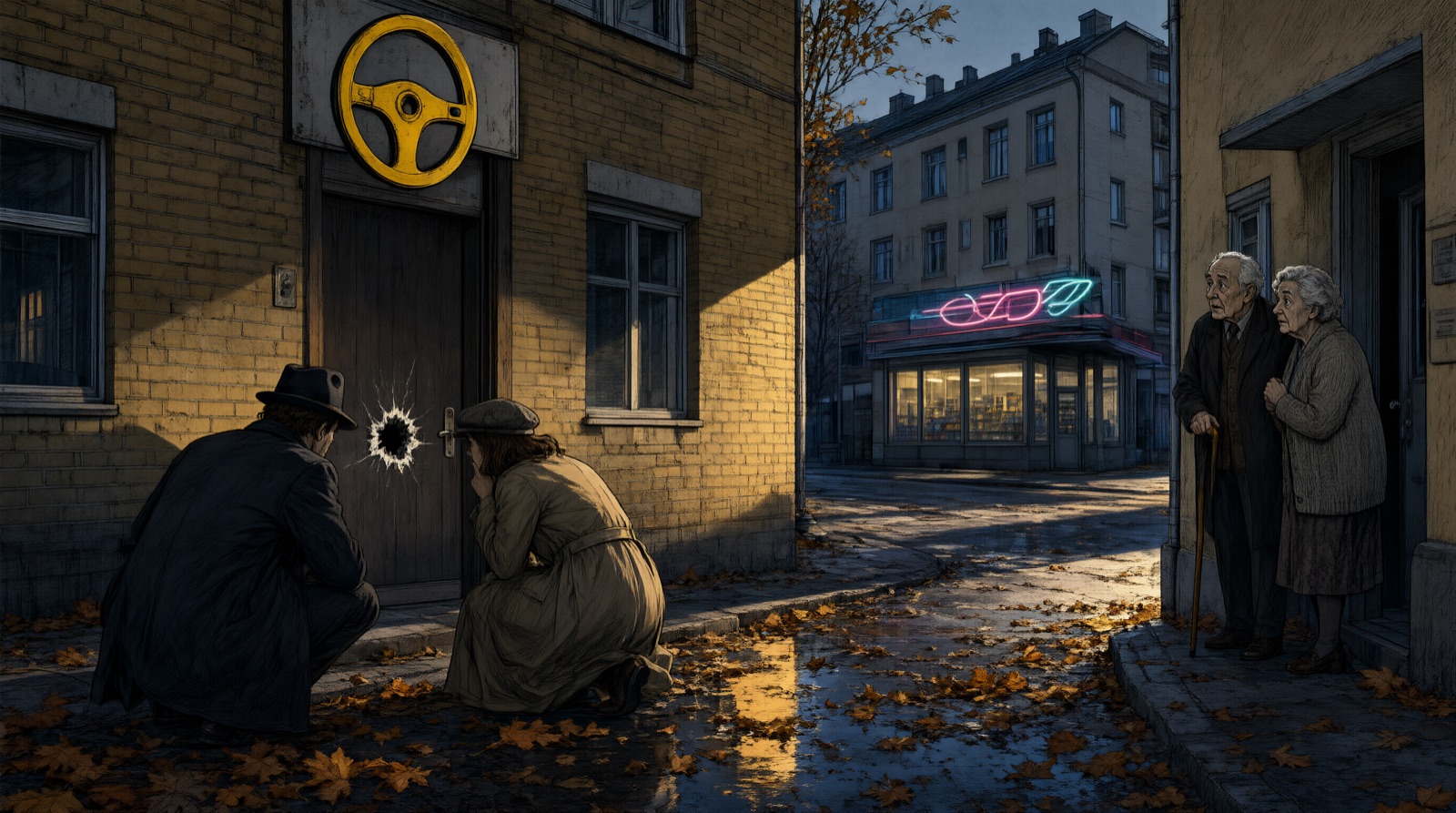
November in Wittenau smelled of dead leaves and sour bins the BSR wouldn’t empty till tomorrow. Kalle stepped out of the silver service Škoda, his leather shoes crunching on the damp asphalt of Oranienburger Straße. In front of him sat the “Am Rathaus” driving school — a yellow brick building from the seventies, its front door now sporting a hole the size of a ten-penny piece. Not exactly a crater, but not the sort of decoration that pulled in new learners either.
“Well, what a right mess,” Kalle said, pulling the collar of his black leather jacket up. The wind whipped brown leaves against the steps. The sun sat low, cold autumn light painting the facade in a shade somewhere between mustard and old gold.
Leni followed him, her pace a beat slower, as if cataloguing the scene before entering it. She wore her dark jacket, the one she hadn’t washed in three years — not because it was dirty, but because it worked. Her hand rested on the warrant card dangling from a leather cord round her neck.
“No injuries,” she said. “Just criminal damage. BAO Ferrum already waved it off.”
“Schneeweiß?”
“The same. He said, long as no one’s bleeding and no clan tag’s stuck round the hole, it’s not LKA business. He said, ‘Rieger. Weber. If this is a clan job, I won’t call you, I’ll fetch you.’ But there’s no tag.”
Kalle snorted. “Nice of him to leave the fun to us, innit?”
Behind the milky glass of the door appeared a middle-aged man whose shirt was pulled so tight it looked like someone else had dressed him.
“Demir. Hakan Demir. I’m the owner.” He wiped his hands on jeans at least one size too large. “Police, they always come. And me, I have three tests today. Three. First since the incident, and now no one wants to come in.”
“Then take a seat, Mr Demir,” Kalle said. “We’ll be gone quicker than you can say ‘accelerate’.”
Hakan hesitated, then nodded. “Tamam. Come in. But wipe your shoes, please. Floor, I clean yesterday.”
Inside, it smelled of disinfectant, old leather, and the sweet fear of people climbing behind a steering wheel for the first time. A driving instructor leaned against the counter, a half-smoked cigarette in the corner of his mouth even though smoking was banned here. He was late fifties, wore a brown waistcoat with the driving school’s embroidered logo, and looked like he’d broken every rule in the Highway Code at least twice — and never been caught.
“Klaus Färber,” he introduced himself, without touching the cigarette. “Thirty years I’ve been teaching people to drive. But this…” He jerked his chin toward the door. “This is new. Even the bloke last year who opened the door with his head — even he didn’t shoot.”
“When exactly?” Leni asked. She had her notebook out, not a tablet. Paper turned faster when the battery died.
“This morning. Quarter past eight. I was outside on the steps, having my coffee. All of a sudden: bang. Wood splinters. I look down, thinking a car’s hit the door. But there was no car. Just the hole. And smoke coming off the wood, thin, bluish.”
Kalle went to the door, crouched down. The hole sat twenty centimetres off the ground, slightly right of centre. The edges were fresh, the wood scraped pale, as if someone had stabbed it with a sharp screwdriver.
“Small calibre,” he murmured. “Maybe .22. Not a shotgun. Not a big bang, more of a crack.”
“No exit wound either,” Leni added. “The round’s lodged in the door. Or it’s bounced back. Either way, nothing came out the other side.”
Kalle straightened up. “Enemies, Mr Demir?”
Hakan shrugged. “Enemies? I have debtors. But they all pay. Almost all. There’s Mr Schulz on the second floor, hasn’t paid his instalment for the lorry licence since March. But he’s a conductor on the BVG. He hasn’t got a weapon.”
“Almost’s an interesting word,” Kalle said.
“No, no.” Hakan waved it off. “Nothing serious. One instalment here, one reminder there. That’s normal. Business. Tamam?”
Kalle turned to Färber. “And you? Anyone particularly angry? A learner who failed for the fifth time and blamed you?”
Färber drew on his cigarette. “They come every week. Every week someone thinks I switched the lights red. But they only shout. They don’t shoot. They haven’t got weapons — they haven’t even got licences.”
Outside, a car door slammed. An elderly couple stood across the street, staring with that mixture of curiosity and disappointment that Berliners reserved for police operations when they weren’t personally involved.
“Witnesses?” Leni asked.
“The neighbours,” Hakan said. “Hoffmann. Couple. They read the paper in the mornings and don’t want to have heard anything.”
“Let’s go over then,” Kalle said. “Maybe they did hear something after all. Pensioners see everything, mate. They just don’t look when you ask ’em.”
Chapter 2: The Angle
The Hoffmanns lived on the ground floor of the apartment block opposite, its facade painted in a shade Kalle would call “pre-March beige”. Mrs Hoffmann opened the door, a thick dressing gown round her shoulders.
“We didn’t hear anything,” she said, before Kalle could open his mouth.
“Good morning to you too,” Leni said.
Mrs Hoffmann frowned. “Good morning. But we didn’t hear anything. We read the paper in the mornings. We concentrate.”
Mr Hoffmann appeared in the hall, jogging bottoms that had seen better days. “Police?”
“Criminal police. Rieger. Weber. The hole in the driving-school door. You didn’t hear anything.”
“Nothing,” Mr Hoffmann confirmed. “I only saw a few students turn up around half eight and then leave again. Panic, I reckon. Young people can’t take pressure.”
Kalle nodded. “Thanks for the… concentration.”
Outside, Leni leaned against the front door, staring at the driving school. “Kalle. Come here.”
He stepped beside her. She pointed at the height of the hole in the door, then the street, then the windows of the building opposite.
“Twenty centimetres off the ground. If the shooter was standing in the street, average adult, the hole should be hip height. But he’s shooting downward. See the angle? The splinters point down.”
Kalle squinted. “The bloke shot from above.”
“Or from a window. Or a roof.”
“Very funny.” Leni pulled out her phone, tapped away. “I’m measuring the angle.”
“You an engineer?”
“I’m patient. That counts sometimes.”
While Leni tapped, Kalle drew his own conclusions. On the second floor hung a flowerpot that hadn’t been watered in weeks. On the third floor, the window was open, a cheap white curtain fluttering.
“Third floor,” Kalle said.
“Why?”
“The curtain. It’s moving. And there’s no flowerpot on that sill. Someone who waters flowers doesn’t shoot. Someone who’s forgotten the pot is either on holiday or… busy.”
Leni pocketed the phone. “The angle fits the third floor. We need the flat. And a name.”
Kalle knocked on the front door of the building they’d just left. A woman in her early sixties opened, hair in a bun.
“Köhler. Landlady and property manager in one. What do the police want?”
“A flat on the third floor. Who lives there?”
Mrs Köhler raised her eyebrows. “Kruse. Rüdiger Kruse. Eight years. Pays the rent — sometimes late, but he pays. Why? Has he done something?”
“Do you know if he has weapons?”
“I know he set the bins on fire last week with a football whistle. But that was just… he was drunk. He’s harmless. Like a fat hamster.”
“Harmless,” Kalle repeated. “Have you got a key? For emergencies?”
“Only for emergencies. Water leaks, gas, that sort of thing.”
“This is an emergency. For the driving school opposite. And possibly for the hamster.”
Mrs Köhler hesitated, then sighed. “Wait. I’ll get the bunch. But I’m staying down here.”
She disappeared and came back with a key ring carrying at least twenty fobs.
“I’m staying down here,” she repeated.
Kalle and Leni went up. The stairwell smelled of chip fat and old plaster. On the second floor, a dog barked. On the third floor, the flat door was plain, with a nameplate: “R. Kruse — Please don’t ring!!!”
Kalle pulled on gloves. Leni put her hand inside her jacket, on her weapon, just to be safe.
Mrs Köhler’s key fit. Kalle pushed the door open.
The flat was one room, kitchen, hallway — the hallway so small you had to turn round to take your jacket off, and so dark you couldn’t find it. The air smelled of stale beer, burnt toast, and a houseplant that had given up out of pity and now consisted only of stems.
“Hello?” Kalle called. “Mr Kruse? Police.”
No answer. Just the hum of an old fridge.
Leni went to the kitchen. On the table stood empty cans, a half-eaten tin of beans, and the Wittenau local paper from yesterday. The BVG timetable lay folded on top. A pen circled the advert for the “Am Rathaus” driving school. Underneath, in scrawled handwriting: “Third attempt. Three. They failed me on purpose. Färber.”
Kalle went to the window. It was wide open, a cheap polyester curtain flapping. On the sill sat no flowerpot. Instead lay a small metal object, glinting in the cold autumn light.
“Leni.”
She came over. On the sill lay a cartridge case. .22 LR. Small, cheap, effective.
“He shot from here,” Leni said quietly.
“And he’s gone.”
Kalle looked down at the street. The driving school lay directly in the sightline.
“Before we touch anything: we need a warrant and a search. If the casing’s here, the weapon might still be in the flat. Or on him.”
They looked round without laying a finger on anything and left everything where it was. Under the bed lay three pairs of socks and a baseball bat so dusty it counted as an archaeological find. The fridge stood ajar: only mustard and a stale beer. The cupboard door hung open on bare hangers.
“He’s got it on him,” Leni said.
Kalle’s phone vibrated. He answered.
“Rieger.”
“Kalle, it’s the desk. We’ve just had a call. Second shot. Oranienburger Straße. Corner shop next to the driving school. Witnesses say it came from the roof.”
Kalle and Leni looked at each other. Leni was one step from the door.
“We’re two minutes away,” Kalle said. “We’re coming. Tell no one to move.”
Chapter 3: Second Shot
The corner shop was called “Kiez-Shop” and was the size of a wardrobe. Behind the counter stood a young man with acne and a name badge saying “Piotr”. The shot had shredded the plastic Coca-Cola sign and lodged in the wall behind the coffee machine.
“I didn’t see anything,” Piotr said. His hands shook. “Only heard. Bang. Like the first one. But closer. Louder. I thought it was a tyre. But this… this was something else.”
“The first one?” Leni asked. “You heard the first one too?”
“Yeah. Earlier. I thought it was a tyre. But this…”
Kalle stood in the doorway, looking up. The third-floor window of the building opposite was still open. The curtain moved more strongly now.
“Leni. Up there.”
She followed his gaze. “He’s come back. Or he never left.”
Kalle stepped onto the street, waving over the patrol car that was just arriving, blue lights flashing. “Third floor, number 47. We’re going in. Seal the back yard.”
Leni ran beside him, her shoes slapping the asphalt. “Stairs or lift?”
“Stairs. The lift in that building makes more noise than my old Hoover at home.”
They stormed up the stairs. On the second floor, the dog barked again, frantic this time. On the third floor, the door stood open. Kruse hadn’t closed it, maybe in a hurry.
Kalle went first, weapon drawn but lowered. The flat was empty. But the window was wide open, and on the table sat an opened beer, still foaming.
“Freshly opened,” Leni whispered. “He was here. Just now.”
Kalle looked out the window. On the roof of the house next door, two metres below, crouched a figure. Green jacket, grey hair, an object in his hand glinting in the sunlight.
“Kruse!” Kalle yelled. “Police! Stay where you are! Drop the weapon!”
The figure twitched as if shocked. Then he jumped — not far, just to the next roof, a gap of maybe a metre. But the man was drunk, and the roof was wet with morning dew.
He slipped. The object in his hand flew through the air and landed with a clack on the tin. A small pistol, .22, old but functional.
Kalle jumped onto the windowsill, then onto the roof. He landed badly, knees aching for a moment, but he landed. Leni followed, more elegantly.
Kruse lay on his back, arms spread, like a snowman in summer slowly melting. He stared at the sky, which today showed a rare clear November blue.
“Bloody hell,” he said. “Should’ve known it’d end like this.”
“Rüdiger Kruse,” Kalle said, weapon trained on him but not aimed. “You’re under suspicion of aggravated breach of the peace, criminal damage, and illegal possession of a firearm. You have the right to remain silent. And don’t bother getting up. This roof’s rubbish.”
Kruse turned his head. He was late forties, face bloated, eyes red.
“You got me,” he said. “Finally got me.”
“Luckily we got you before you hit anyone,” Leni said. She pulled out handcuffs, metal clicking in the cold air. “Get up. Slowly. No tricks. You’re not a stuntman.”
Kruse stood up. He wobbled, like a table with one short leg, but he was cooperative. He held his arms out.
“I didn’t want to hurt anyone,” he said. “Just… just the hole. In the door. That was for Färber. And the second… the second was for the shop. For the box. The music. All night long. And for you lot. So you’d look over.”
Kalle lifted the weapon from the roof, bagged it. “You shoot at a driving school because you failed? Three times?”
“Three times. Three times he failed me on purpose. He touched the brake. I saw it. I saw him put his foot under the wheel. I just wanted him scared. Like I was scared. Of the test. Of losing my job. Of everything.”
They led him down the stairs. Mrs Köhler stood in the yard, hands over her lips.
“Harmless,” Kalle said to her.
“I didn’t know,” she whispered.
“No one knew. That’s the joke.”
Chapter 4: Licence for the Afterlife
The interview lasted two hours. Kruse sat in the kitchen chair of the interview room, a blanket round his shoulders, a coffee in front of him that he didn’t touch.
Leni led the interview. She sat opposite him, calm, hands folded. Kalle leaned against the wall, arms crossed.
“Mr Kruse,” Leni said. “The second shot. The one at the corner shop. Why there? Why again?”
Kruse shrugged. “I saw the coppers arrive. You lot. In the driving school. I thought Demir had grassed me up. Or Färber. I wanted to distract. A second hole, so you’d look over. Stupid, innit? Very stupid.”
“Very stupid,” Kalle said.
“I was drunk. I didn’t know… didn’t know it would go this far.”
“It always goes this far,” Leni said quietly. “When you pick up a weapon, it goes this far. You were lucky no one was hurt. That’s not merit, that’s luck.”
Kruse nodded. “The job. The lorry licence. The new boss wanted it badly. I paid everything, the school, the lessons, the test fees. And then… then Färber says I braked too late. I never brake too late. I always brake too early. Everyone knows that.”
Kalle pushed off the wall. “Rudi. Listen. You don’t shoot for a licence. You don’t shoot for a job. It was a bad idea, mate. But you had it. Now you live with it.”
“How long?” Kruse asked quietly.
“Not my call. Get a solicitor. And a new licence… you won’t be getting one any time soon. In prison you don’t drive yourself. They drive you. If they drive you at all.”
Kruse laughed. A dry, rough laugh. “Licence for the afterlife, eh?”
“Nah,” Kalle said. “The old one’s enough for prison. You don’t drive there. They drive you. If you’re lucky.”
Leni stood up. “We’re done.”
Outside, in the corridor, Kalle breathed deep. It was nearly noon, the sun high enough to light the last leaves on the roof of the police headquarters. The autumn wind had dropped, and the city had slipped back into routine.
“What a right mess,” he said.
Leni straightened her jacket. “Good job today.”
Kalle nodded. Nothing else came to mind, and nothing else was needed.
Note: All persons, places, and events in this story are fictitious. It was inspired by a public police report but does not depict any real events, persons, or circumstances. Further information: Legal Notice.