The Kudamm Courier
Chapter 1: The Stop
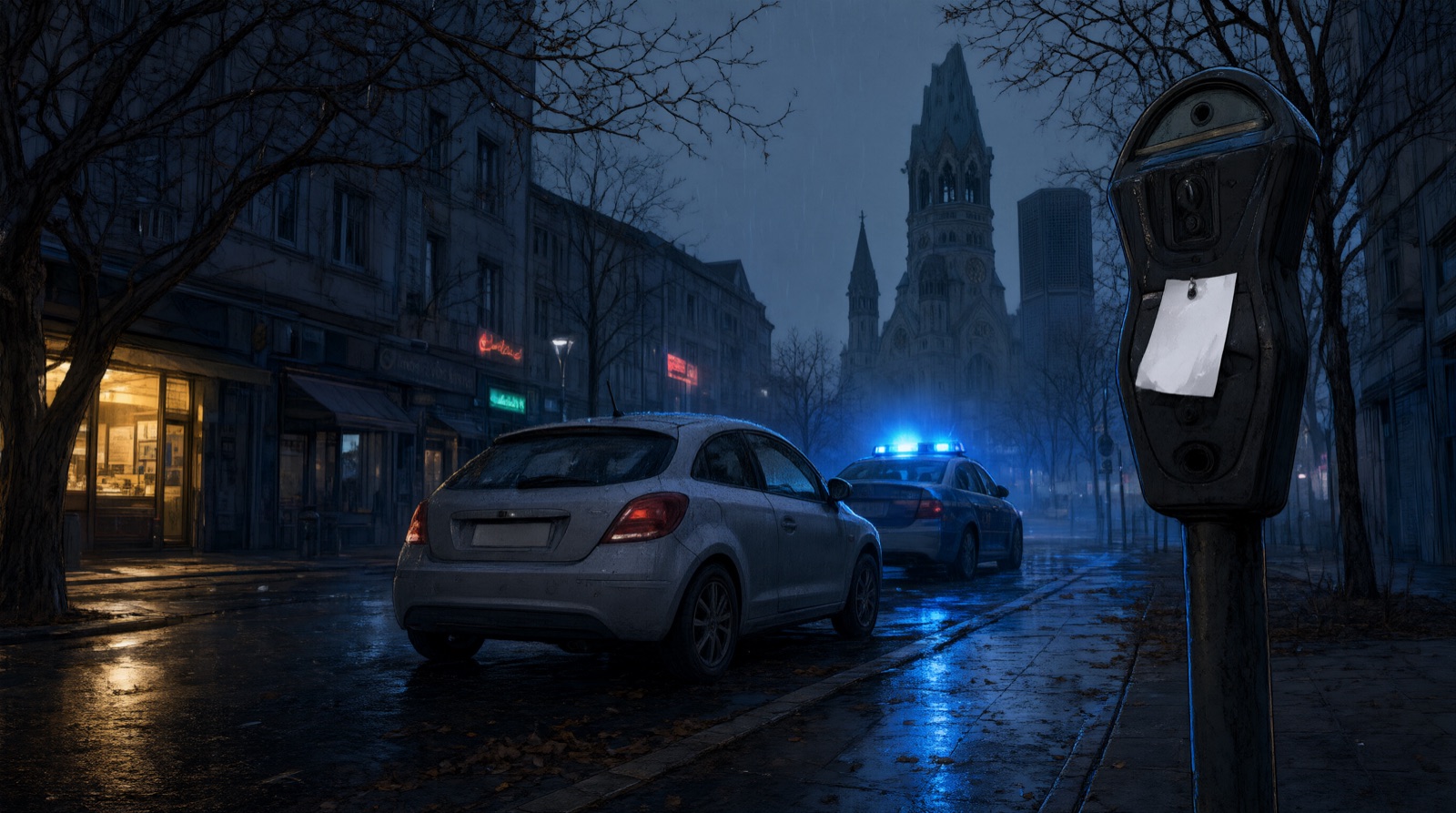
November had dunked the Ku’damm in a soup of yellow neon. The chestnuts had shed their leaves weeks ago, and the fine drizzle wrapped the street in a veil that turned headlamps into soft smears of light. Kalle climbed out of the squad car, the soles of his boots crunching on wet tarmac. Ahead of him sat a silver VW Polo, its rear picked out by the revolving red halo of a blue light.
“Mobile at the wheel,” said the uniformed officer standing at the driver’s window. “Twenty-three years old. Tapping his screen while rolling toward the Memorial Church. We pull him over, and what do we see? Stack of flyers on the passenger seat, plus a little spray can. Looks like pepper.”
Kalle nodded. “Well, what a turn-up.”
The driver sat motionless behind the wheel. A skinny kid with a three-day beard and a black bomber jacket frayed at the seams. His fingers trembled slightly as Kalle leaned to the passenger window.
“Out,” said Kalle.
The boy obeyed. On the back seat lay a package of aluminium foil, something white underneath that gleamed under the officer’s torch. Kalle didn’t sniff. He’d seen enough.
“Name,” said Leni, now beside him.
“Finn. Krüger.”
“And that?” She gestured at the foil.
“No idea. Not mine.”
“Right,” said Kalle. “And the flyers aren’t yours either. And the spray can’s for gardening. On the Ku’damm. Half eleven at night.”
Finn shrugged. “I just do the runs. It’s only a job.”
“Job,” Kalle repeated, glancing at Leni. “We’ve got a bleeding start-up here.”
The officer handed over the boy’s licence. Still warm from the leather seat. Leni glanced at it, slipped it into her pocket. She knew the type. Not the boy himself, but the pattern. No priors, clean sheet, a jacket too thin for November. Someone who thought he was clever and was just realising cleverness didn’t count for much on the Ku’damm.
“Come down the station,” said Leni. “Or tell us here who gave you the flyers.”
Finn bit his lower lip. A red van rolled past, its radio blasting schlager into the drizzle. The boy said nothing.
“Fair enough,” said Kalle. “Let’s go then.”
Chapter 2: At the Station
The Charlottenburg nick smelled of stale coffee and damp carpet. Finn sat in the interview room, hands wrapped round a plastic cup of lukewarm water. He stared at the table as if he could see straight through the scratches in the linoleum. The overhead fluorescent flickered in time with a dodgy ballast.
Leni sat opposite. She opened her folder, turned pages slowly, let the pauses do the work. Kalle leaned against the wall, arms folded, watching the kid like a telly on the blink.
“Finn,” she said quietly. “You’re twenty-three. No priors. Licence five years. You live in Spandau, work as a bike courier by day, and drive the Ku’damm at night. Why?”
“Money.”
“Supermarkets pay money too.”
“They don’t pay ten euro an hour plus tips.”
Leni didn’t smile. “Tips. Is that what you call it? The foil on the back seat was a tip too?”
“I’ve no idea what was in the foil.”
“You’ve told us that already.” She turned another page. “But you know who hired you. And you know the flyers aren’t for a pizza place.”
Silence. The fluorescent buzzed.
Kalle pushed off the wall and leaned over the table. The boy smelled of cheap deodorant and fear.
“Listen,” said Kalle. “That flyer is a fancy bit of work. Glossy paper, four-colour print. ‘Fast. Discreet. 24/7.’ QR code and a mobile number. That didn’t come from the copy shop round the corner. Who pays for that?”
Finn looked up, then dropped his gaze.
“You do the runs,” said Leni. “You don’t know the goods. You don’t know the boss. You just had rotten luck getting pulled over. That your story?”
“Yeah.”
Kalle snorted. “What a load of cobblers. Pardon me. But if I worked for a bloke who wouldn’t even show me a business card, I’d have to be thick as two short planks. And you don’t look thick.” He rubbed the back of his neck. “We’ll find who’s behind that flyer. The number leads to a prepaid SIM, yeah. And the printer in Neukölln who churns out that sort of thing wrote an invoice. With a name. With an address. It’s a bluff, mind. But it costs you two hours. You fancy sitting here that long?”
Finn swallowed. The plastic cup crumpled in his hand. A drop of water ran across the linoleum, followed a crack, vanished under the table.
“Julian,” he said quietly. “Julian Brenner. He lives by the Lietzensee.”
“And who’s Julian?”
“The… the dispatcher.”
Kalle caught Leni’s eye. “Dispatcher. Told you. Start-up.”
Then he leaned over the table again. “And where do you drop the flyers off? Someone’s taking them off your hands.”
Finn looked at the door as if he might walk out of it. “Corner shop on Kantstraße. Old fella’s called Hasan Yılmaz. He takes the stacks, that’s all he does.”
Kalle wrote the name on his napkin. “There. That wasn’t so hard.”
Chapter 3: Hasan’s Place
Kalle drove alone. Leni stayed at the station to log the exhibits and get Finn’s statement down. The drizzle had got heavier; the Skoda’s wipers beat out the rhythm of a dull ballad.
The print shop in Neukölln he’d talked about in the interview had taken the job cash. No name, no address, no invoice. The bluff had held for two hours, then it was gone. What Kalle had left was a street, a shop and a name.
The corner shop on Kantstraße sat between a shuttered perfumery and a kebab joint whose neon spelled “DÖNER & PIZZA” in a red, flickering shower. Behind the frosted glass a middle-aged man stood reading a newspaper. He wore grey trackie bottoms and a training jacket that had once been blue.
Kalle pushed the door. The bell jangled.
“Evening,” said Kalle.
The man didn’t look up. “Night, more like. What d’you want?”
“A word. You’re Mr Yılmaz?”
Now he looked up. Dark eyes, a nose that had been broken once. “Hasan. Who’s asking?”
Kalle produced his warrant card. Hasan eyed it like a receipt he didn’t need.
“CID,” said Kalle. “We pulled a young lad over earlier. Does runs for someone handing out flyers. You seen the flyers?”
Hasan set the paper aside. He reached under the till, pulled out a slip. A flyer. Same gloss, same QR code.
“Every day someone comes. Drops five, six off. Collects money evenings. Sometimes collects five more if they’re gone.” Hasan shrugged. “I say nothing. Not my problem.”
“Who collects the money?”
“Young lad. Always fancy shoes on. Talks like the telly. ‘Disruption’, ’last mile’, that sort of thing. I only understand half.” Hasan sniffed. “But money don’t stink. Even if it comes from a daft business plan.”
“What time today?”
“Quarter to. Maybe. Sometimes not at all. Like Deliveroo. App-controlled.”
Kalle pocketed the flyer. “Has Finn – the driver – ever said anything? About the boss?”
Hasan shrugged again. “The lad’s quiet. Comes, picks up, goes. Sometimes buys a bottle of water. Don’t talk much. Better that way.”
“Why better?”
“Because I’ve stood here twenty years and I know when not to listen.” Hasan tapped his temple. “Tamam?”
“Tamam.” Kalle nodded. “Cheers, Hasan. You were never here.”
“I wasn’t.” Hasan reached for his paper. “Good hunting.”
Chapter 4: By the Lietzensee
Leni parked by the jetty of the little lake, where in summer pensioners feed the ducks with bread scraps. In November it smelled of rot and dead reeds. The street lamps threw yellow cones onto the water, and somewhere a fountain splashed, the sort they never turn off for winter.
The flat was on the second floor of a Fifties brick house. The search warrant had come through around half twelve, signed off by the duty prosecutor because there was no time to rouse a judge – risk of the place being cleared: Finn had talked about a dispatcher, and one call from him would’ve emptied the flat by morning. The property manager had handed over the key – a neighbour had complained about music thumping all night. Finn had taken the flat as a subtenant and was registered in Spandau; Julian Brenner paid the rent.
Leni pulled on gloves. Kalle followed her up the stairs. The stairwell smelled of cabbage, someone cooking late. A bicycle leaned against the wall three flights above the cellar, chain rusted, saddle worn through.
The flat was a two-room dive with a kitchen bigger than the bedroom. On the kitchen table stood stacked boxes. Hundreds of flyers. Underneath, a laptop, lid open, the screen still warm. Leni tapped the space bar carefully. The machine woke from standby and showed an Excel spreadsheet.
“Customers,” Leni said quietly. “Code names. Addresses. Quantities. Prices per gram. Delivery slots. This isn’t a dealer’s contact list. It’s an ERP system.”
Kalle rummaged in a drawer. Business cards. Glossy, black stock, silver foil: “Julian Brenner – Dispatcher & Logistics Solutions.” Below that, a mobile number matching the flyers.
“Dispatcher,” said Kalle, holding a card out to Leni. “Business school graduate. Learned how to sell drugs with a pitch deck.”
In the bedroom they found a second phone under the mattress. Unlocked. WhatsApp chats. Group names: “Team Alpha”, “Team Bravo”. Messages like “Drop 7 done”, “Customer Lion ordered 2g again”, “Driver Finn running late, activate replacement?”
Leni photographed everything on her work phone. The images sat on the internal server as evidence before Kalle closed the drawer.
“We’ve got enough,” she said.
“Nearly,” said Kalle. “Now we just need to meet the managing director.”
At a quarter to two Leni stood beside the frosted glass of the corner shop, hands in her jacket pockets. Julian Brenner came down Kantstraße on foot – white puffer, expensive trainers – and Hasan pushed a fold of notes out through the gap in the door. Then he crossed Savignyplatz and disappeared into a bar. Leni rang Kalle, who was waiting in the Skoda two streets away. They gave him an hour.
Chapter 5: The Dispatcher
Julian Brenner came out of a bar on Savignyplatz at a quarter to three. He wore a white puffer jacket whose sleeves carried a logo Kalle didn’t recognise, and trainers that must have cost more than Kalle’s first motorbike. He was small, looked younger than twenty-one, and when Kalle and Leni stepped in front of him he smiled as if he were about to hand them a pocket calculator.
“Julian Brenner?” Leni held up her warrant card.
“Yeah? Is there a problem?”
“Several,” said Kalle. “Search warrant, arrest, the usual drill. We’re going to the station.”
Julian laughed. Briefly. A giggle that died at two seconds. “You’ve got it wrong. I’m a logistics provider. I organise transport. What my drivers carry isn’t my responsibility. Platform liability. Like Uber. It’s case law.”
“You’ve got staff,” said Leni calmly. “You’ve got customer lists. You’ve got quantities. You’ve got a scaling model. This isn’t a ride-hailing app. It’s dealing. And that doesn’t make you an entrepreneur. It makes you a dealer.”
“I’ve got a pitch-ready business concept!”
“You’ve got a file,” said Kalle.
They drove to the station in three cars. Julian sat in the back, beside a colleague, and talked the whole way. About markets, about efficiency, about the “last mile” no one in Berlin nightlife had covered yet. “The clubs want it. The customers want it. I just provide infrastructure. If someone orders coke, it’s like ordering a kebab. I’m not the chef. I’m the delivery app.”
Kalle didn’t look round. “You’re a petty criminal with a spreadsheet.”
“I’ve got revenue! Three hundred grams in week one. Five hundred in week three. That’s exponential growth.”
“That’s prison.”
At the station Julian cracked in the second hour of interview. Not dramatically. He laid his head on his arms and said quietly: “I just wanted something of my own. My dad always says I’m nothing. I wanted to prove I could do something.”
Leni waited. She said nothing.
“I started with ten grams. Then twenty. Then someone said do flyers. And then everyone wanted flyers. It’s like… it’s like a business, you know? You can’t stop once it’s running.”
Kalle stood up. “You can. Now.”
Chapter 6: Cold Coffee
At five in the morning the sun wasn’t up yet. The sky over Charlottenburg was a leaden nothing, slowly fading to an undefined pale grey. Kalle and Leni sat in the Skoda, engine running, heater on three. On the back seat lay a soggy box of flyers a colleague had brought from the flat.
Kalle drank from a cup he’d bought four hours earlier at a takeaway. The coffee was cold, oily, and tasted of ash.
“The lad,” said Leni. “He’s twenty-one. Thinks he’s founding a company.”
“He’s selling poison to people who don’t know where else to go,” said Kalle. “And he prints flyers like it’s a pizza parlour. That’s not founding. That’s just stupid.”
Leni nodded slowly. “Finn’s talking. He’ll give us the drivers, the customers, the suppliers. The prosecutor will be happy.”
“Good.”
Silence. The drizzle had stopped. On the pavement a street-sweeper gathered the last chestnut leaves. Behind the wheel sat a man with headphones, nodding in time to some domestic radio show.
“Good job today,” said Kalle.
Leni looked at him. “Cheers. Same to you.”
Kalle lobbed the empty cup at a street bin. It bounced off, rolled across the wet tarmac, came to rest under a parking sign.
“Let’s go,” said Kalle. “One more report, then we’re done.”
The car pulled away. The Ku’damm lay behind them, quiet and wet, the neon lights slowly dying in the grey morning light.
Note: All persons, places, and events in this story are fictitious. It was inspired by a public police report but does not depict any real events, persons, or circumstances. Further information: Legal Notice.