The Customer at Five
Chapter 1: Two Bags That Hang at the Back
Bleibtreustrasse at a quarter to six smelled of wet leaves and of the fat from the chip shop on the corner, which nobody had wiped off in two years. Kalle liked that smell. It smelled of knocking-off time, and knocking-off time was something other people had.
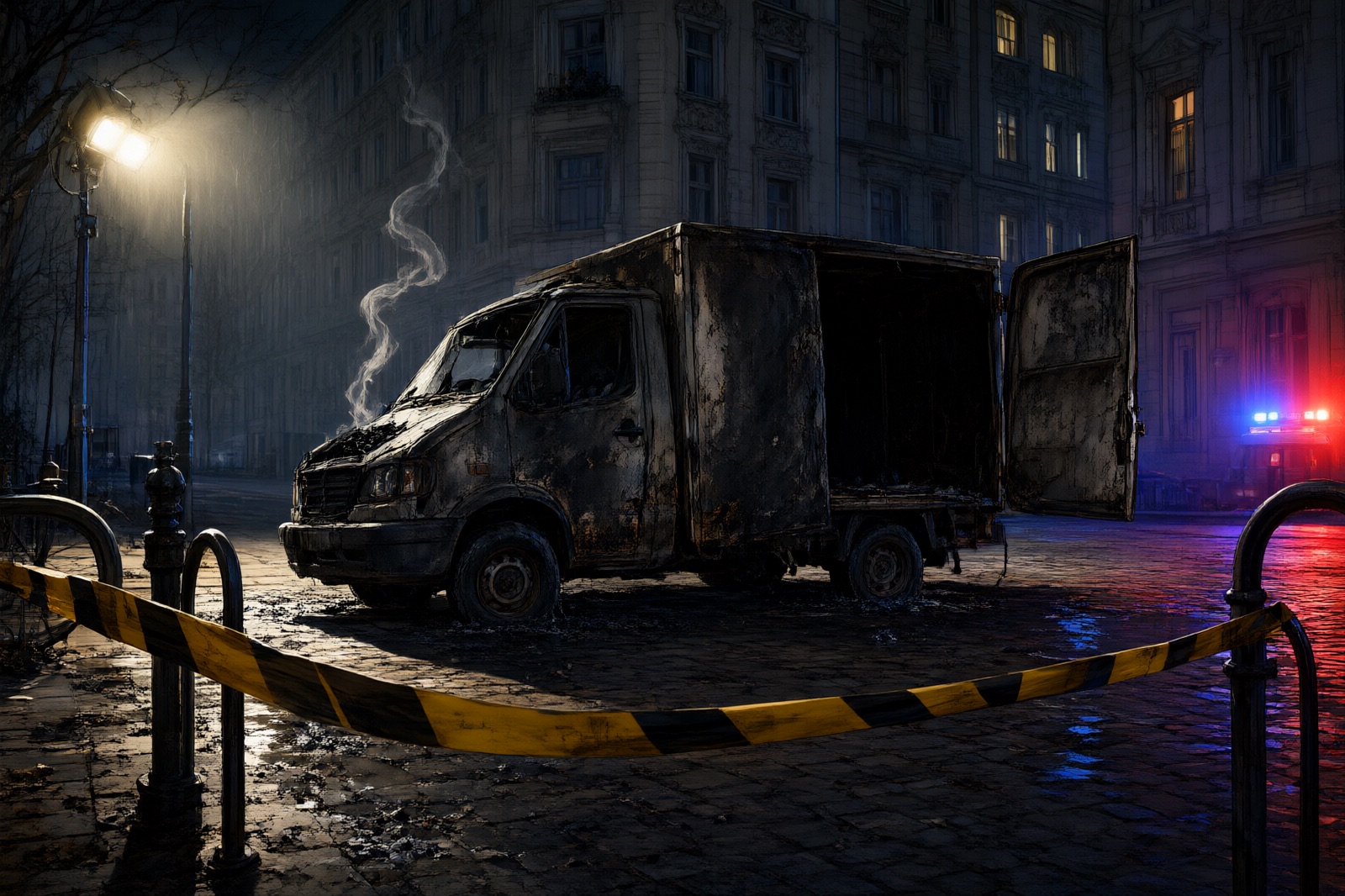
Outside number 62 stood a patrol car with its engine running, because the driver didn’t want to switch the heating off. Glass crunched on the pavement, fine as coarse sugar, and there was a chunk of a display case edge with a price tag still stuck to it. 1,290 euros. Kalle left it where it was.
“Where’s the colleague?” he asked the uniform.
“Back room. Grazed her hand. Won’t have an ambulance.”
“They never do.”
In the back room a woman sat on an office chair with ice cubes wrapped in a tea towel, turning a biro over in her fingers. Black blouse, hair bobble on her wrist, a graze across the back of her hand like it had been done with a ruler. On the table in front of her, a cold coffee.
“Mira Bohnenkamp?”
“Yes.” She looked up. “You’re not the forensics one.”
“Kalle. This is my colleague Weber. We’re the ones who ask later.”
Leni pulled a second chair over without asking and sat so she wasn’t in the way. Mira noticed and calmed down slightly, which Kalle had seen happen a hundred times and could never explain.
“Tell it once from the start,” Leni said. “Not for the file. Just tell it.”
Mira told it twice. The first time in the order it happened. The second time in the order it hurt.
At five she had locked up, half-lowered the shutters, and left the light on in the shop floor, because you can’t do the till at the back without light. That’s how they all do it in the chain. Customer rings, light’s on, someone’s in, door opens. Worked for a hundred years.
At three minutes past five the bell went.
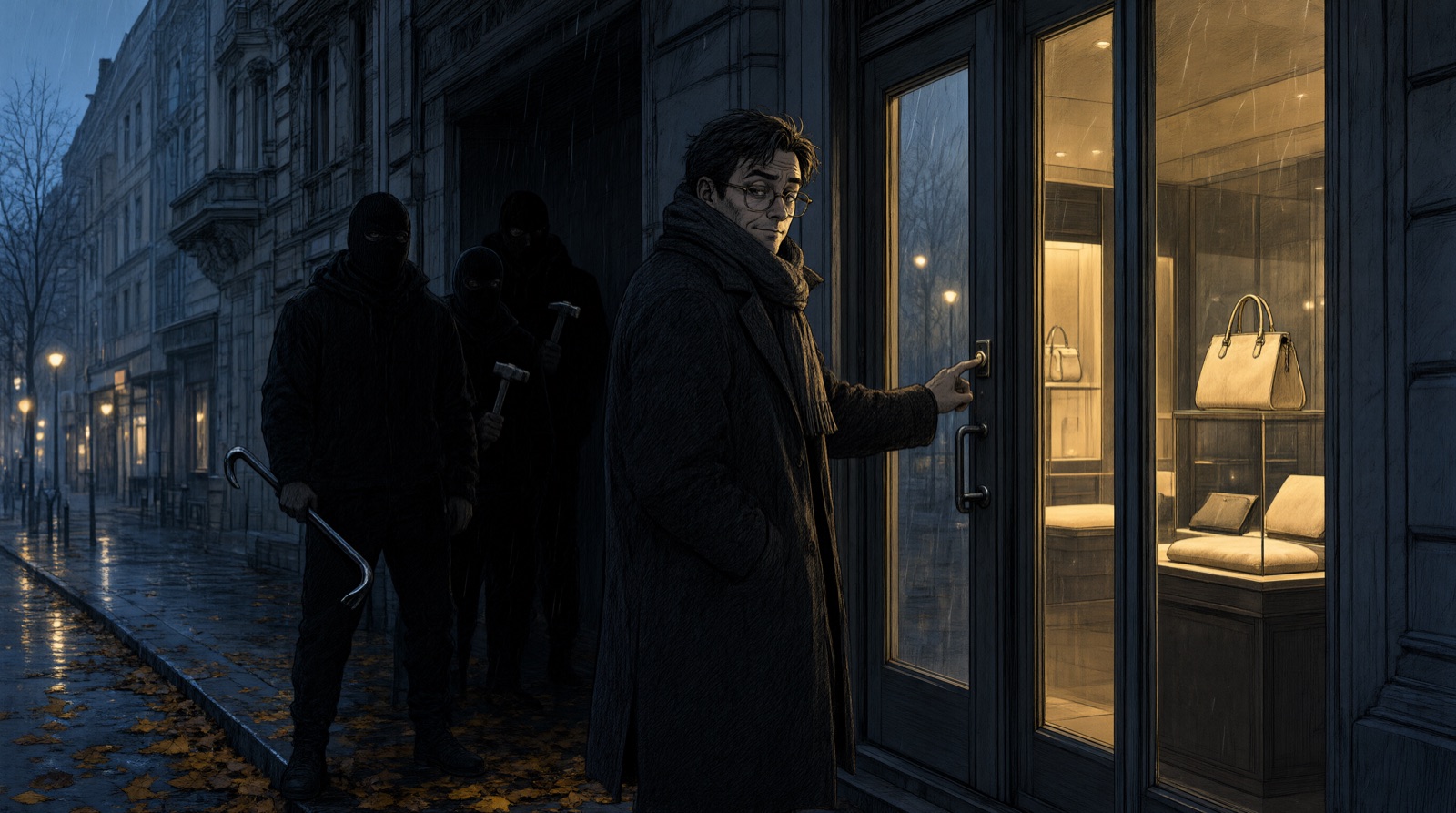
A man, middle-aged, dark wool coat, scarf up to his chin, glasses. “I’ve got something on reserve. Christmas present. I’m late, I know.”
She asked for the name. He said: “Krause. Two bags. The grey one with the chain link and the little suede one.” And then he pointed through the glass, to the back, at the second display case, as if it were nothing.
It was not nothing.
“The two of them have been at the back since Monday,” Mira said. “We changed the display round. The window has the new trapezoid bags, and none of it is even ticketed yet, because the distributor doesn’t release the price labels until Thursday.” She looked at Kalle. “Anyone who comes in to buy a Christmas present knows what’s in the window. They don’t know what’s hanging behind the second case. We know that. And the decorator. And the man who left in September.”
Leni wrote nothing down. Leni listened, and did the notes later, in the car, from memory, which Kalle had forbidden twice and failed to enforce three times.
“And then?”
“I unlocked. He said thanks. He took one step in – and held the door with his foot.” Mira showed it. Heel into the corner, knee locked. “And then there were three of them behind him. Masked. One with a hammer, one with a crowbar. The masks were cloth, neatly sewn, elastic, not out of a packet. The one with the hammer said: ‘Easy.’ Just that. One word.”
“Accent?”
“Berlin.” She thought about it. “No. Not Berlin. More like he’d got the word off the telly.”
Kalle looked at the floor, where a strip of tape marked the bit the forensics people were working on. “And the customer?”
“Stood in the doorway and did nothing. Didn’t even look away.” Mira turned the biro. “He wiped the handle. With his sleeve. Nice and slow, three times, like you’d wipe a knife.”
“While the others were already in?”
“Yes. Before he went out.”
Kalle nodded slowly, the way a man does when he’s done a sum in his head and doesn’t like the answer. “You said three behind him. How many altogether?”
“Four.” Mira looked up. “Three inside, one at the wheel outside. I only saw him through the glass.”
“Glasses?”
She looked at him as if he’d been through her handbag. “Yes. The driver had glasses. I thought it was odd, because the others were all masked and he wasn’t.”
Leni sat back. “The customer had glasses too.”
“He kept pushing them up,” Mira said. “The whole time. Like someone who takes them off to read and then forgets he’s still wearing them.”
The shop floor had been sealed off twelve minutes after the call, but the light was still on, so Kalle saw everything he needed in one go: the empty case, the glass, the hammer — a 300-gram joiner’s hammer from a DIY place, thrown away because it was too light. And two bin liners. Man who brings bin liners is planning on twelve bags, not three.
Above the till hung a camera. Kalle looked up, then looked at Leni, and Leni was already at the computer.
“Fourteen seconds,” she said later, with the file on the laptop. “That’s all it’s got. The camera hangs over the till and doesn’t see the door. It sees whoever comes in from the side, from the second step onwards.”
“And?”
Leni played it. A man in a dark coat, soft focus, the line of a shoulder, the arm of a pair of glasses catching the light from the case. Then, right at the edge of the frame, a sleeve moving three times over something that isn’t in shot.
Kalle watched it for a while. “He knows where the camera is.”
“And he wipes anyway.”
“Because he knows it doesn’t see the handle.” Kalle picked up the cup he’d brought in and hadn’t opened, and put it down again. “That man has worked in this shop. No customer knows the display plan and the blind spot.”
Outside, a tram went past that doesn’t stop here, because it doesn’t stop here. Mira said: “There’s something else.” She pulled the scarf off the back of her chair and showed him her neck. “Under his scarf there was a strap. Dark blue. With a white edge, like a card.”
“Like a staff badge.”
“I didn’t want to say anything, in case I’d imagined it. But I saw it. And then he pulled his collar up.”
Leni shut the laptop. “Then we’re not looking for a customer.”
Kalle went to the door, stopped, looked at the handle the forensics officer had already covered. “We’re looking for someone who used to belong here.”
Chapter 2: Series 41 118
At half eight the next morning Leni sat with two lists on her desk and laid them side by side, the way she did with everything.
On the left, Monday’s delivery note: twelve bags from the winter collection, 11:20, signed “S. Aydın”. On the right, the list of what was taken, which Kalle had pieced together the night before from Mira’s memory and the boxes in the stockroom. Twelve lines. The stock figures were kept in a notebook by Mira, because since August the system had been swallowing the numbers every other Friday. Paper has never had a server crash.
All twelve serial numbers sat in one block. 41 118 001 to 012. No gaps, no jump, not one summer model in between.
The distributor’s Ms Kaminski turned ten minutes into four. Result: series 41 118 was a single consignment, only to the Bleibtreustrasse branch. And because the numbers sat inside the leather under the flap, at the chain fitting, you couldn’t wipe them off like a sticker. You had to cut them out or grind them down — and after that the bag was worth nothing.
“Which means,” Leni said at ten in Kalle’s office, “if one of these bags turns up anywhere — a fence, a pawnbroker, an online marketplace — it leads us here. Not to the man. But here.”
“And if they grind the numbers off?”
“Then we’ve got twelve bags without numbers and a pile of broken glass.” Leni perched on the edge of the desk, which she only did when she was leaving something unsaid. “A buyer takes them with the box and the papers or not at all. That’s how it works with leather. Without the box the bag’s worth half. So the numbers stay on until it’s sold.”
Kalle looked out at a courtyard where a woman had been hanging washing for years that never dried. “Right. So we’ve got a clock. Now the personnel file.”
Three people had left in September. A student who went back to university. A colleague on parental leave who didn’t come back. And Yorck Wenzel, 34, deputy branch manager, dismissed on 12 September 2026, “in connection with inventory discrepancies”, as the line put it that a lawyer had written.
In the file was a copy of his own report from 28 August: 4,300 euros missing over four months, neatly listed, with a note in someone else’s hand in the margin — Lübbert, the area manager.
In the folder was a photo from the 2025 works outing: sixteen people outside a boathouse in Grünau, all wearing the same dark blue strap round the neck.
“The strap only comes with the card,” Leni said. “Card goes back when you leave, signed for. Signed for means someone ticked a box.”
Kalle looked at the photo. Third from the right, medium build, dark glasses, hand at his collar as if he were cold. “How old was he when he left? Thirty-four.”
“Thirty-four.”
At eleven Mira sat in the interview room with a plaster on her hand and a Coke she didn’t touch. Leni laid out five staff photos, same grey background. “He may not be in there. If he isn’t, just say so.”
Mira went through them like a woman checking an invoice. She stopped at the fourth.
“Him.”
“Sure?”
“He pushed his glasses up the same way. With his middle finger.” She looked up. “And he talked like someone who works here. Not like a customer. When he said where the bags hang, he didn’t point like someone looking for something. He just indicated. That way. That’s how you talk about your own shop.”
Leni turned the photo over. On the back: Wenzel, Yorck, left 12.09.
Kalle leaned back. “Mrs Bohnenkamp, a question that’s got nothing to do with the photo. How would you get at the reservation book?”
“It’s in the left-hand drawer. Anyone who’s ever stood behind that counter knows that.”
“Thank you.”
When she’d gone, Leni said: “I took the book with me last night. There’s no reservation for Krause. Not this week, not last. He made the name up and banked on her not checking, because it’s five past five and he’s got a foot in the door.”
“And the door opens because the light’s on.”
“Because the light’s on.”
Kalle drank the coffee that had gone cold, finished it anyway, and put the cup down with a care that boded ill. “So he didn’t just know the shop. He knew which day, which colleague, which hour. That’s not luck, Leni. That’s a calendar.”
Chapter 3: Six Masks, One Pair of Glasses
At a quarter past three they stood in a courtyard on Schillerstrasse, between two bins and a bicycle that hadn’t had a saddle since 2019, watching a sewing machine run behind a window papered over with newsprint.
“She’s still at it,” Kalle said.
“She’s always at it.”
Benny Schröder was twenty-two and looked like a man who’d been brought up by his mother with an iron. He’d opened the door because he’d recognised Kalle on the entryphone, and now stood with both hands in the pockets of a denim jacket that was too thin for 18 November.
“I ain’t done nothing.”
“You opened the door. That’s more than most manage.” Kalle leaned on the frame, comfortable, which in his case meant he wasn’t leaving. “We’re talking about September.”
“September what?”
Kalle’s eyes went to the table without him turning his head, and he spun a spiral notebook round with one finger, lying open beside the machine. Date, quantity, amount. No names.
“14.9., six pieces, 1,100,” he read. “What do you sew in six pieces, Benny?”
“Patches. For the dry cleaners.”
“Six patches for eleven hundred. That’s a dear patch.” Kalle pushed it back. “The masks yesterday were cloth. Neatly sewn, elastic, not out of a packet. I know exactly one man in Charlottenburg who does that, and I asked him about it two years ago.”
Benny looked at the floor. “That’s a book for repairs.”
“Then explain the six.”
Kalle let him stand there a bit, the way you let tea brew. Then: “I’ve no interest in doing you for sewing masks. Sewing masks isn’t actually illegal. Assisting an investigation, that’s got six months to five years on it, and that’s a lot of time for a lad of twenty-two who’s never been inside.”
The needle went into the cloth, the machine clattered once and stopped.
“He ordered six,” Benny said at last. “Six, because they go four-handed and wanted two spare. That’s what he said. Like a tradesman. ‘Two spare.’”
“And?”
“And a wider eye slit. More room left and right.” He looked up. “He said he wears glasses. Can’t see through a narrow slit, needs the room for the arms. I said I could sew the masks onto the glasses, but then he’d never get them off if it went up. He laughed at that.”
“How did he talk?”
“Normal.” Benny thought about it. “Like an office bloke. He said ‘stocktake’ when we went through the sizes. ‘Like a stocktake.’ I didn’t even know what he meant.”
Leni looked at Kalle, and Kalle looked back, and that was the moment they both knew they’d stopped looking for the man.
“Where’s the gear?” Leni asked.
Benny said nothing. Kalle said: “Benny. You’ve already told me what you did in September. That’s in. Everything you do from here is a question of remorse, and remorse looks a lot better on paper than silence.”
“He’s coming tonight.” Benny sat down after all. “Half nine. Picks up his cut, I take the numbers off, Friday it goes to Frankfurt.”
Leni wrote it down as if she’d expected it. “The numbers are still on?”
“Course they are. Where else would they be. The bags are in the garage in the bin, with blankets in it, and the boxes are next to it. I’m not wrecking the boxes, the buyer said you get thirty per cent more with the box.”
“The buyer.”
“She calls herself ‘madam’. I’ve never seen her.”
Kalle took his glasses off the table, polished them on his sleeve and put them back on, which he did when he wanted to look at someone without showing it. “And when we’re standing in your garage tonight, Benny, what are you doing?”
Benny looked at the door. Then at his hands. “Nothing.”
“Good.”
Chapter 4: Grey-Green, Silver, B-CW 4419
Mrs Klemm lived on the ground floor of Sybelstrasse 14 and had been peeling potatoes at five past five on Tuesday, because you can watch the street while peeling potatoes without it looking like anything.
“I’m seventy-one,” she said. “I have to do something.”
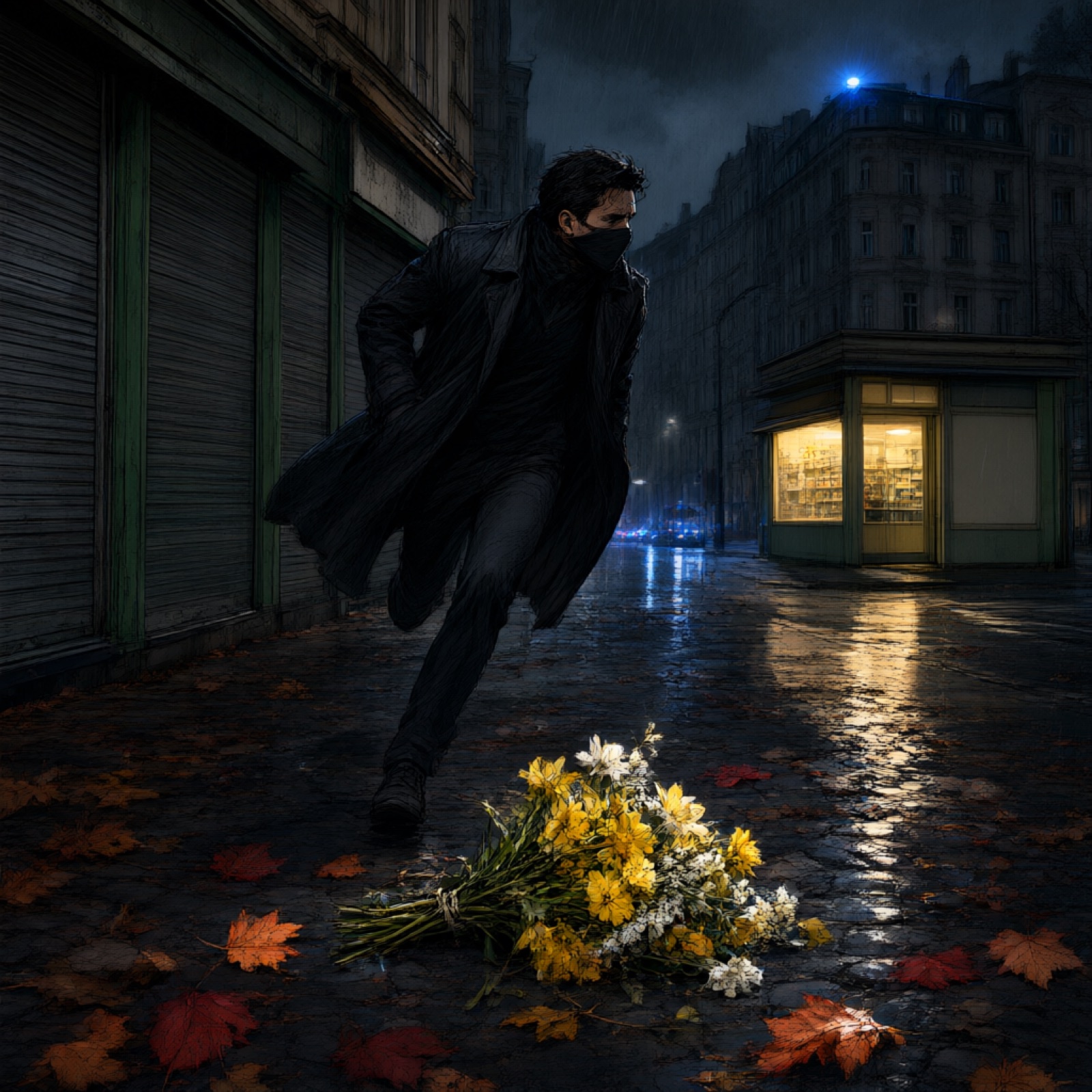
She’d seen three men running, all masked, out of the passage behind 62. She pushed her reading glasses up, exactly as Wenzel had, which briefly put Kalle off his stride. “Then they got into an estate car, and then a fourth came, no mask, with glasses, and got in the driver’s side.”
“Colour?”
“Grey-green. A funny grey-green, like an army coat.”
Kalle didn’t, but nodded, because he knew how to talk to a witness.
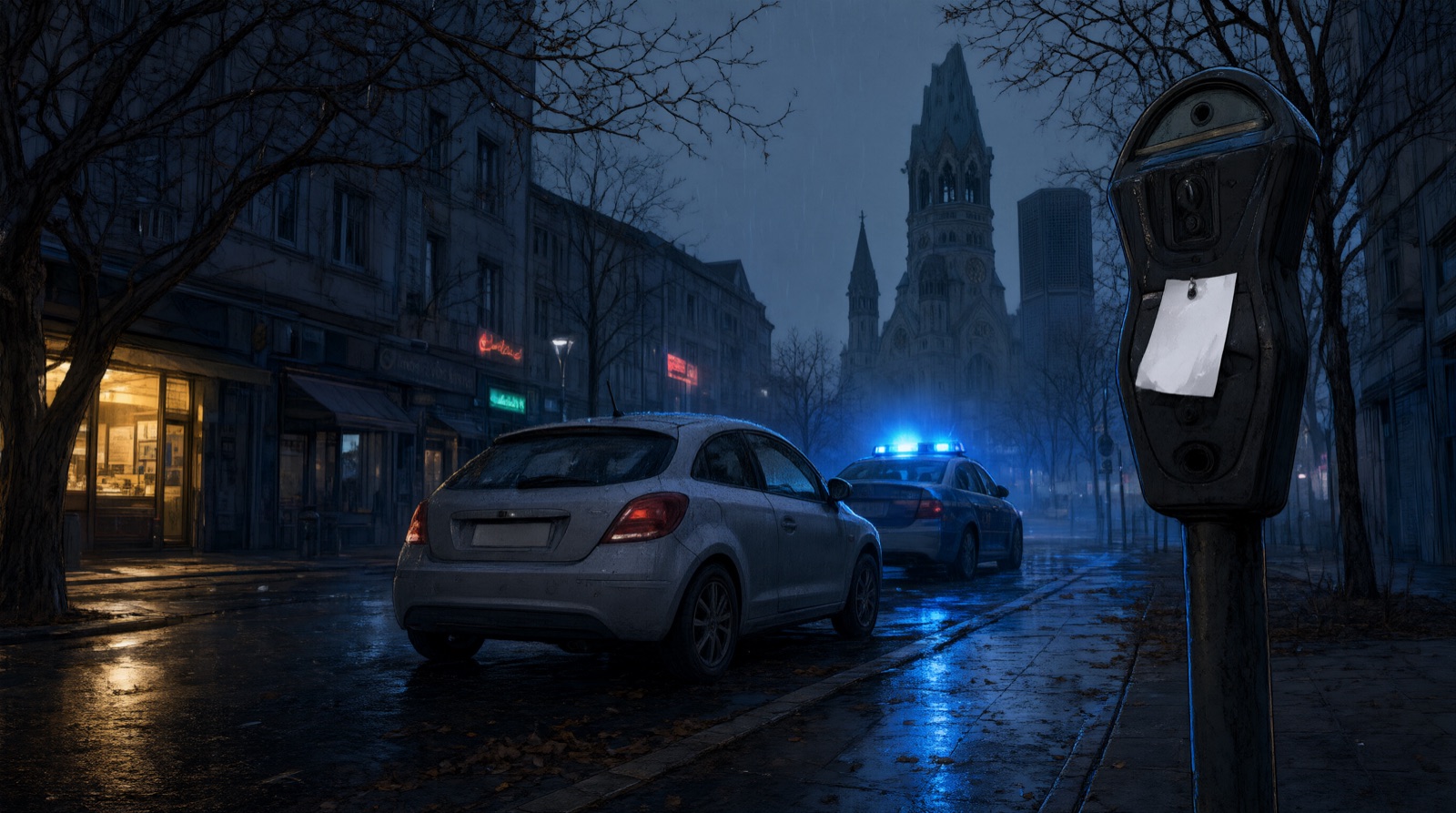
At five Leni collected the tape from the jeweller on the corner. 17:06, an estate car, silver, a scratch on the rear wing like a paperclip. Plate: B-CW 4419.
“Grey-green,” Kalle said.
“She’s got the order right, the number, the time. Everyone has an off day with colour.” Leni looked at her phone. “Hire car, booked on the 13th on a Danish licence that expired two years ago. We won’t get anywhere through the car. Don’t need to. We’ve got the man.”
Kalle looked down Bleibtreustrasse, where twenty people were walking home with shopping bags, and thought about the camera image. Fourteen seconds. A sleeve moving three times over a door handle.
“He’s one of those,” he said.
“One of what?”
“Wipes the handle and forgets his own glasses.” Kalle grinned without any joy in it. “He was the deputy. He stood there every day. Opened up, locked up, checked the camera, got himself a coffee and laughed at the customer who asks the price. Then in September they chucked him out, and he still thinks the shop belongs to him.”
Leni looked at him. “How do you know that’s what he thinks?”
“Because he came back,” Kalle said. “With a story. He helped himself and told himself the story he’s been telling himself the whole time: that he’s just a customer.”
Chapter 5: The Handover
At half eight they stood in the dark courtyard on Schillerstrasse. Two colleagues at the yard wall, two in the stairwell, one in a car at the corner. Benny had opened the garage and left the door ajar. Leni checked her watch.
“He’s always on time,” Benny had said. “He’s not coming at twenty-five to. He comes at half nine.”
He came at 21:33.
He walked through the yard without looking, without hesitating, like a man who’d walked that way a hundred times. Wool coat, scarf, glasses. In his rucksack, it later turned out, was a cloth for wiping handles — a man who brings a rag.
And in his coat pocket, a notebook. Thin, black, with an elastic band, the kind bookkeepers use.
Kalle stepped out of the shadow when Wenzel was three metres from the garage and said: “Yorck.” Just the first name. He’d learned that people stop for that.
Wenzel stopped. His right hand went to his pocket, then stayed at his belt.
“Criminal police. Rieger. This is my colleague Weber.” Kalle showed the warrant card without showing it for long. “We’d like a look at what’s in there.”
Wenzel glanced at the garage door, ajar. Then back. “I’ve got a key off the landlord.”
“The landlord hasn’t given us his name yet,” Leni said, “so do try that again.”
He said nothing more until they were inside and had taken the blankets off the bin. Twelve bags. Grey, black, one in suede, all with boxes, all with the little booklets and the fleece bags the straps come in. Leni switched on her torch and felt along the seam at the chain fitting, turned the bag until the spot under the flap came up.
41 118 004.
She breathed out. She didn’t say another word that evening.
Kalle took the black notebook out of the coat while two officers walked Wenzel to the car, and Leni read over his shoulder.
Six lines. Six shops, all in Charlottenburg, each with a time and a weekday beside it. A boutique on Stuttgarter Platz, Friday, 17:00. One on Knesebeckstrasse, Tuesday, 18:30. A leather goods shop on Pestalozzistrasse, Monday, 17:15. Under each line, in pencil: “1”, “2”, “1”.
“That’s not a shopping list,” Leni said.
“No,” Kalle said. “That’s a rota.”
In the interview room Wenzel said nothing for twenty minutes. Then he asked whether he could smoke. Kalle said you haven’t been able to smoke in here since 2005, and Wenzel nodded as if he’d known.
“You knew the shop,” Leni said. “We have your staff photo. Mrs Bohnenkamp picked it out without me saying a name. Benny’s mask has a wider eye slit because you wear glasses. And the camera above the till saw your sleeve run three times over that handle for fourteen seconds — the handle itself it doesn’t see.”
Wenzel looked at the table, hands folded like a man arriving at an exam. “The flat’s gone. The notice is in. My mother needs a hundred and fifty a month, that I can carry. But in December I have to pay back eighteen thousand.”
“To whom?”
“To someone who doesn’t like people being late in December.” Nothing more came.
“And the discrepancies?” Leni asked. “In August you reported that stock was going missing at the branch. Four thousand three hundred in four months. You reported that, didn’t you?”
The corner of Wenzel’s mouth moved. “I reported it. And then the area manager said two of them were returns with discount, and the rest was me.”
“Because you’d bought two bags at staff discount.”
“Because I’d bought two bags at staff discount. We all do it in November, when the Christmas stock’s in and the discount counts for Christmas.” He looked up. “And because the man who had the discrepancies forwarded my report upstairs. With his handwriting in the margin.”
Leni wrote it down. She held the pen still and said, without looking up: “That report was the only reason it didn’t get bigger in September. You wrote your own dismissal, Mr Wenzel. And then you went back and helped yourself.”
He looked at her a second longer than you look at someone who’s right. “I didn’t take anything that wasn’t owed to me.”
“You took twelve bags that weren’t yours and brought three men with a hammer into a shop where a woman was on her own.”
He didn’t answer. Outside, in the waiting area, Benny Schröder sat on a bench twisting a thread between his fingers. He’d get a penalty order for what he’d done and a note on file for what he’d said. Kalle had fixed it that way, because he knew the next case would come through Benny’s sewing machine sooner or later.
At half eleven they stood in the street. It was quiet for Charlottenburg, the bakery trays were under cloths for the morning, and from the Ku’damm came two mopeds riding as if they’d bought the road.
Leni turned her collar up. “The six shops. We need to ring them all.”
“Tomorrow.”
“Today. If one of them opens at half six.”
Kalle looked at his phone, which had two messages, one from Brandt and one from a betting firm. “I’ll take the Charlottenburg side, you take Wilmersdorf.”
“It’s all Charlottenburg.”
“Then I’ll take the side with the cars on it.”
Leni looked at him. “So that’s your plan.”
“My plan is you ring them at seven and I write up the report for Brandt in the meantime. If she asks who found the serial numbers, I’ll say.”
Leni put her hands in her coat pockets. “Just say it when she asks. You don’t have to rehearse it.”
Kalle walked to the car and took the key out of his jacket as late as he could, because he’d once watched someone go over on a wet leaf and had decided it wouldn’t be him. Bleibtreustrasse was six minutes away. The light in the boutique was off.
“Good job today,” he said, getting in.
“I know,” Leni said.
Note: All characters, places and events in this story are fictional. It was inspired by a public police report but does not depict real events, persons or circumstances. More: Legal notice.