The Man Who Didn't Want to Be Rescued
Chapter 1: Two Knives and No Passenger
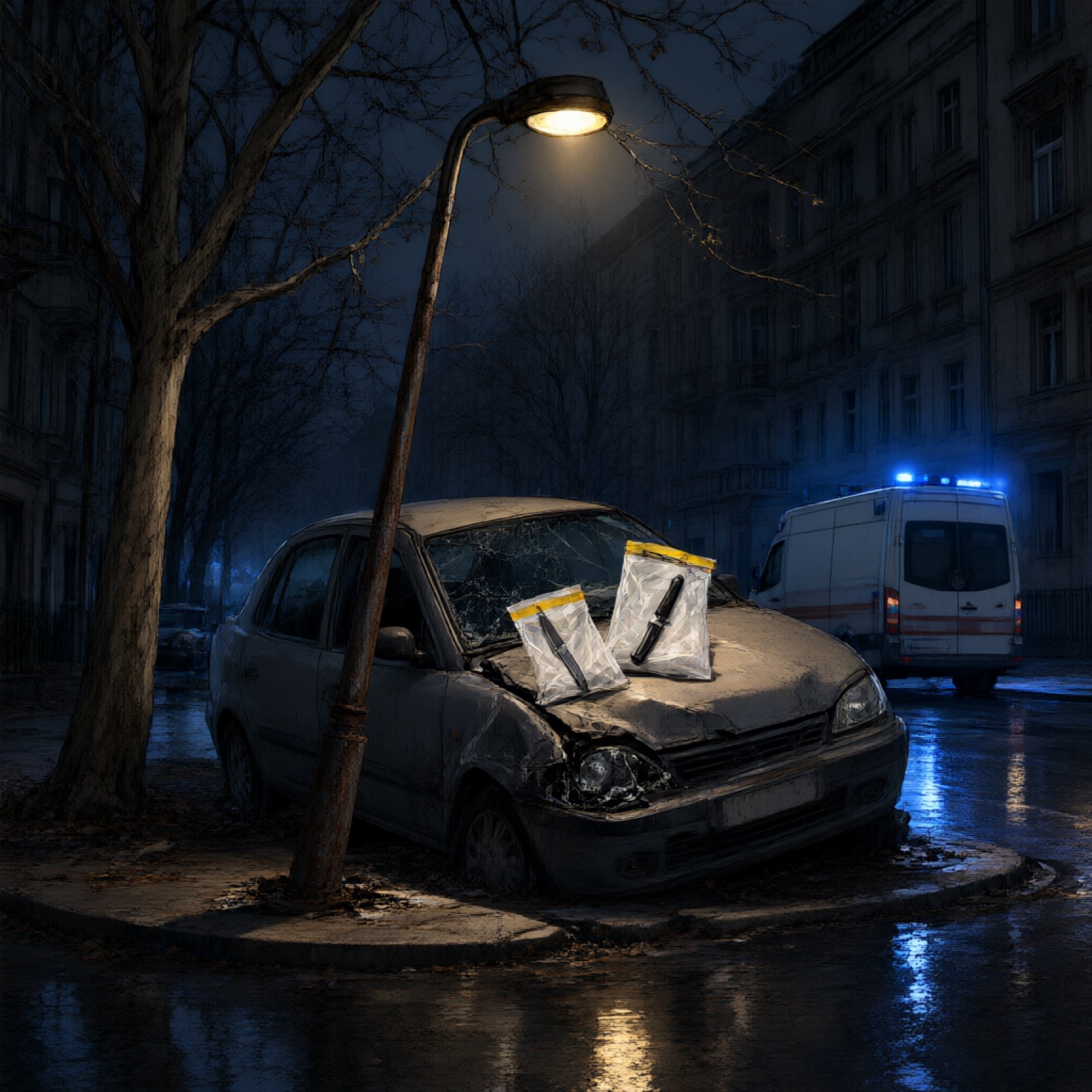
The lamp post on the traffic island on Reichsstraße carried the number M 114 and a council sign somebody had overwritten in marker: Post dead. The post was standing. The Fiat Tipo in front of it was not.
Kalle walked round the car once. Quarter past four, two degrees, drizzle like sand in the face. The Tipo was grey, a dent in the rear wing. The airbag hadn’t gone off, the windscreen was cracked from the passenger side.
“Now that were a car once,” Kalle said, and tapped the roof. It sounded hollow.
Two evidence bags lay on the bonnet. Two kitchen knives, twenty-centimetre blades, one with a brown scorch mark on the handle. Both from the boot, which was still open.
“The paramedics say he stood in front of them like a keeper,” Kalle said. “Three crews. Six people. They locked themselves in their vans, the way you lock yourself in when there’s a bloke outside with two knives.”
Leni knelt at the passenger seat, torch laid flat so the light went into the fibres. The cover was grey, with a seam somebody had stitched again with twine. Something dark sat in the seam.
“Blood,” she said. “Not much. But the amount that comes out of a head nobody’s pressing on. Two hours old, crumbly at the edge. And not his. He had a scratched forehead, that’s all.”
“Half two, into the post,” Kalle said. “Two thirty-four the paramedic starts treating him. And gets a fist in the head for it.”
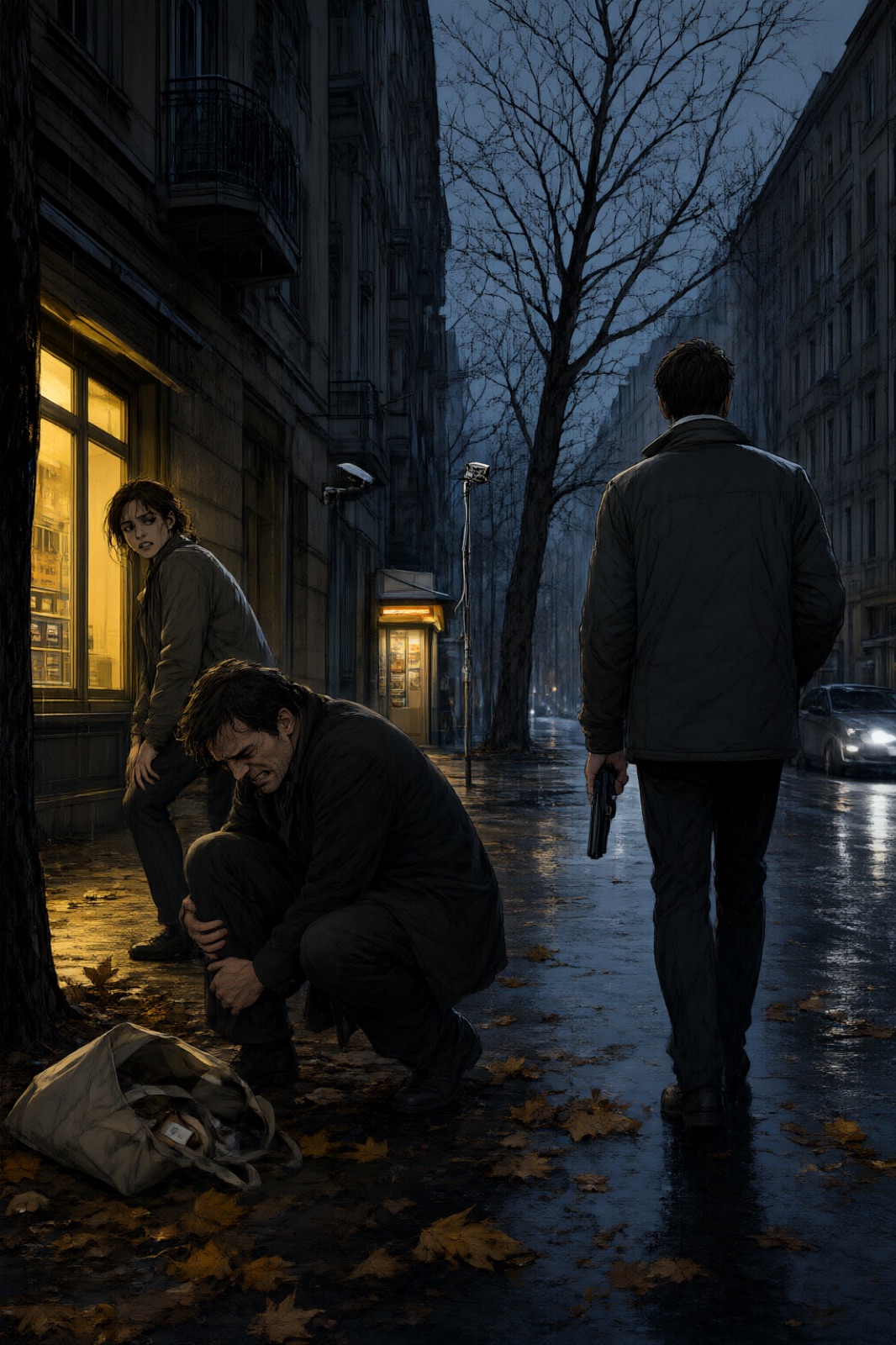
“Not for him.” Leni stood up. “According to Constable Jensen he didn’t go to the driver’s window. He went round to the passenger side and reached for the woman. That’s when the driver hit him.”
The paramedic was Henning Pahl, forty-seven, fourteen years on the ambulance. Concussion, kept in. His colleague, twenty-one, gave her statement in the vehicle.
“Maik Trettin,” Kalle read off the printout. “Thirty-five. Assault 2019, driving without a licence 2023. Licence: none. Car registered to a firm in Spandau, Kroll Drylining.”
Leni went through the glovebox and the door pocket. “The passenger, according to the report, is a woman of forty. She ran into the yard with him. That’s where the report stops.” She pulled something out of the door pocket. “Same as this.”
It was a beer mat, edges soft with age, stamped: Zur letzten Hand · Preußenallee 14 · since 1987. On the back: four columns of strokes in fives, sums in biro.
“Sixty, sixty, forty.”
“Who plays cards and keeps score in biro?”
“Someone who doesn’t want to be diddled and counted at the same time.”
By ten to five Leni had been through four hospitals. Between half two and five, no A&E in Westend, Charlottenburg or Moabit had treated a forty-year-old woman with a head wound.
Opposite was a late-night shop. Kalle bought three cups, the third for Leni, who didn’t want one.
“Car came in fast,” said Emre Tuna, eleven years in the shop. “Half two, two minutes before. And then bang. Drunks, I thought.”
Leni put her coffee on the colleague’s car without drinking it. “He drives down Reichsstraße at half two with a bleeding woman beside him. Two minutes later he’s into a post. Then he attacks the paramedics who want to touch her. Then he legs it into a yard with her. And the woman is gone.”
“She ain’t gone,” Kalle said. “She’s just somewhere we ain’t looked.”
Chapter 2: A Tally on a Beer Mat
Kroll Drylining was a shed with two gates, plasterboard on pallets out front. Inside it smelled of plaster and cold cigarette smoke. Detlef Kroll, fifty-four, stood between stacks of profile.
“The car’s a write-off,” he said.
“The car’s not the problem just now. The key is the problem. You’re the registered keeper, you know who drives.”
“Without a licence. I know. I took him on because he can work. The last one with papers tipped over a stack of plasterboard.”
“You’re describing a case of your own there.”
“I’m describing how it works here.” Kroll threw the cigarette he hadn’t lit into the bin. “Friday I gave him the key, for the run to Spandau. Saturday morning he should’ve been back. He wasn’t. He said he had to look in on a friend first.”
“Which friend?”
“The Nadine. She sits in the card school in the back yard, Preußenallee, at Bode’s.” He looked into his cup. “We’ve been building on Platanenallee since September. The crew sits at Bode’s after work. Not because it’s good. Because it’s near.”
“You knew he had no licence and you let him drive. That’s the one case. The other is a woman who sat bleeding in a car two hours later, and you called her an insurance problem on the phone.”
“I called the car that.”
“Exactly.”
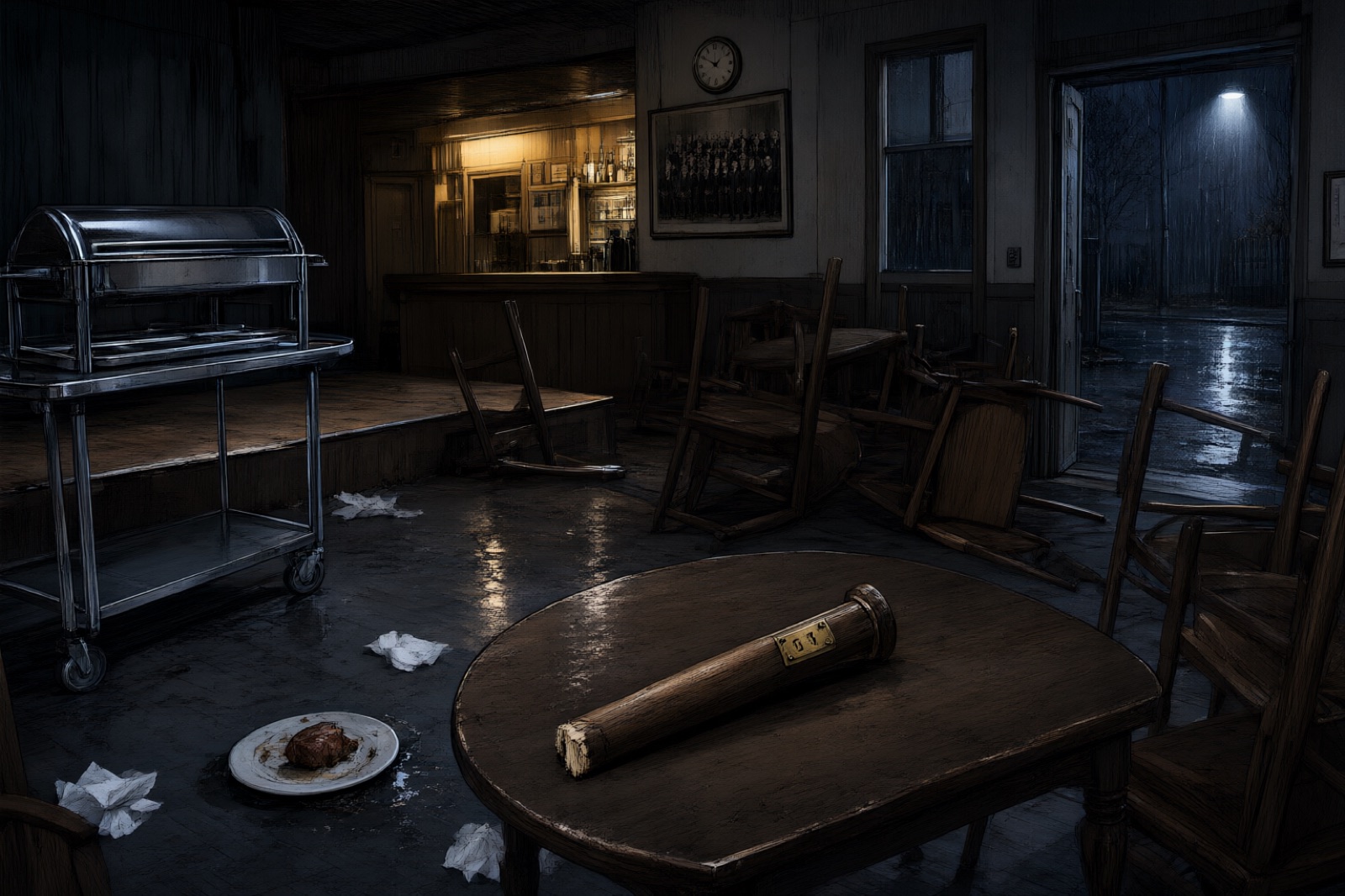
The “Letzte Hand” was a pub of the kind Westend still has a few of: sliding door, leaded panes, a sign with a hand holding three cards. In the yard stood Kurt Bode with a broom.
Sixty-one, cardigan under his coat, moustache, apron with beer stains, broom in hand.
“You play cards here.”
“I’m the landlord, I don’t play. I pour and I watch.”
“Last night, half one?”
“Table started half nine, packed up just after one. Same as always.” He swept a pebble two hand-widths further. “Nothing happened.”
“Then explain this to me.” Leni knelt behind the beer crates. Between crate and wall lay a bottle neck. Label half torn off, dried blood at the broken edge, dark brown.
Bode stopped sweeping for a second. “It’s a pub. Bottles fall.”
“Who was here last night?”
“Long Heiko. Uwe Kranz. Maik. Nadine, she keeps the tally. And me.” He turned the broom in his hand. “We don’t play for money. We offset. Uwe was in a mood because she said he was playing wrong. Then he went out for a cigarette.”
“Uwe owes her sixty euros,” Leni said, without looking up. “The mat says sixty, sixty, forty. Offsetting.”
“He says she counts wrong.”
“And how did she count,” Kalle said, “when she wiped her face? You’re missing two knives from the kitchen. One with a scorch mark on the handle.”
Bode swept again. “Knives go missing in a pub the whole time. I didn’t search, I looked.”
Above the yard door hung a small black camera dome, cable tied to the drainpipe. “And that?”
“Broken since September. Recorder behind it too. I can’t be doing with the argument from the back room. If they know they’re on film, they drink less.”
“Sundays, what time do they come?”
“Six. Same lot, every week, no exception. Tonight as well. Continuity.” He swept a pebble into the bed and missed.
Kalle turned the heating up in the car. “The landlord told us three things. Two were rubbish: that the table broke up just after one, that no knives are missing, and that his camera’s broken.”
Leni looked out of the window. “That’s three.”
“Exactly.”
Chapter 3: The Drying Room in the Cellar
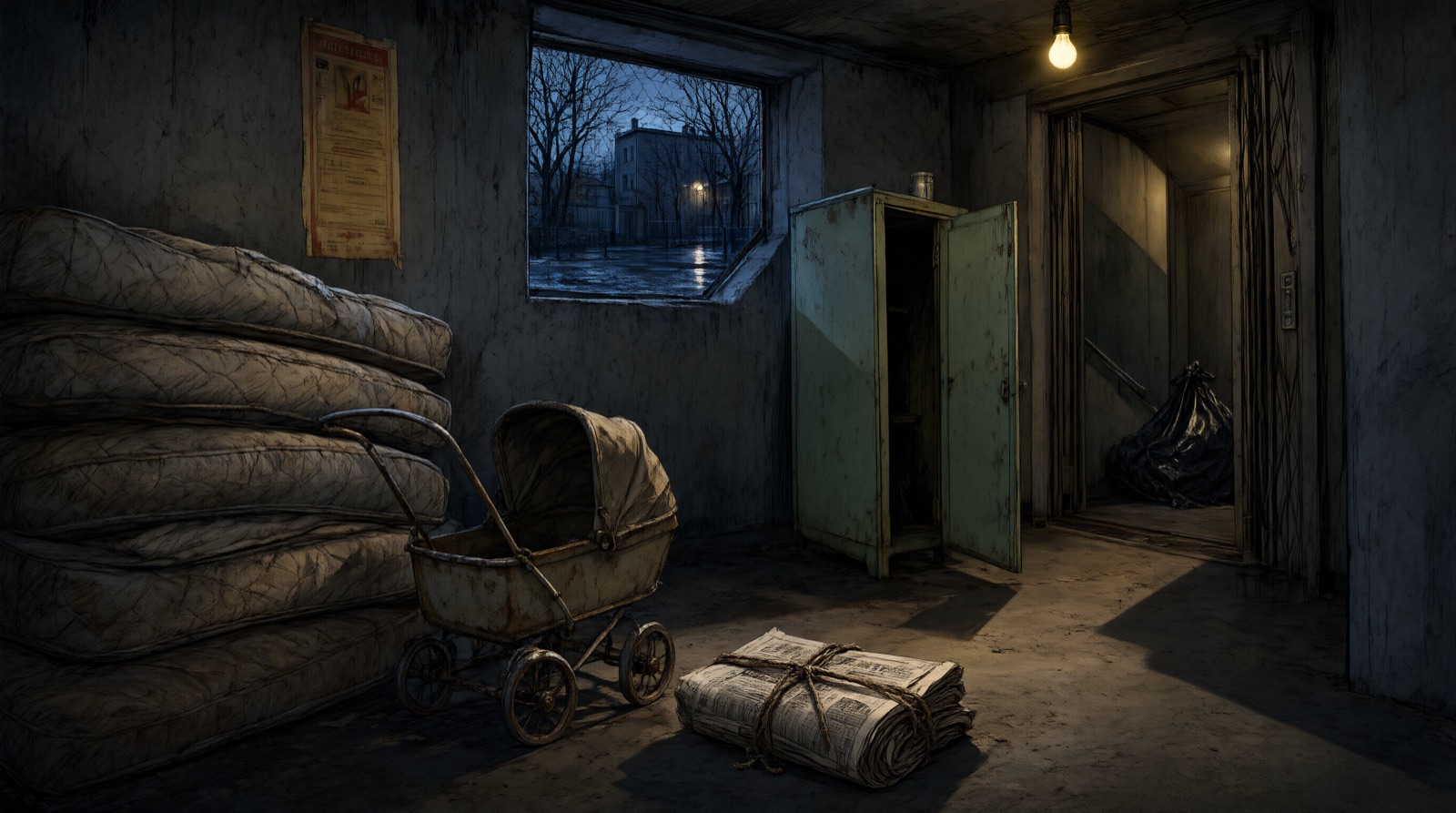
Preußenallee 14 was built in 1898, according to a brass plate in the hall. The stairwell had stucco like a wedding cake and a smell that has stayed the same for a hundred and twenty years: coal, wet washing, onions.
Zbigniew Kujawa was fifty-eight, grey overall, key ring on his belt, and spoke with the calm of a man who has seen everything here and comments on none of it.
“Yes, yes. Blood up there, on the landing. I said I’m not wiping it, because the police are coming. Proszę, here.”
The first drops lay between the second and third steps, a finger-width apart. Then on the stair, then on the tiles, along the wall, to the cellar door.
“The cellar door’s never locked. Hasn’t been for years. The cylinder’s gone, the owner won’t pay, I tell him three times a year, nobody listens.”
Leni knelt at the door. “Someone who’s bleeding and goes downstairs isn’t going home. They’re going somewhere they know, where they think nobody will look.” She looked up. “A woman, forty, leather jacket. Have you seen her?”
Kujawa thought about it, key ring in both hands, then went down the stairs as fast as a man can go who doesn’t dare run.
The drying room was a cellar bay with two radiators and lines on rollers. She lay between the radiators. The leather jacket was black with blood at the shoulder, and she had folded her sleeve and pressed it to the wound.
Leni pushed the jacket aside. “Don’t move. I’m police. You’re found.”
“Don’t talk,” Leni said. “I’ll talk. You weren’t in any hospital. So you didn’t get anywhere. So you’re here. Took me a minute to be embarrassed about it.”
Kujawa stood in the doorway, phone to his ear, giving the control room the address. The key was in his pocket now.
At ten past ten the ambulance came. The paramedic put in a line, her colleague called out numbers: “Thirty-seven, nineteen, fifty. Fair.” The woman was Nadine Sobotta, forty, a one-room flat near the station. She had her phone and fifteen euros.
In Klinikum Westend, room 4, she had eight staples in her head and half a litre of blood too few. She was sitting up, which the doctors didn’t like.
“She said I shouldn’t say anything,” she began. “But you found me in the cellar, so I can talk now, can’t I.”
“Uwe. With the bottle. He didn’t swing. He hit me like he was clearing a table. I lay there three seconds and thought my ear had come off.”
“Why no emergency call?”
Nadine looked at her hands. “First, Uwe’s got friends. He knows everyone who plays cards. Second, I’m nine hundred euros down, and I didn’t want to arrive at the law in an ambulance.”
“You lay in that cellar. You could have died there and nobody would have noticed.”
“Maik wanted to drive me. Klinikum Westend, he said, he knows the way from his mother’s. I said no police. He said, you don’t either. Then he drove into the post because he says he saw a cat.”
“You knew he had no licence?”
“I knew he hadn’t. And that the car’s Kroll’s. Everyone knows. Nobody minded, because he drives like a pensioner with full beam on.”
Leni wrote it down. “And the Fiat was parked where before?”
“Outside the Hand. Back yard.” Nadine looked at the door. “Uwe’s back Sunday. Six o’clock, same as always.”
“Mrs Sobotta, I need a name for the interview.”
She said it out loud in that room for the first time: Uwe Kranz. Then: “When you pick him up, tell him I didn’t break anything. I only did the sums.”
Chapter 4: What Was in the Boot
Uwe Kranz lived at Zikadenweg 6, fourth floor, a racing bike in the hall. The flat smelled of cigarettes and cheap glass. Fifty-two, grey tracksuit top, a loose gold ring.
“What’s this about?”
“A bottle,” Kalle said. “And a woman.”
Kranz let them into the hall, the only clever move he made all day.
“I was home by one. My wife can tell you. We watched sport, with the sound off. Half one I was in bed.”
“So you didn’t play.”
“I played. Sundays, six o’clock, same as every week. Not with Nadine. She counts wrong. She says sixty, I say sixty was right, thank you, and then she kicks up.”
“You were in the yard.”
“I was outside, yeah. Cigarette. But there was nothing, Nadine was inside, and Maik drove her off, that’s their business.” He looked past Kalle at a photo on the wall, a man with a fish. “I didn’t drag him into it. I went home.”
On the way to the door Kalle said: “Maik’s sitting in a cell. The landlord’s not, but he sits like a man who’s seen something he hadn’t planned for.”
Outside, with the bike between them, Kalle said: “He didn’t look me in the eye.”
“He looked at your chin,” Leni said.
At half three Maik Trettin sat in interview room 214, hoodie, forehead scratched, hands on the table. He’d said nothing for two hours.
Kalle put the file down, opened it, closed it. “Nadine Sobotta is in Klinikum Westend, room four. Eight staples, half a litre of blood short. She’s talking.”
Trettin lifted his head. You heard it before you saw it: a man taking a breath he doesn’t need.
“Uwe hit her.”
“She says so too.”
“He didn’t even swing properly, he just—” a movement with the back of the hand, short, downwards. “I put her in the car. I wanted to get to A&E. I know the way, my mother lives behind it.”
“And the police?”
“Didn’t want them. I’ve no licence, the car’s Kroll’s, and I’d been drinking. That’s the job and everything else gone.” He looked at his hands. “I said we’d sort it without. I drove round for over an hour. Twice past the hospital, and both times I pictured a bloke at the gate asking for my licence. Third time I didn’t go up to it, I just put my foot down and wanted gone. And then the post was there.”
“And the knives in the boot?”
Trettin answered fast.
“From Bode’s kitchen. After he hit her I went back in, through the back door. And then I took the two.”
“Why?”
“For Uwe.” He didn’t look up. “I wanted to go back. If a man waves a bottle, he’s got nothing to laugh at with knives.”
“You wanted to stab him.”
“I wanted him to stop.” The voice had lost its footing. “I’ve been playing cards round that man for two years like he was a bin in winter. Ask Nadine if I’ve ever hurt anyone.”
Kalle turned a page. “And the paramedic? Forty-seven, reached for the woman because she was bleeding.”
Trettin looked at the table. The hand with the backhand lay still.
“I didn’t see him,” he said. “I saw the jacket. And then: police, questions, licence, no job. It took two seconds. And then the man was on the floor.”
Kalle closed the file. “I believe you. It doesn’t make it better.”
Chapter 5: Sunday Table, Six O’Clock
At twenty to five Leni stood in the half-metre of office behind Bode’s counter: a cup without a handle, a monitor, a recorder under Saturday’s paper.
“You said the camera was broken.”
“It is broken.” Bode stood beside her, hands in his apron pockets. “It records. But I see nothing. It goes to a telly with one channel, and that channel’s broken too.”
Leni moved the paper. The recorder was running. On the small screen, black and white: the yard, the crates, the back-room door, a man in an open jacket, a woman in a wool hat. The time stamp sat bottom right, green: 00:49.
“You see that,” Leni said, because Leni didn’t ask about things like that.
They saw it. The man took the woman by the sleeve. She pulled away. He had a bottle and he didn’t swing, not really, it was that movement with the back of the hand, short, downwards. The woman went down. Then Trettin came into frame, took her under the arm, and they ran out of shot.
Bode looked away.
“I didn’t want him sitting in my back room,” he said. “Uwe’s been coming eleven years. He drinks well, he pays well, he gets loud when he loses. If I throw him out, he comes back with a bottle.”
“You told the police the camera was broken.”
“The police,” Bode said. “They’re not here. They’re outside.”
Leni took the memory card without asking. “He’s nicked now.” At the door she stopped. “And your camera’s sharp. It points at the gate. Move it.”
At twenty to six Brandt had read the file and watched the video. Fifty-five, glasses, stacks on the desk.
“Three ambulances,” she said. “Six people. A twenty-one-year-old woman getting into a van and holding the door shut from inside.”
“Constable Jensen. She complained she couldn’t get the passenger door shut faster.”
Brandt looked at him over her glasses. “That’s not funny.”
“I didn’t think it was.”
“Uwe Kranz, fifty-two, card table.” Kalle put the memory card on the desk. “Assault, motive, video, victim.”
Brandt looked at the clock. Twenty to six. Kalle looked too, and she saw that he’d looked. “He’ll be there at six. That’s not a temptation, that’s an appointment.”
“I never said anything.”
“You looked at the clock on my wall like it had given you something.”
The Sunday table had started at six on the dot, as it had for years. Six men, worn felt, four beers. They played as if it were work.
When Kalle and Leni came in, Kranz sat at the head and held his cards so only the backs showed.
“Let him finish the hand,” Kalle said to the others. “I’ve got time.” He pulled a chair from the wall and sat down without taking his coat off, which is the kind of announcement that works better than a paragraph.
Kranz played slowly. Ten minutes. Then he laid his last card.
“Uwe Kranz. You’re under arrest. Grievous bodily harm to Nadine Sobotta, in the night to Sunday, at 00:49, in the yard of this pub. The bottle is in the evidence store, the video is on my laptop, and the woman is in Klinikum Westend with eight staples in her head.”
At the table one of them said: “Uwe?” And nobody answered, because they all knew each other’s hands.
Kranz stood up. “Over a bottle and sixty euros? She counted like the tax office.”
“She counted like someone who wanted her money,” Kalle said.
On Monday the post would get a new number and the Fiat would be scrapped. On Sunday evening Nadine Sobotta sat up in bed, and Henning Pahl lay two rooms away with the first pain that felt like healing.
Kalle drank Emre’s coffee outside the hospital, cold since five to five. “Still better than the machine at the Yard.”
“That’s not a standard.”
“You say that because you’ve never had to drink the machine at the Yard.”
Leni put the cup down, the one she had touched after all these years. Outside it was still raining, and under the hospital light Reichsstraße looked like a street in a film where the lights come on.
Note: All characters, places and events in this story are fictional. It was inspired by a public police report but does not depict real events, persons or circumstances. More: Legal notice.