The Shovel Jeweller
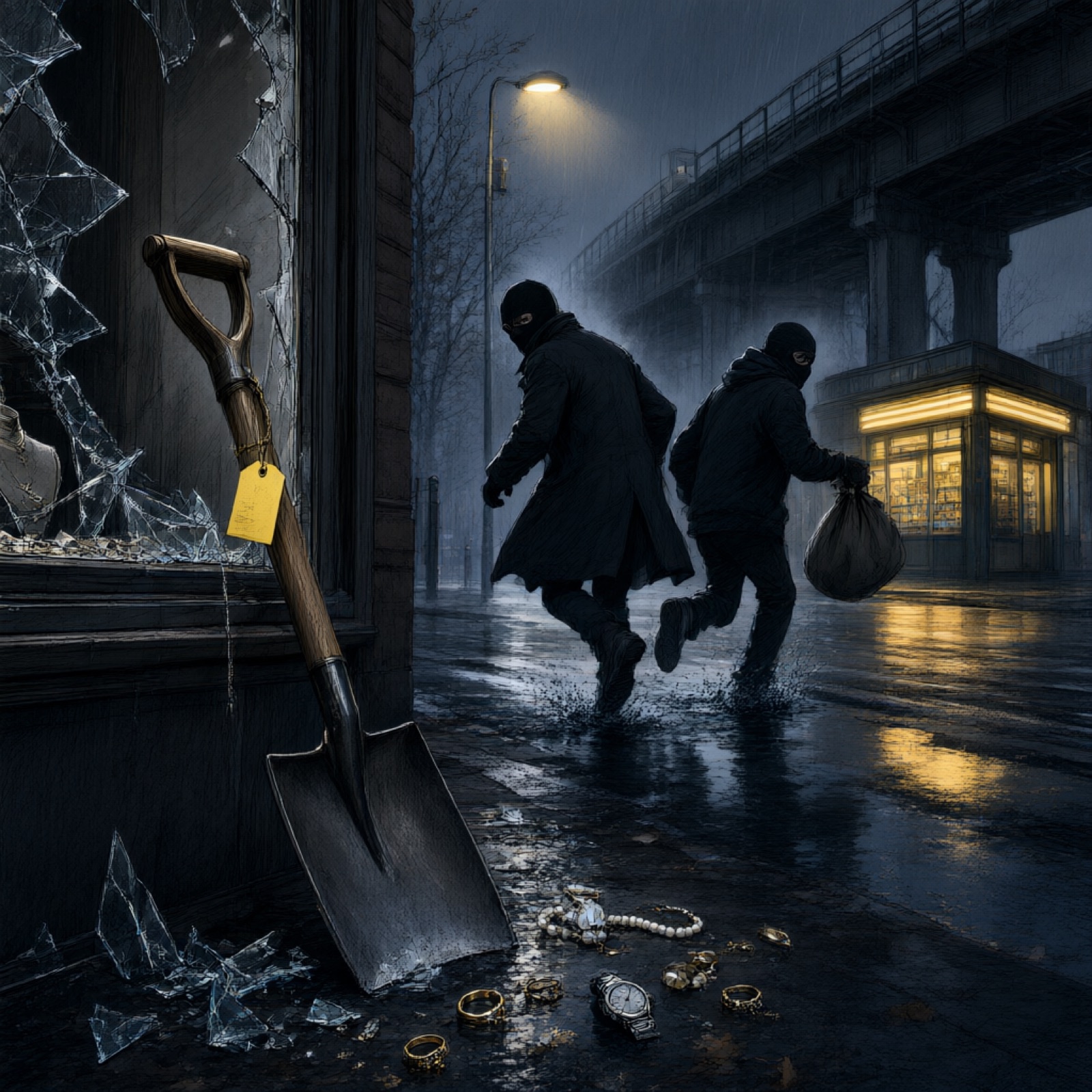
Müllerstraße at half three in the morning is not a place anyone goes for a stroll. Street lights that cast more shadow than light, a handful of pigeons dozing under the U-Bahn viaduct, and a corner shop whose neon sign flickers as tiredly as its owner. Exactly the right moment for two men with a shovel — if your plan is to smash a jeweller’s window and vanish inside three minutes.
Kalle stands outside the remains of the shopfront at half five, wondering why it’s always Müllerstraße. Three weeks ago a hold-up at the mobile-phone shop two doors down, five days ago a punch-up outside the betting shop — and now this.
“So what’s it telling us, then?” he asks, nodding towards the shattered glass.
Leni stands beside him, hands buried in her coat pockets. The drizzle has stopped, but the asphalt still glistens. “That someone knew when the patrol car was due through. And that someone brought a shovel.”
The shovel leans against the window frame as if someone’s tidied it away after a job well done. Blade down, handle up. At first glance an ordinary garden tool — stainless steel, the shaft of pale wood, the grip painted red, the sort of thing you’d pick up at a DIY shed for twenty quid. Second glance says otherwise: the blade’s forged, not stamped, the weld at the neck drawn by hand, and the shaft sits tighter than any DIY shed ever manages.
Kalle steps closer. He studies the shaft, turns it carefully with his gloved hand. No engraved name, no bloodstains, just a small sticker at the bottom of the blade. A Bavarian steel merchant. Landsberg am Lech. And above it, punched into the blade, two letters. S and S.
“Blimey,” he mutters.
“What?”
“The shovel. It’s from Bavaria.”
Leni moves in beside him. She reads the sticker, then looks at Kalle. “And?”
“And?” Kalle straightens up. “Who nicks a shovel from Bavaria in Berlin? That ain’t a coincidence, innit? Someone brought that with ’em. Someone who knows a proper shovel when they see one. Not a load of cheap rubbish — a real tool.”
The jeweller’s name is Schneider — and no, that’s not a joke. He stands in the doorway of his shop, a man around sixty, grey woollen jumper, hands in his trouser pockets. Behind him, chaos: empty velvet trays, knocked-over display stands, shards of glass glittering in the neon light like cheap rhinestones.
“Mr Schneider?” Leni approaches him, her voice calm, matter-of-fact. “Detective Chief Inspector Weber. My colleague, Detective Chief Inspector Rieger. Can you tell us what exactly is missing?”
Schneider nods. His hands don’t tremble, but his eyes belong to a man who’s just watched thirty years of work get smashed to bits in three minutes. “Watches. The cabinet on the left. Twelve of them. Rolex, Omega, Breitling. Plus the rings from the counter — all gold, all with stones. They knew exactly where to go.”
“Were you inside?” Kalle asks.
“I live above the shop. I heard it. Two blows with the shovel, then the glass gave way. I came down, saw the two of them running off. One had a rucksack, the other a sports bag. Both dressed in black, balaclavas. Heading towards Seestraße.”
“Faces?”
“Nah. Just the masks. But one of them — the one with the sports bag — he ran a bit funny. Sort of … limping. Like he had a dodgy knee.”
Leni makes a note. Limping. That’s useful.
“The shovel?” Kalle asks. “You ever seen it before?”
Schneider shakes his head. “No. Never. I haven’t even got a garden.”
That’s when Kalle decides this case is different. Not because of the haul — watches and gold are standard fare. Not because of the method — smashing shop windows is as old as shop windows. But because of the shovel. Because it doesn’t belong here. And because nobody robbing a jeweller in Berlin brings a Bavarian garden tool unless they know exactly why.
Half past seven, a patrol car finds the getaway car. Burnt out, in a side street behind Leopoldplatz, its number plates nicked and swapped for ones from Lower Saxony. Silver, that’s still plain enough to see, an estate, and the dent in the rear right wing hasn’t burnt away either. Same MO as three break-ins in Mitte back in August — except those times no shovel was involved, just a crowbar. And except that this time there are two sets of tracks in the mud beside the car, not one.
“The Audi only got them from the scene to here,” Leni says, the patrol’s report open in front of her. “A second car was waiting. They moved the gear across and one of them drove off in it. The Audi went up after that. And of the second car there’s no trace at all — no camera, no plate, nothing.”
“The plates,” Leni says, going through the reports back at the office. “Were nicked four days ago in Braunschweig. But the car itself — it’s an Audi A4 Avant that went missing in Reinickendorf last week. MOT was due, the owner left it parked in front of the garage. Gone by next morning.”
Kalle leans back, balancing his chair on two legs. “Right: plates from Braunschweig, motor from Reinickendorf, shovel from Bavaria. That’s a proper shopping trip, that is. Who plans something like that?”
“Someone with access to stolen cars. And someone who knows where to get stolen plates.” Leni taps the screen. “The swapped-plates method — we’ve seen this before. April 2024. String of break-ins in Charlottenburg. Jewellers, watch shops, even an antiques dealer. Always with swapped plates. Always with a specific tool.”
“Yeah? Who was it?”
“No arrest back then. The trail went cold. But the investigating officer noted: ‘Offender uses unusual entry tools. Vice, crowbar, jemmy — and a garden shovel. Blade of Bavarian steel. Two letters punched into the blade.’”
Kalle puts the chair back on all four legs. “So he’s not new, this bloke. He’s old. Except this time he left the shovel behind.”
The witness lives on Triftstraße, third floor, old building, lift broken — obviously. Her name is Mrs Kowalski, mid-seventies, and she opens the door before Kalle can even ring the bell. She must’ve been at the window.
“Come in, come in. I’ve been expecting you.”
The flat is small, tidy, flowers on the windowsill. A telly’s running with no sound, and somewhere coffee is brewing that smells of chicory. Mrs Kowalski sits down at the kitchen table, folds her hands and looks at Kalle and Leni like a schoolteacher about to hand out a test.
“I can tell you exactly what I saw. I sleep badly, you see. And when I sleep badly, I sit at the window. Done it for twenty years. I know everyone who walks past here at night. The bloke with the dog at two, the corner-shop drunk at three, and the police patrol at half three.”
“And tonight?” Leni asks.
“Tonight it was ten to four. A car pulled up. Not a big one, more of an estate. Stopped on the other side of the street, in front of the bakery. Engine off, lights off. Then two men got out. Both in black, both with masks they only pulled on once they were in the street. The bigger one got a shovel out of the boot.”
“A shovel?” Kalle leans forward. “Are you certain?”
“I know what a shovel looks like, love. It wasn’t dark — the street light shines straight onto the bakery. And the shovel had a pale shaft. I saw that. And then the two of them went down the road, towards Müllerstraße. Five minutes later they were back. Running. But the smaller one — he was moving funny. Sort of … like he was in pain. The bigger one was pulling him by the arm to get him moving faster. Then they got in the car and off they went.”
“The number plate?”
Mrs Kowalski shakes her head apologetically. “Couldn’t make it out. Too far, too dark. But the colour — the car was silver. That I did see. Silver, estate, and a dent in the rear wing on the right-hand side.”
Leni makes a note: Silver estate, dent rear right. The motor behind Leopoldplatz was silver, an estate, and the dent was still there after the fire. Limping suspect. Two men, one taller. That’s more than she’d hoped for.
“Mrs Kowalski — thank you. That helps us a great deal.”
“I should hope so. The jeweller — is he all right?”
“He’s fine. His shop window’s done for, though.”
Mrs Kowalski nods. “Shame. He does lovely things. My sister bought her watch there. Ten years ago. Still keeps perfect time.”
The fence is called Else Gerber, but everyone calls her Gold-Else. She runs a little shop on Weserstraße in Neukölln — officially a “purchase and sale of antiques and second-hand goods,” in reality a clearing-house for anything that sparkles and has no paperwork.
Kalle’s known Else for twelve years. She’s never once smiled at him, and he’s never once expected her to. The terms are clear: she’s his informant, he’s her leverage. She knows he could shutter her operation any time. He knows she’ll only ever give him the bare minimum. That’s the deal.
The shop smells of old wood and cigar smoke, though Else doesn’t smoke. Maybe the furniture. Maybe the clientele. Else herself sits behind a counter that looks like the reception desk of a hotel that shut forty years ago. Her hands lie flat on a worn blotter, fingers heavy with gold rings — all stock, nothing personal.
“Karl,” she says. She’s the only one who calls him that. “And Mrs Weber. To what do I owe the pleasure?”
“Watches,” Kalle says. “Rolex, Omega, Breitling. Twelve of them. Plus gold rings with stones. All from Müllerstraße, about six hours ago.”
Else raises an eyebrow. “Twelve watches. That’s not a random grab. Someone knew exactly what was in that window.”
“That’s why we’re here.” Kalle leans on the counter. “Who in Berlin moves twelve watches in one go?”
“No one I know. There’s no market for that. It’s far too hot. Either the pieces go out singly over months — or they go straight abroad. Warsaw, Prague, Istanbul. Nobody asks for papers there.”
“And who runs something like that?” Leni asks.
Else falls silent. Her fingers tap the blotter. Once, twice, three times.
“Else,” Kalle says. “I’m not asking out of curiosity.”
“I know.” A pause. Then: “There’s one bloke who can do it. He’s called Kowalski. Heinz Kowalski. They call him Shovel-Heinz.”
Kalle and Leni exchange a look.
“Shovel-Heinz?”
“Because he doesn’t like using the same tool twice. Sometimes it’s an axe, sometimes a crowbar, sometimes a sledgehammer. But lately — shovels. Bavarian shovels. He reckons they’re better. Tougher steel. You can give it three proper goes and the shaft won’t snap.”
“Where do we find him?”
Else shrugs. “Couldn’t say. He was here three weeks ago. Wanted to know if I’d take a consignment. Watches. I turned him down — too much volume, not enough risk diversification.” She speaks like a bank manager, not a fence. That’s what makes her dangerous. And useful.
“Did he say where the watches would be coming from?”
“Only that it was imminent. He had a buyer lined up, some middleman who could push goods straight to Dubai via Warsaw. That was it. I don’t know any more than that.”
Kalle straightens up. “Else — if he shows up again, let us know. No questions, no paperwork. Just a message.”
“And what do I get in return?”
“The usual. You were never here.”
The file on Heinz Kowalski is thin. Three pages, one prior — breaking and entering, 2018, ten months suspended. Back then it was a cycle shop in Pankow, tool of choice: a pair of bolt cutters. No mugshot, just an old address on Bernauer Straße and a note from the detective at the time: “Offender works with precision, calm, no emotion. Favours garden tools. No known accomplices.”
“That’s our man,” Kalle says. “A burglar who fancies himself a craftsman. Shovels instead of crowbars. Bavarian steel instead of Berlin tin.”
Leni, meanwhile, has been running the mobile-cell data for the masts around Müllerstraße. It takes her two hours, then she finds the hit: a prepaid phone that was logged on Triftstraße at 3:45, on Müllerstraße at 3:52, and on Seestraße at 4:02. The SIM is registered to a made-up name — but the call data shows regular contact with a landline in Neukölln. The address belongs to a back-courtyard business on Fuldastraße — a garden-tool workshop.
“‘Scharf und Spitz — Master Workshop for Garden Tools,’” Leni reads out. “Specialising in shovels, spades and axes. Proprietor: Heinz Kowalski. They’ve even got a website. With a blog about the merits of Bavarian steel.”
“S and S,” Leni says. “Same as the two letters in the blade of that shovel.”
Kalle laughs. It’s not a cheerful laugh, but that of a man who’s just found the missing piece of the puzzle and can’t believe how obvious it was.
“A burglar with his own shovel factory. Only in Berlin, innit?”
The back courtyard on Fuldastraße is a proper quagmire. The drizzle’s started up again, and the sky over Neukölln has the colour of old dishwater. The workshop is on the ground floor, the roller shutter half-open, a strip of neon light spilling out beneath it. Inside, a grinding machine whines.
Kalle and Leni don’t go in through the shutter. They take the rear entrance — a narrow door leading to a small office. Invoices, delivery notes, a computer still running. On the screen: an Excel spreadsheet with entries like “Consignment 3 — Watches (12 pcs.) — Collection Tuesday, Driver: Darek.”
Past the office lies the workshop. Heinz Kowalski — Shovel-Heinz — is at a workbench, running an angle grinder along a piece of steel, drawing a glowing line. He’s wearing safety goggles, leather gloves and a blue work apron that looks like it’s never once been washed. Mid-fifties, broad shoulders, the build of a man who bends metal every day.
“Mr Kowalski?” Leni’s voice cuts through the whine of the machine.
Kowalski switches off the angle grinder. He turns, takes off the goggles. His face shows no surprise. More like resigned acknowledgment.
“The shovel,” he says. “I left it for you. To make things easier.”
Kalle steps closer. “To make things easier? You forgot the shovel at the scene. That wasn’t a gift, mate. That was a mistake.”
Kowalski sets the goggles down on the workbench. “Not a mistake. By design. I knew you’d find the shovel. And I knew that sooner or later someone would put the two letters to a name. I reckoned on you turning up here — just not this quick. In Charlottenburg you didn’t catch me. Because I was too fast. And because I didn’t leave a shovel.”
Leni frowns. “You wanted to be caught?”
“I wanted it to stop.” Kowalski sits down on a stool. The grinder still drips, slow, like a tap that won’t quite shut off. “I’m fifty-two. Haven’t had a bank account with more than a grand in it for twenty years. I live in a bedsit above the workshop. No family, no mates, no dog. The only thing I know how to do is break in — and even that gets harder every year. You know what it’s like, running down Müllerstraße with a duff knee while the alarm’s going off behind you?”
The limp. The smaller man. It was Kowalski himself.
“The bloke you were with,” Leni says. “Who was he?”
“Darek. A Pole. I know him from work. He moved the gear into the second car behind Leopoldplatz and drove to Warsaw. He torched the Audi before that. The watches are long gone. But he promised me he’d never lay a hand on the jeweller — and he hasn’t. We never hurt anyone. Never.”
Kalle looks at him. “So why the shovel now? Why the confession?”
“Because Darek rang yesterday. He wants to do the next job. Bigger. A jeweller on Kurfürstendamm. But this time he wants to carry a gun — ‘just in case someone comes down.’ I said no. And then I decided it was time. Time for someone to stop me. Before Darek or the next one stands in a jeweller’s with a gun and someone gets hurt.”
Kalle nods. Slow. “Right then. Tell us. From the start. Everything you know.”
Heinz Kowalski tells them. About the break-ins in Charlottenburg, about the watches that went to Warsaw, about Darek and his contacts, about the stolen cars and the plates from Braunschweig. He tells it calmly, precisely, like a craftsman doing an inventory. When he’s done, he places the leather gloves neatly on the workbench, stands up and holds out his hands.
“Right then. Let’s be having you.”
Leni reads him his rights. Kalle walks him to the car. It’s raining properly now, a fine drizzle that sparkles in the street lights. Kowalski doesn’t say another word. But before he gets into the car, he looks back at his workshop. One last look at thirty years of work — and at the best shovel he ever made.
In the car, on the way back to headquarters, Leni says: “Good job today.”
Kalle stares out the window. The rain runs in streaks across the glass. “The shovel put us on him. The phone brought him in.”
Notice: All persons, places and actions in this story are entirely invented. It is inspired by a public police report but does not depict any real events, persons or situations. Further information: Legal Notice.