The Seventeenth Fire
Chapter 1: Sixteen Times the Same Corner
The lift at Tirschenreuther Ring 12 was a model still running in a few thousand Berlin buildings: plywood panels, a carpet somebody had once brought from home, a ceiling light that rattled on the way up like a bearing full of sand. On the floor lay a melted bin bag, black, with a hole in the middle and a tin can peering out of it. Next to it a note from the fire brigade: Lift out of order.
“That’s the sixteenth, then,” Kalle said, and took a step back. He didn’t want to be the one who shut it. “They’ll be handing out loyalty cards next.”
“They already have one.” Leni held four printed pages. “The fire brigade files the address as its own object. Since the fourth call-out they come with a dedicated route.”
“And what do they say about their lift?”
“That it’s the sixteenth.”
The hallway was clean the way a hallway is clean a week after the last mop and a hundred pairs of shoes. Fake marble, a bank of letterboxes with one nameplate torn off, a chipboard wedge under the fire door to the underground car park. The wedge was brown with age and shiny at the edges. It had not been there since yesterday.
Dietrich Burchardt came down the stairs in blue overalls, a bunch of keys on a carabiner, dragging his left foot. Caretaker since 2003, thermos in one hand that he did not put down.
“You’re police? The lads from the station said police were still coming.”
“CID. Rieger, this is my colleague Weber.” Kalle looked at the lift. “Who has keys for this place?”
“Me.” Burchardt tapped the bunch. “The letting agent. And the lift engineer, but he only comes with an appointment, and he doesn’t make appointments, he gets them.” He drank. “Lift door’s separate. Second lock, service key, emergency release. Every caretaker has to have one. Regulations.”
“When did the bag go in there?”
“Thursday, half ten. I’m sitting in the laundry, I hear the stairs, and the third floor is full of smoke. Not much. Just enough to look like something, if you ask me. I ring them, they come, water on it, done. Sixteenth time.” “I know the lads by their first names now.”
Leni held up her phone. “I got the call-outs. Sixteen fires, third of August to nineteenth of November. Nine in the lift, five in the stairwell, two in the cellar.” She scrolled. “All of them on objects. Bin bag, paper sack, bulky rubbish, a pram. Not one fire reached a wall, a ceiling or a flat door. Nobody hurt.”
“So what?”
“And all three rooms have one thing in common.” She tapped the screen. “They lock. You don’t get into any of those three without a key, and none of those doors shuts itself.”
Kalle looked at the lift carpet. “So we’re not looking for a firebug from outside.”
“Not exactly.”
“We’re looking for someone with a key and a fairly precise plan.” He looked at Burchardt. “How many people live here?”
“Sixty. Twenty-two flats.”
At ten past eight Nolte came into the yard, fire investigator, grey jumper, reading glasses on his head, three printouts with coloured circles. He didn’t say hello.
“Seat of fire one, lift floor, ignition at the bin bag. Two, stairwell, paper sack. Three, cellar, bulky rubbish. Sixteen times, three rooms, three variations. Same ignition sequence, same amount, always after eight in the evening, because that’s when people are home and it smells.” He turned a page. “Have a look at the numbers first, then I’ll ask you something. If somebody wants to burn a house down, why doesn’t it burn?”
“Because he can’t?”
“Because he doesn’t want to.” Nolte drew a line under the last entry. “Sixteen fires, no flat fire. That’s a pattern that isn’t counting the fire. It’s counting something else.”
Leni looked at him. “The alarm.”
“Exactly.” He polished his glasses on his jumper. “Sixteen times the fire brigade. Sixteen times the announcement in the stairwell. Sixteen times the insurer. And not one of those reports says what it ought to say. You know what it says? Cause undetermined. For a pile of rubbish in a lift.”
Kalle looked up at the first-floor windows, where a woman with a teacup stood behind a curtain with a cat pattern on it and did not look away.
Chapter 2: Two Hundred and Fourteen Letters
The glass door on Alt-Marienfelder Strasse said Sperling & Söhne, property management, since 1978. One room with three shelves of files, a desk, a cactus that had given up, and Anita Grabowski, holding a biro she was only pretending to use.
“I’ve spoken to the insurer. The claim is being processed.”
“That’s the sentence,” Kalle said, sitting down anyway, “that keeps every problem in this city lying about until the house falls over.”
“Frau Grabowski, we need three things.” Leni stayed standing. “Every key handover of the last five years. The building’s complaint file. And the name of the caretaking contractor.”
“Caretaking was done by a tenant.” Grabowski said the name like a lift with a bad noise in it. “Sawatzki. Rita Sawatzki. Until the end of July. Then we terminated the contract.”
“Why?”
“Because she wrote every day.” She put a file on the desk, frayed at the edges. “Two hundred and fourteen letters since 2022. Recycling. The lift door. A light in the stairwell. A bin next to the letterboxes that doesn’t get emptied, and then does get emptied, and then it’s back again.” She closed the biro lid, click. “At two hundred and fourteen letters in four years, a management company eventually stops replying every week.”
Leni looked at the file. “How many replies are in there?”
“I’m not sure I follow.”
“In the file. How many replies from you?”
Grabowski looked at the cactus. “We spoke on the phone.”
Kalle pulled the handover sheet out of the folder: one page, two date stamps, and in pencil at the top right a question mark so small it looked as if somebody hadn’t dared. “What’s this?”
She leaned forward and adjusted her glasses on their chain. “Key bunch returned, eleven items. One key outstanding. Lift, H2 — the master key for the whole building. It opens the lift, the front door and the cellars.”
“And the pencil mark?”
“She signed, she handed the bunch over. We noticed one missing in November, when the caretaker did his accounts. By then the deposit had long gone.”
“Frau Grabowski. You have two hundred and fourteen letters. You have no replies. You have a key that never came back. And you have sixteen fires.”
“I manage buildings.” She closed the file. “Not dramas.”
“Two hundred and fourteen letters,” Kalle said on the stairs, “and not one bugger answered a single one. That’s not a property manager. That’s a bin with a telephone.”
At the entrance Kalle stopped in front of the extinguisher on the second floor, because he hated it when a wall was honest. It hung crooked in its bracket, the inspection tag bleached, but the year still read 2024. Leni eased it two fingers to the side.
“Kalle.”
Behind the extinguisher, taped across the seal of the fire door, was a laminated A4 sheet. Defect notice. Lift fails every other six months. Emergency phone in the lift dead. Carpet in the lift flammable. Since 14.3.2022. Rita Sawatzki, caretaking, building 12.
Underneath, in blue biro, a line as if somebody had added it for later: Lift, cellar pen, rubbish room. Reported in that order.
Kalle looked at the wall, then at Leni. “Been hanging there four years.”
“Been hanging there four years.”
“And nobody shifts the extinguisher.”
Burchardt came up the stairs with his thermos and stared at the sheet as if he had never seen it. Kalle took the bunch out of his hand and held it to the light. Twelve keys, each with a number on a strip of tape. The lift key was among them, H1, in the middle, where a man who uses it often would put it.
“Complete,” Kalle said.
“Told you.”
Chapter 3: The Key That Never Came Back
Melanie Krumm was released at eleven, with a charge sheet and the smell of cell disinfectant on her jacket. One night, because there was a lighter in her coat pocket and because on Thursday at half ten she had stood alone in the yard smoking, which nobody confirmed.
“And?” Kalle asked, when Leni came out of the interview room.
“No accelerant, no time, no motive a prosecutor couldn’t take apart in two minutes.” She dropped the statement on the desk. “She has a boy on oxygen at home, and she stood in that yard for an hour with nobody to confirm it.”
“She knows how to handle fire.”
“She knows how to handle a lighter.” Leni looked at him. “So do three million people in this city.”
At twenty past four she rang the letting agent. The building’s access system was one somebody had once paid a lot of money for: every door remembered the last cylinder key turned in it. Leni thought it was the only luxury in this city that didn’t lie.
At ten past five she hung up. “Thursday, 22:29, lift door, ground floor. Key H2.”
“H2.”
“The one Sawatzki never handed back. The one Grabowski put the pencil question mark next to.”
Kalle took his jacket off the hook. “Then let’s go and talk to her.”
Cellar compartment 12-B was the tidiest in the corridor. The others had bamboo shelving, barbecue charcoal, Christmas trees from two decades. This one had a steel cupboard, a ladder, two laundry baskets of towels, and a can of spirit with a strip of masking tape over the label. It looked like the compartment of somebody with plans for the weekend.
Leni was down there at five past six. She looked at the can first, then the cupboard.
In the cupboard was a ring binder, and on the spine in marker: Defects, from 2022.
It was not a folder of letters. Every complaint was filed three ways: her carbon copy, the receipt from reception with the date stamp, a photograph. Page 17 showed the lift carpet with a tape measure across the seam. Page 118 showed the extinguisher on the second floor, 2021 tag, with an arrow. Page 171 showed the floor of the rubbish room, scattered with polystyrene beads.
The last page number was 215.
Notice 215. Logged 21.11., 19:00, rubbish room, building 12. Condition as described: 14 mattresses, two prams, polystyrene. The smoke goes up the only stairwell, the building has no second escape route, and the 2019 notice about that is resolved, signed, official. On 23.11. there is an inspection at nine. I will be there at 19:00.
Leni rang Kalle. “She wrote it down.”
“Wrote what down?”
“She’s been writing an appointment since August. No — a forecast.” Leni turned back through the pages. “From page thirty she stops writing about the lift and starts doing arithmetic. How long a fire engine takes. How long the smoke takes. How many years an inspection takes when every deadline has expired.”
Kalle was already on his way.
Chapter 4: Fourteen Mattresses
The rubbish room was behind the yard, under the building’s only stairwell. There was no second staircase, only a lift stuck between two floors since Thursday. And there was a door that had not been painted in twenty years.
Kalle shone a torch inside and stopped in the doorway.
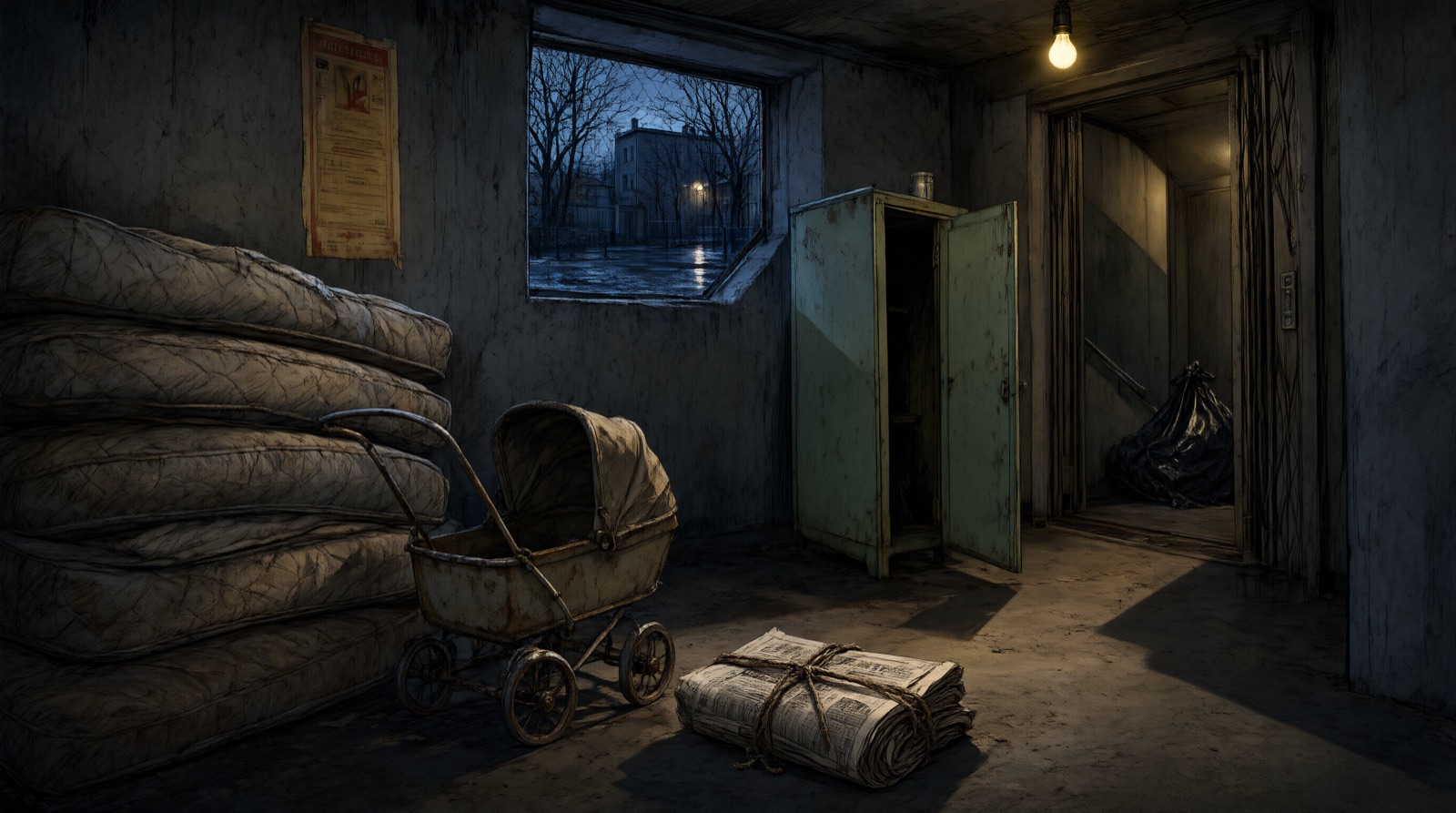
Fourteen mattresses, stacked on end, neatly sorted. Two prams, one with a predator print. Four bags of polystyrene, one split, the beads lying like hail up to the threshold. It smelled of wet plastic and, underneath, something sharp.
Upstairs on the first floor Leni had spoken to the woman with the carpet. She had seen a woman with a bicycle and a pale jacket leave the yard at a quarter to eleven on Thursday. No face, no voice.
Kevin Prange, 23, fourth floor, slung his bag over his shoulder in the yard and told it willingly, with the zeal of a man finally needed. “The mattresses, yeah, they came Wednesday. There was a van in the yard, one of them chemist’s vans, and a bloke unloading. Mattress after mattress. I thought, leave it, the room’s been full of junk since 2019 anyway.” He thought about it. “I didn’t see him. I mean — I saw the woman. When she came in the evening, that’s when it came back to me.”
“What woman?”
“With a bike. Newspaper basket on the front.” He shrugged. “She took newspapers in and came back out. Thursday, just after half ten. I was watching from the yard with my rucksack. She didn’t see me.”
Kalle went back down, pulled the fire plan out of the inside pocket of the binder and held it so Leni could read. The plan had last been printed in 1996: one single marked escape route, from the third floor down the stairs into the yard. Beside it somebody had written in green biro, in handwriting nobody had used for years: One. Only one.
“She read the plan,” Leni said. “And reported three hundred times that one is not enough.”
Kalle looked at the mattresses. “And now she’s standing here doing the thing that finally makes people look.”
Chapter 5: Six Fifty-Two
On Saturday they were in the back yard at twenty past six, because Kalle would rather freeze than wait. It was cold for November, the wind smelled of district heating and wet paper.
At six forty-nine the yard gate rattled. Then footsteps, a rolling sound, a metallic noise like somebody setting down a can.
She came in without the bike; it was outside. Pale softshell jacket, wet through in patches. At the rubbish room she took a key out of her pocket, red ribbon. She unlocked it without hesitating and shouldered the door wide because it stuck.
Kalle stepped in behind her so that he was standing in the doorway. “Rita Sawatzki.”
She didn’t turn round.
“Leave the bag where it is.”
There were two bags with firelighters in packets and, under them, a bundle of newspaper folded lengthways. She held them steady. “I reported it.”
“I know.”
Now she turned. She did not look like somebody about to set a house on fire. She looked like a woman who hadn’t slept since Thursday and had given up looking at it.
Leni stood by the gate with the binder and held it open so she could see it. “Page 215.”
Rita looked at the page, then for two seconds into the room with the mattresses, as if the sight were hard work. The smoke would have been at the ceiling of the third floor by five past seven, sixty people coming down the stairs, including a boy with an oxygen cylinder.
“I don’t do flats,” she said.
“You do an escape route.”
“Have you read the plan?” She didn’t raise her voice. She spoke like somebody finishing a thing because they’ve explained it too often. “Half a building with one stairwell, and the smoke is what can’t get out at the top. That’s the only thing that was ever in my plan. For four years.”
Kalle listened the way he listened when he noticed he was about to make an exception.
“Frau Sawatzki, Monday at nine is your appointment. And I’ll tell you how it looks after tonight. Tomorrow you’re standing there with a bag of firelighters, and your 215 pages don’t go into the record, they go into evidence. Everything you wrote down in four years becomes proof that it was you.”
“And if I don’t?”
“Then it’s twenty-two more reports nobody reads.” He looked past her at the mattresses. “Then tomorrow I ring a woman on the first floor who kept her letters and doesn’t know where her carpet is.”
Something in her face opened, not much, just enough to still count as a face. “She made me a coffee once. Two years ago. She cried when she signed.”
“We’re taking that with us.” Kalle lifted the bag by its knot, gloved. “And you’re coming downstairs.”
She looked at the mattresses, the pram, the polystyrene, then at Leni with the binder. “Can I hand that in?” she asked. “Before. Not as evidence.”
Leni closed the book. “It’s part of the file now.”
At a quarter past seven Leni called the fire brigade, not the management, and Kalle watched two men stand the mattresses against the wall, because that’s what you do when you check a room that isn’t supposed to burn. Burchardt held the broom as if it were a statement.
On Sunday morning the management company wrote that the room would be cleared by Monday and the defects “thoroughly worked through”.
“She wrote two hundred and fourteen times,” he said to Leni. “And now they’re writing to the authority.”
“Because there’s now a file with a police officer in it.”
Monday at nine was the inspection. Forty minutes, three officials, a structural engineer with a clipboard who held the fire door open and went “hm”.
“And what happens now?” Kalle asked afterwards on the pavement.
“They check. Then they set deadlines. And when the deadlines pass, they check whether anybody checked.” Leni had the binder under her arm, which she now had to hand over a second time because the first time she hadn’t asked for a receipt. “Next door it took eleven years.”
Kalle looked at the building with its twenty-two flats and its one exit. “You know what I don’t get? Nobody had to let her in any more. No contract, no right to be here. But she still had the master key, and no lock asks for a contract. She could get at her letters because she kept the copies.”
“The only key that worked was called H2.”
“H2 is the coffee she made the woman on the first floor.” He walked to the car. “I’m not writing that down.”
“Neither am I.”
At headquarters he met Brandt in the corridor. “The paper says she wanted to set the building on fire.”
“No report says that.”
“It’s in the paper. And the footnote says she reported it for four years.” She looked at him. “And the 215 letters?”
“Those are a passion. You can punish that.” He took the stairs. “You can’t prevent it by letting the building fall down.”
Brandt watched him go. “Good job today.”
Leni had stayed in the car because she wanted to look in on the woman on the first floor. The carpet was past any tape measure now; she had put it in a cardboard box, the way half the building consisted of boxes. She stood at the window with her teacup and looked past Leni into the hallway, where Kalle was leaning.
“The short version,” he said. “The room is empty. The door is new. The extinguisher is new.”
“And the woman from the management company?”
“She’s in trouble.”
She nodded as if she had known that for four years, and then she said the sentence Kalle left out of his report because he could not find a paragraph for it: “I waited for her. Two years.”
In the yard the lift stood between two floors, and above the entrance the light was on that hadn’t worked since 2021. Burchardt had changed the bulb that morning without anyone asking.
Note: All characters, places and events in this story are fictional. It was inspired by a public police report but does not depict real events, persons or circumstances. More: Legal notice.