The Petrol-Station Clown
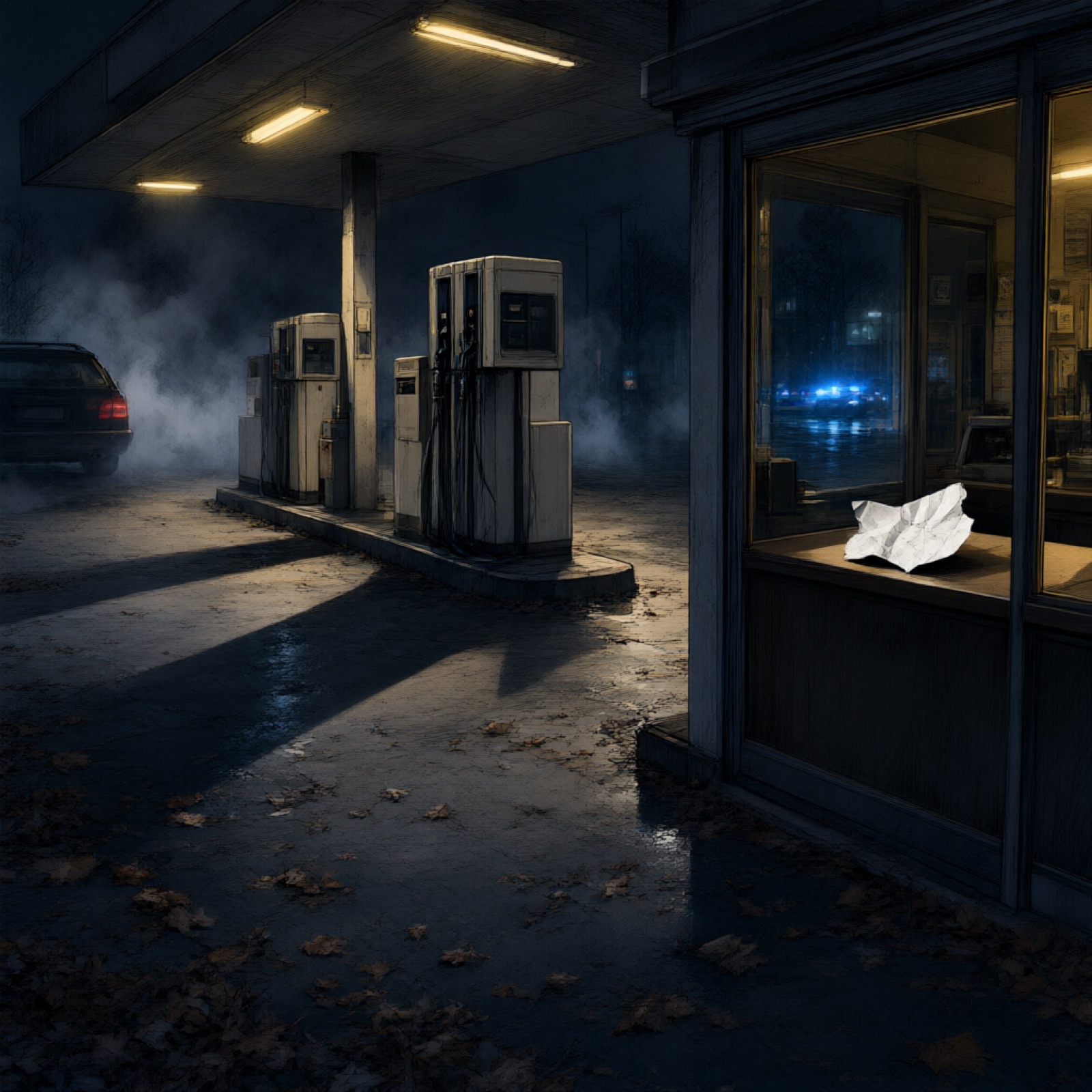
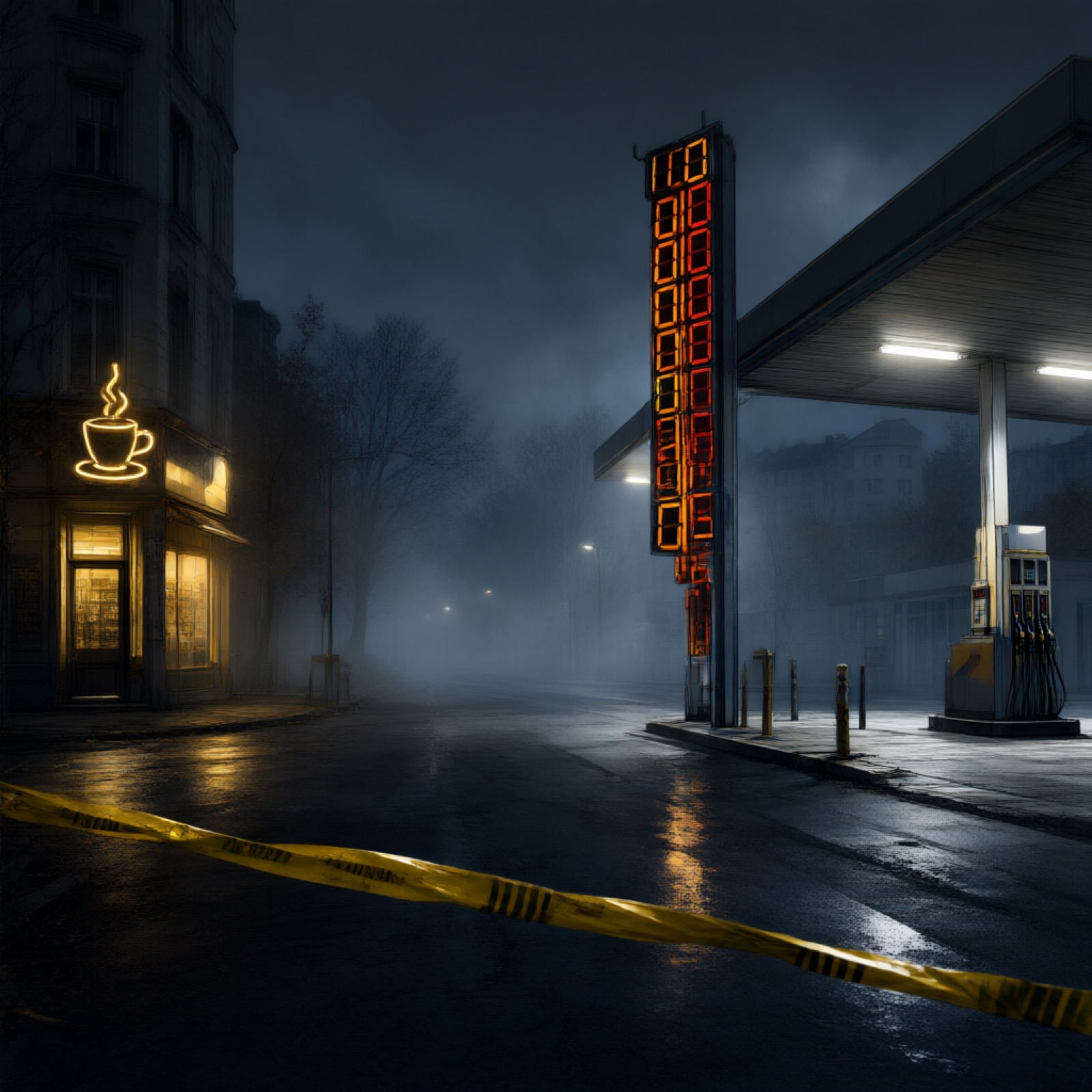
That the petrol station on Friedrichshagener Straße was robbed just after eleven, Kalle learned while still half asleep. That the take amounted to exactly eighty-three euros and fifty-seven cents, he learned an hour later, standing with Leni outside the cordoned-off forecourt and reading the receipt the robber had left behind.
Not the petrol station’s receipt. A receipt from a kebab shop three streets away, with a handwritten note on the back: “Thanks for shopping. See you soon.” And underneath, in careful block capitals: “Petrol-Station Tom”.
“Right, you’re having me on,” Kalle said.
Leni studied the slip of paper, now sealed in a clear evidence bag by forensics. “He signed it. The robber signed it with his nickname.”
“Not his nickname. His brand name.” Kalle zipped his leather jacket higher. The November night was cool with autumn damp, mist clinging to the streetlights, and somewhere beyond the petrol-station roof the air smelled of wet leaves and old chip fat. “This bloke reckons he’s a star. Petrol-Station Tom. Like a bleedin’ wrestling name. All I’m missing is the entrance music.”
The petrol-station attendant, Mrs Yildirim, sat in the break room on one of those wobbly plastic chairs you only find in petrol-station break rooms. Fifty-three, dark hair, a black jumper that had seen better days. Her hands lay flat on the table, as if they needed contact with something solid. The patrol officers had made her a tea. She hadn’t touched it.
“Mrs Yildirim,” Leni said, sitting down across from her. “I’m Detective Chief Inspector Weber, this is my colleague Rieger. We know you’ve told this story twice already tonight. We’d still like to hear it from you. When you’re ready.”
Mrs Yildirim nodded slowly. Her voice was quiet but steady. “Just before eleven. I was in the back, in the stockroom, sorting deliveries. The shop was empty — no customers for twenty minutes. Then I heard the door chime and went up front. He was already standing in the stockroom doorway. Black balaclava, black jacket. And a pistol. Held it right in my face. Said: ‘Come out front, open the till. No arguing.’”
“How did he sound?” asked Kalle. He leaned against the doorframe, arms folded, calm.
“Calm. Not fast, not slow. No accent. No dialect. Like someone reciting a text he’s learned by heart.”
“And the second one?”
“He stayed outside. I only saw him through the glass. Also dressed in black, also a balaclava. He was watching the street. The whole time he never looked in. Just stood guard. Like it was a drill. Military, almost. But wrong. Like…” She searched for the word.
“Like theatre?” Leni suggested.
Mrs Yildirim looked at her, for the first time directly in the eyes. “Yes. Exactly. Like theatre. The one with me — his gestures were too big. He held the pistol like someone who’s seen how to hold a pistol but doesn’t understand why you hold it that way. Finger on the trigger. The whole time. As if waiting for it to get dramatic.”
Kalle and Leni exchanged a glance.
“And the note?” Kalle asked. “Did you see when he put it down?”
“After he took the money from the till. He reached into his jacket pocket, pulled out the receipt, flipped it over, and placed it on the counter. Then he said: ‘That’s it. Thanks.’ And left. Didn’t run. Walked. Briskly, but walked.”
“Ta. Like a head waiter after the bill’s settled,” Kalle muttered. Leni shot him a look. He took the point.
In the car on the way back to Section 13, Kalle let Friedrichshagener Straße roll past him. Petrol station, kebab shop, corner shop, car wash, another corner shop. The classic arterial-road string of pearls.
“The receipt,” Leni said, tapping on her phone. “Kebab shop ‘Grill am Eck’, Friedrichshagener Straße 84. Sold a kebab meal yesterday at 21:42, with extra chilli. Cash payment. No card, no credit card, no name. No cameras in the shop — the owner says they’re ‘broken’. Since March. And he’s in no rush to fix them because he’s not keen on the health and safety inspectors. Lovely place.” She scrolled further. “But the corner shop directly opposite has a camera above the door. Facing the petrol station. Might’ve caught something.”
“And if not?”
“Then we’ve got the receipt and the name. And the certainty this bloke isn’t doing it for the first time, nor the last. And that he needs the stage. The business card. The theatre. The big gestures. Someone like that doesn’t stop. Someone like that wants you to look for him. So he can prove you’ll never find him.” Leni closed her phone. “Narcissist. Classic. Except this one doesn’t ring his mum to complain — he robs petrol stations and leaves autograph cards behind.”
“Corner shop,” Kalle said. “Let’s head there now. If the camera’s got something, we’ll see whether the corner-shop bloke’s got equipment as dodgy as the kebab man’s.”
The corner shop was called “Nachtbeleuchtung” and belonged to a woman who was not pleased to have two detective chief inspectors on her doorstep at one in the morning. She was late forties, wore a wool cardigan over a nightdress and had the kind of expression that says: I’ve done nothing, but I want nothing to do with it either.
“Police. We need your camera footage from tonight, between ten and eleven. Petrol-station robbery opposite. We need to know who passed by,” Kalle said.
The woman folded her arms. “Camera? What camera?”
“The one above your door. The one that’s hanging there. The one that’s blinking.” Leni pointed upwards.
“That’s decoration. Just blinks. Not hooked up. Data protection and all that. You know how it is.” She shrugged, but her eyes didn’t join in. They wandered. Left side of the counter, right side of the counter, Kalle’s face, Leni’s face, the door.
“Data protection,” Kalle repeated. “With a petrol-station camera I’d almost buy it. But you’ve got a camera pointing straight at the street where an armed robbery just happened, and it’s decoration?”
The woman lifted her chin. “I didn’t see the robbery. I was in the back. Cleaning the fridge. You can’t hear a thing back there. If you want to know something, ask the petrol-station people. Or the taxi driver. He stood there nearly an hour. Just waiting. Maybe he saw something.” She reached for the door. “I really need to carry on now. The fridge is calling.”
“Taxi driver?” Leni asked. “At that hour? Where was he?”
The woman sighed, as if being interrupted mid-lie was inconvenient. “The car-wash car park. Fifty metres from the petrol station. Black saloon. No taxi sign on the roof, but one of those illuminated ads in the windscreen. ‘Berlin Taxi’. Or something like it. Parked there from half ten to just past eleven. Didn’t pick anyone up, didn’t drop anyone off. Just sat there. Engine off, lights off. Then, just after the two came out of the petrol station, he puts his headlights on and drives off. Leisurely. Like he’d missed his bus or something.” She glared at Kalle. “Now you can go. You come back when you’ve got a warrant for the camera. And maybe then I’ll fix it.”
Kalle pulled out his phone. Made as if to dial a number. “I can ring the magistrate now. One in the morning. Sunday night. He’ll be over the moon. Door-step production order, camera seizure, contempt. Shall I?”
The woman stared at him. Two seconds. Then she stepped aside and let them in.
The camera was indeed hooked up. That became clear when Leni pressed the playback button on the monitor behind the counter and the image from 22:38 appeared on the screen. Black and white, but sharp. The angle caught the petrol station and part of Friedrichshagener Straße.
22:41: A dark estate car pulls onto the verge, fifty metres before the petrol station. Driver doesn’t get out. Headlights stay on.
22:43: Two figures come round the back of the petrol-station building. Dark clothing, balaclavas. Walk purposefully towards the entrance. One stops in front of the door, back to the glass, watching the street. The other goes in. One of them — the one who goes in — has a noticeably loose movement when walking. A slight bounce in the shoulders. Not a swagger. More like someone carrying too much confidence on too little body.
22:48: The first one comes out. Then the second, three seconds later. Both head towards the estate car. Not running. Brisk, but controlled. The one with the shoulder bounce makes a gesture — quick, with both hands, as if brushing flour off his fingers. Two pats. Then they get in. The estate car pulls away. Indicator left, then off, towards central Berlin along Friedrichshagener Straße.
No taxi visible on the car-wash car park. But something else: a small, dark car at the right edge of the frame. Freeze-frame, as Leni zooms out. A driver’s door that opens as the estate car pulls away. A driver who gets out and watches the estate car depart. Then he gets back in and drives off in the opposite direction.
“That’s the taxi driver,” Leni said. “She lied about the car wash and the taxi sign. But she didn’t lie that someone was waiting. He watched the robbery. And then drove somewhere completely different from where the perpetrators went. Who does that?”
“Someone who knows the driver. But not the passengers.” Kalle tapped a finger on the screen. “And someone who knows exactly this isn’t a one-off. The little one there — that’s the scout. He guided the estate car to the scene and then waited to see if it worked. Like a theatre critic at the premiere. Sits in the stalls, watches, doesn’t write a review — just cheers on his star.” He looked at Leni. “We’re not dealing with two offenders, Leni. We’re dealing with a crew. Three at least. And the star’s the one who left the note. Petrol-Station Tom. Probably the one with the shoulder bounce. The rest are staff. Props and logistics. The scout and the driver are the stagehands. And Tom? Tom’s the lead actor, signing autographs after the show. And the show’s only just started.”
They spent the rest of the night at Section 13, trawling through files. By four in the morning Leni had four cases on the desk that she could link to Tom. Three in Berlin, one in Potsdam. All within the last six weeks. All petrol stations. All at night. All with minimal take. Two of them had also had a calling card left behind — not “Petrol-Station Tom” but once “The Nozzle” and once “Petrol Bert”. But the same handwriting. The same block letters. The same mix of grandiosity and attention to detail.
“This bloke collects names like other people collect trainers,” Leni said. She had her third cup of coffee in front of her and looked like she could handle a fourth. “Every robbery gets a new alias. A new costume. A new audience. This isn’t a robber, Kalle. This is a performance artist. One who went to the wrong art school.”
“And the take?” Kalle asked.
“Average eighty-seven euros per robbery. Total damage: about three hundred and fifty euros. Plus some loose change. At this rate he’ll have a second-hand bicycle together in three months.” Leni leaned back. “That doesn’t motivate anyone. Not when you’re as logistically organised as this one. Three cars, coordination, a scout, a driver, good planning — that costs more in petrol than he earns. He wants something else. But what?”
Kalle stood up, walked to the whiteboard. “The app,” he said, drawing a circle around the word he’d written on the board. “Petrol-station loyalty app. Every chain’s got one of those things. You fill up, you collect points, you get a discount. And in the database you’ve got name, address, phone, email, credit card, number plate, refuelling habits, mileage. When you fill up, where you fill up, how much you fill up. Knows everything about you. When you’re on holiday, because you haven’t filled up for three weeks. When you’re out at night, because you filled up at half two in the morning. When you’re skint, because you’re only putting in twenty euros’ worth. Best surveillance in the world without a single bug. And Tom? Tom isn’t nicking cash. Tom’s nicking data. The cash is just the tip. The app is the main course. And the first robbery where he spent that much time alone with the cashier — that was tonight. This one. Where he spent almost seven minutes at the till, according to the video. Normally he does it in two. Tonight he needed seven. Because he wasn’t counting the money. Because he was copying the app interface. Or whatever the till software gives you. He didn’t rob the petrol-station till. He hacked it. He left the business card behind to taunt us. But what he really wants is to distract us. From the digital side. Because the clown doesn’t just wear one mask — behind the mask there’s another mask. And behind that: the real Petrol-Station Tom. The IT bloke. The data thief. The one who knows more about every petrol-station customer than their own landlord. And who’s now got enough data to know the addresses of a thousand people going on holiday next week. That’s the coup, Leni. Not the eighty-three euros from the till. The database with a thousand customers who’ll be on holiday from next week.”
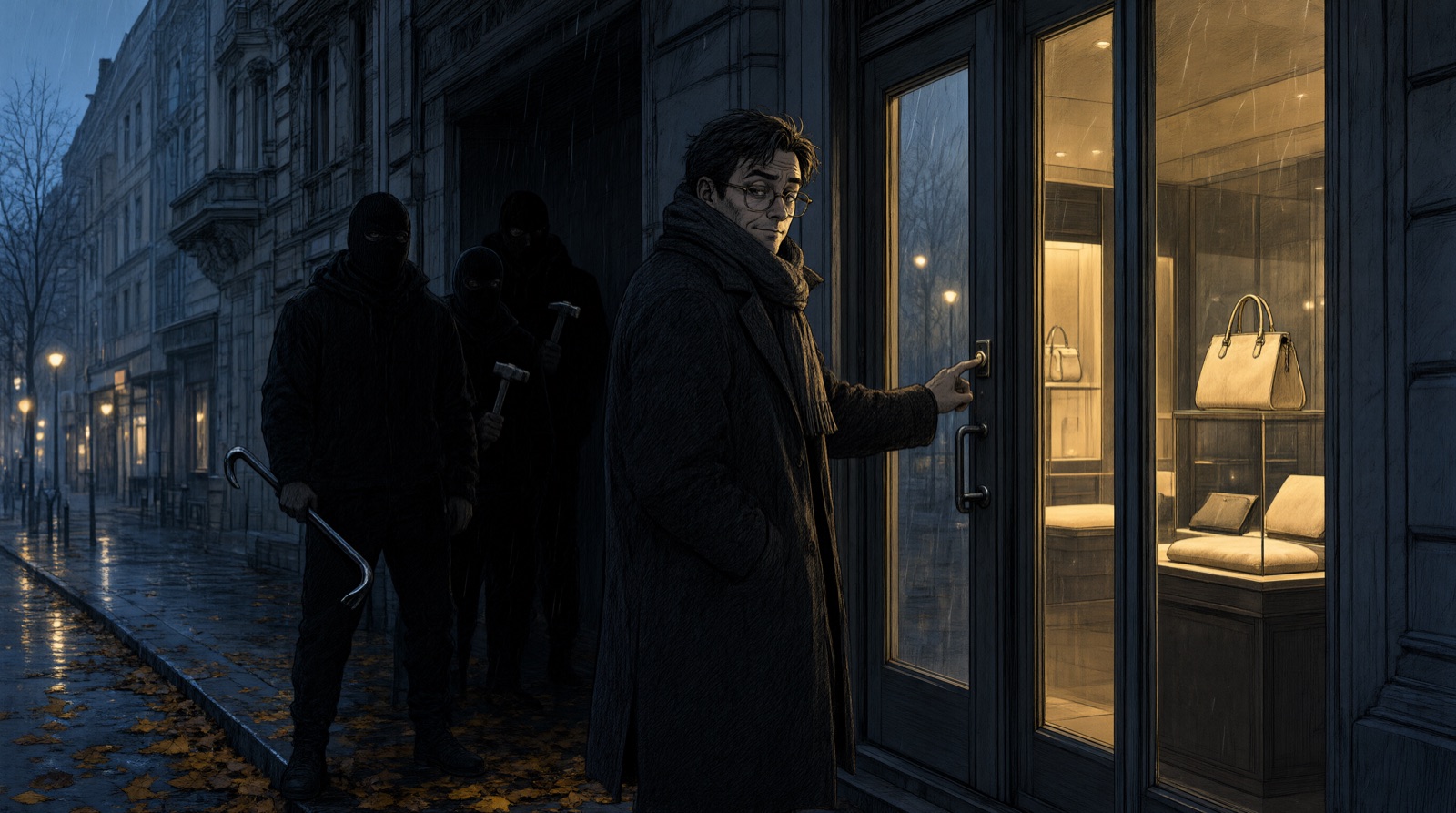
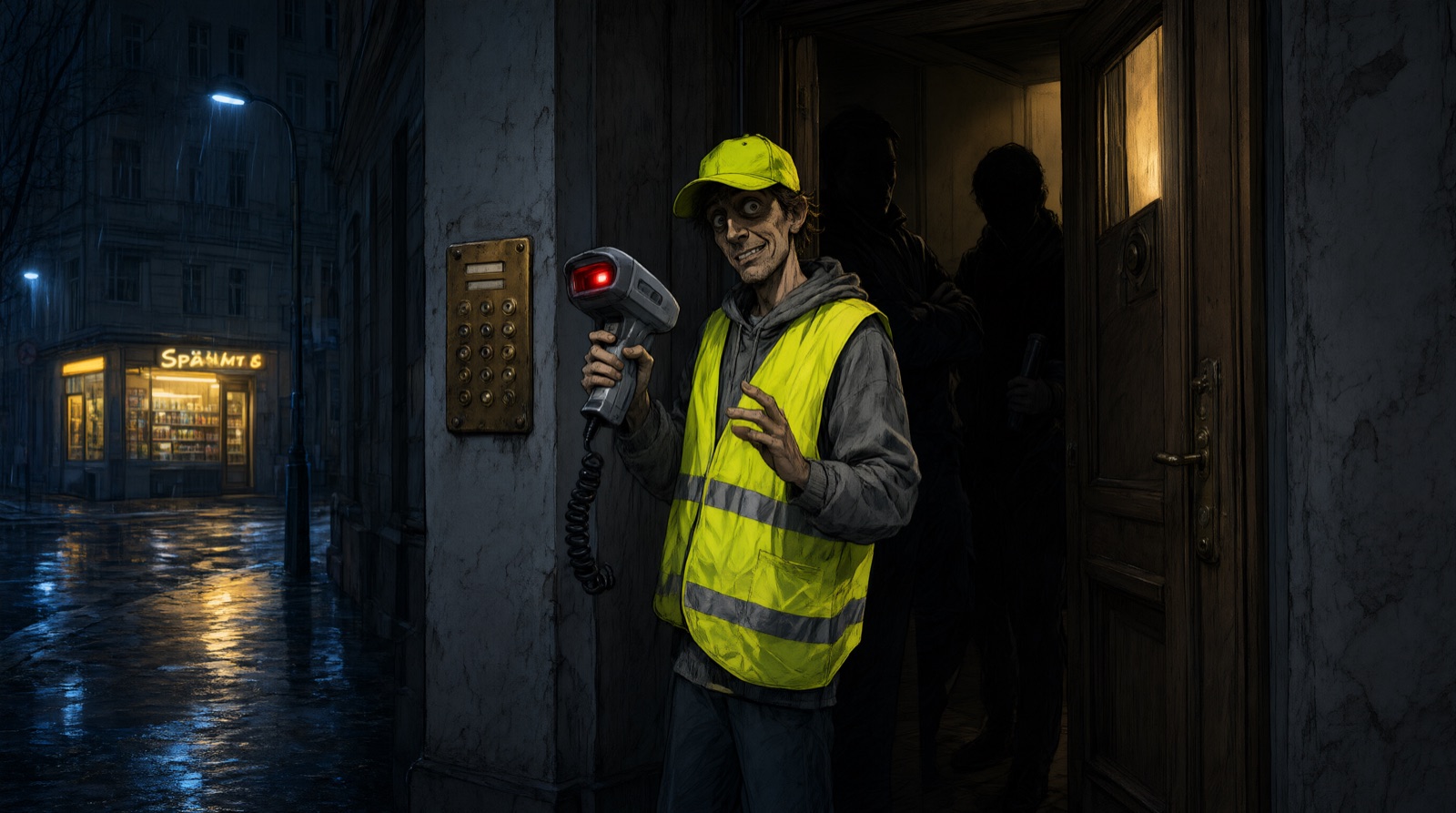
Leni had stood up. “Then we need to find out who programmed the app. Or maintains it. Or has access. Someone with IT skills, access to petrol-station till systems, probably an ex-employee of the app company or the petrol-station IT department. And someone with the narcissistic disorder to leave calling cards behind. And mates who’ll drive cars for him. That’s a crew, Kalle. Not amateurs. And they’re not finished. They’re only just getting started. And the next person who goes on holiday leaving an empty flat — that’s who they’ll be knocking on. Not at the petrol station. At his home. With a yellow delivery-driver outfit and a prop scanner and an empty hallway where the front door flies in. We need to find the scout. It wasn’t the taxi driver. But the little car that waited — that’s the one who knows where Tom lives. The scout. The stagehand who drives his star to the premiere and catches the flowers at the end. And he’s sitting in some pub right now, drinking his end-of-shift pint and thinking he’s invisible. He’s the key. Not Tom. Tom’s too careful. But the scout? He waits. He stands. He gets bored. He makes mistakes. We’ll nab him. And he’ll give us the rest. Willingly or not — he’ll talk. Because he’ll know we know he isn’t the star. He’s just second fiddle. And when we make it clear to him that he’s doing Tom’s sentence for contempt while Tom’s out there writing business cards — that’s when he’ll flip. They all want to be stars, Leni. Every last one of ’em. And when they clock they’re just extras? They sing like a canary. Literally. Maybe even with a business card. But no name this time. I’ll write that one. Petrol-Station Scout. Not as pretty as Petrol-Station Tom, but more honest. And honesty’s a solid basis for negotiation when you’re dealing with supporting actors. I’d say. Innit?”
Leni gave a thin smile. “Eat your sandwich, Kalle. It’s four in the morning and you haven’t eaten since midday. Then we’ll go and find this scout. The little car has a number plate we can read on the video once we have the lab enlarge it. And then we’ll knock on his door. Not Tom’s. The scout’s. Like you said. Second fiddle. They always play too loud. And when they stop playing, they start talking. Because Tom’s most likely response to questioning is writing another business card. But the second fiddle — he just wants his name in the programme. And we give him a name. Not the one he wants. The one he’s got. Extra.” She stood up, reached for her jacket. “Come on. Morning’s breaking, and we’ve got an address to find before Tom prints his next card. And this time he might not write a business card — he might write an invitation. To a house viewing. No appointment necessary. At the home of someone who’s on holiday and doesn’t know their data’s up for auction on the darknet. That’s what I call a good reason to stay awake. Or what?”
Kalle stood up, grabbed his sandwich. “What a day, Leni. What a day. And it’s only just started. But first, coffee. Then business. That’s the way it goes. That’s the way it goes in Berlin. And that’s the way it goes even more in Köpenick, when the petrol-station clown leaves the stage and the curtain falls. And behind the curtain? No applause. Just us. And a warrant. Two, to be precise. One for Tom. One for the scout. And maybe another one for the driver. Three-pack. Family discount. Petrol-station rate. You’d have to laugh, wouldn’t you?”
Disclaimer: All persons, places and events in this story are entirely fictional. It is inspired by a public police report but does not depict real events, persons or circumstances. Further information: Legal Notice.