The Table-Leg Clinch
Chapter 1: Two Hundred and Fourteen Cards
The Lindensaal smelled of pepper spray, beer and cinnamon from a bowl Frau Boddin had put on the counter in October and never emptied.
Kalle stopped in the doorway. Paper napkins, a tipped glass, one shoe.
“Eight injured,” said Leni, notebook already open. “Two went to Virchow in the ambulance. One broken nose, one with spray in his eye and glass in it. The rest: cuts, a sprained wrist, a bite wound on the forearm. The guest says he doesn’t know who bit him. He’s lying.”
By the counter stood a woman with a grey bun, keys rattling.
“Boddin. I run the hall. I called 110 at 23:12, not 23:11, it’s written here.” She tapped a line with her biro. “Three tables wrecked, one rear windscreen. The windscreen isn’t insured.”
“How many guests?”
“Two hundred and twenty-nine. Two hundred and fourteen cards.” “One without a card sat at table nine.”
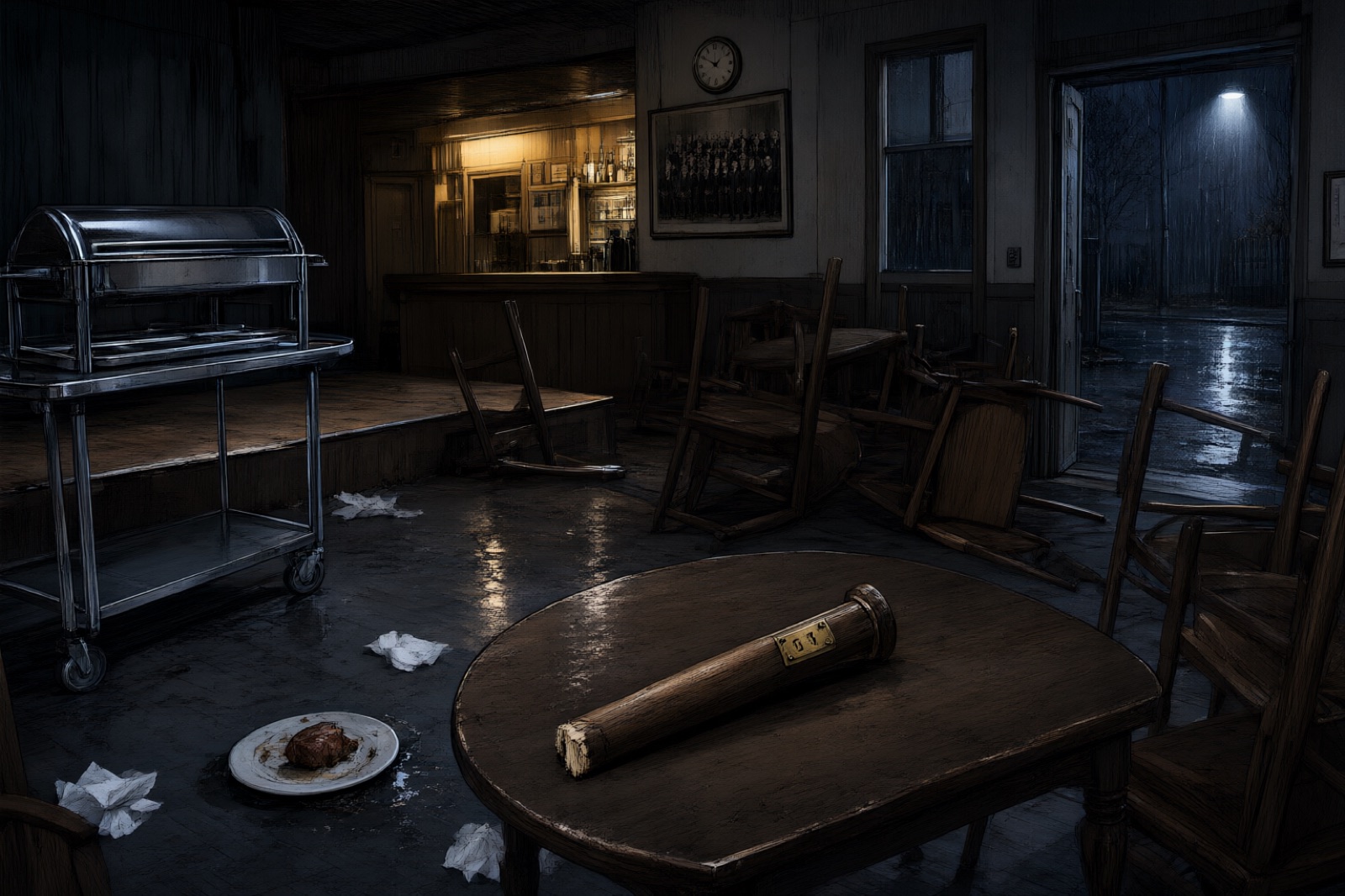
Table nine lay on its head like an upturned animal, legs in the air. Between the legs a piece of wood was wedged, cleanly sprung, with a brass plate on the side. A nine was engraved in it, and under the nine a black ring, as if someone had rested a cigarette there and forgotten.
Kalle crouched. “Leni. I know that leg, me.”
“You know a table leg.”
“June, Oranienstraße, the pub. The Last Round. Kalweit showed me his tables like other people show you their grandkids. And then he said: ‘I re-screwed the nine, because Bernd tore the leg out of it in March.’” Kalle pointed at the brass plate. “Nine. Burn ring. That’s the leg.”
“You recognise a piece of furniture. That’s a door, not a verdict.”
In the yard Bernd Kruschke sat on a beer crate. Grey parka, corduroys, one ear red, right knuckles split open.
“Rieger, this is my colleague Weber. You’re the bride’s uncle?”
“Her mother’s brother. Yes.”
“You’ve got a bloody hand.”
Bernd looked at his knuckles. “I hit something somewhere. Can’t remember where. Might have been a table.”
“You were sitting at table nine.”
“I was sitting at table nine.” A fact that had lain in his stomach three hours. “By the kitchen door. Where the plates rattle.”
At 23:41 Leni crouched under the top and pulled the leg out as if it might bite, then bagged it.
“It was under the table the uncle was sitting at. And the same man tore this exact leg out of this exact table eight months ago. A story that fits too well.”
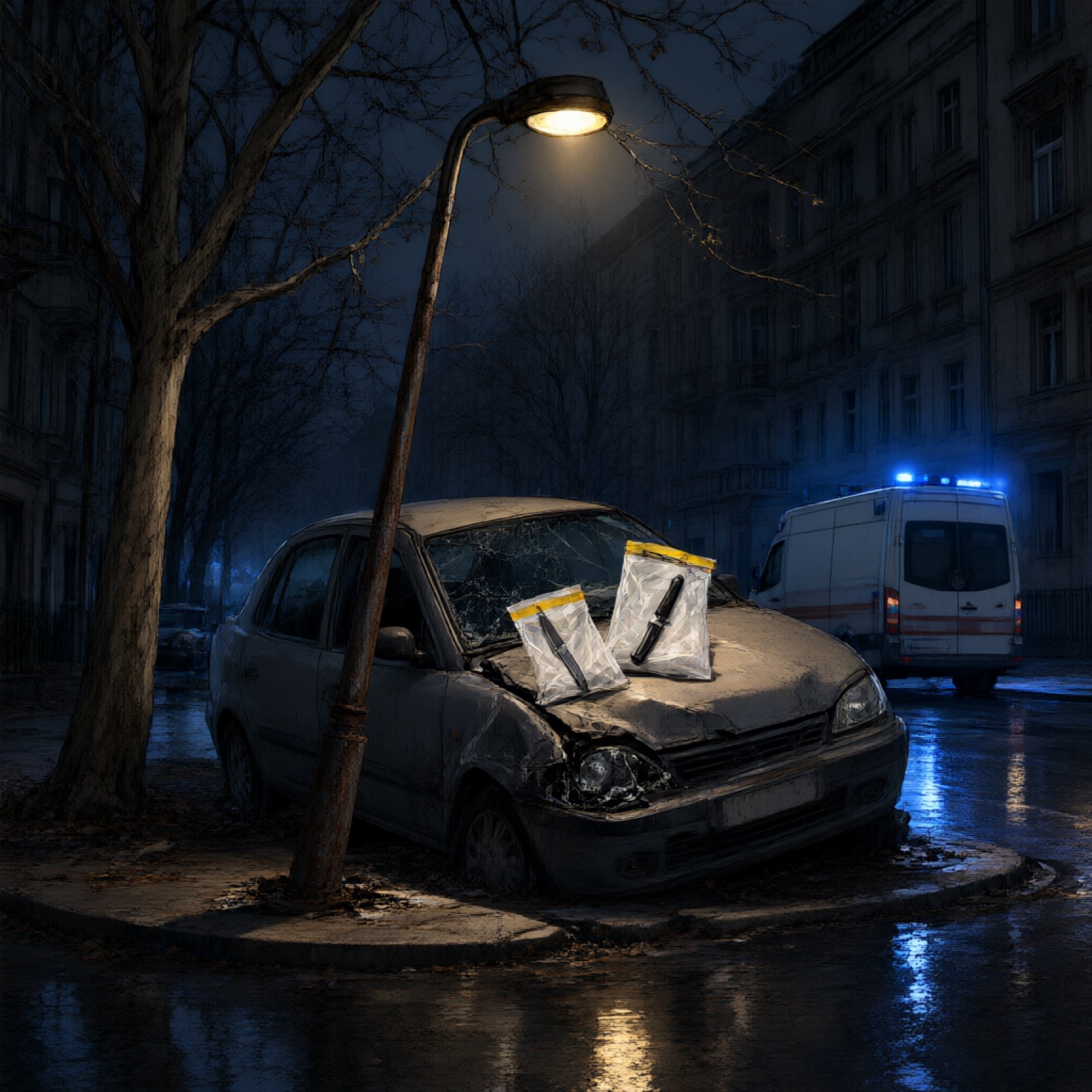
At five past midnight a colleague came from the cloakroom with an extended baton. “It was in the black jacket. Not mine.” The second lay on the dance floor under a chair, grip tape still round it.
At twenty past midnight the same colleague opened a Passat’s boot in the yard. “Registered to Tom Wuttke.” Marek the caterer pointed with his chin. Between the jack and a wet box lay a baseball bat, paint flaked off.
On the grip a sticker, blue and white, a football, and underneath in biro: Kevin, 11.
“Tom Wuttke’s twenty-nine, isn’t he?”
“Yeah.”
“And Kevin?”
Leni leafed through. “Twenty-five. Brother.”
Chapter 2: Pencil
Sunday, half nine. The November air over Wilhelmsruh was cold milk. Frau Boddin swept and talked, cards under her arm.
Leni pulled out the T9 card. Eleven names in small handwriting, the last added in pencil: Kruschke, B. — uncle of bride — 20:10.
“He came at ten past eight, no card. Two places free at nine.”
“Who showed him the seat?”
“The bride, from the head table.” Boddin paused. “And Kevin had said beforehand there was still room at nine. I know because he helped me set them out.”
Kalle went to the table. The leg lay in its bag on a beer mat. Two empty screw holes. The thread inside bright, no rust, no splinter.
“Where’s your toolbox?”
“In the drawer by the fridge.” A hammer without a handle, two screwdrivers too small for anything, a radiator key. No Torx. “I’ve got a plumber, he’s got one. He’s coming Tuesday.”
The ring binder lay open on the counter.
“Eighth of November. T9, leg loose, screws gone, ask the plumber. That’s in pencil. You write in biro. Every other entry in here is biro.”
Boddin took the book. “That’s not my handwriting. And the eighth was a Sunday. Sundays we’re shut. I was in Templin at my sister’s.”
“Who else gets at the book?”
“Anyone who stands behind this counter. I had a temp for three Saturdays in October. Kevin. He was here on the seventh too, for the setup. The entry’s from the eighth, so Saturday night, after midnight. If a man’s got the number in his head and doesn’t look at the calendar.”
In the corridor Mareike Kruschke sat on a bench, ivory dress with a glass edge on the sleeve, arm bandaged.
“Your uncle was sitting at table nine.”
“I waved him over. It was the last place with two chairs. Kevin said nine was free.”
Leni held up the invoice Boddin had pulled from the folder. Sixteen tables, 1,920 euros, delivery Pankow, seller: a pub on Oranienstraße.
“Now it’s paper. Before it was your memory, and your memory isn’t evidence.”
Kalle looked at the empty threads. “Whoever takes that leg for a weapon had to know it was loose.”
“And whoever unscrewed it knew first.” Leni laid the invoice beside the bag. “The entry isn’t information. The entry is permission.”
Chapter 3: What the Camera Left Behind
Marek’s interview at eleven was the politest thing in months. He put down his folder and pulled out the buffet card, numbered.
“One to six cold, seven to nine hot. If the order’s wrong, the buffet’s mush.”
“You hadn’t been paid.”
“I had four hundred. In hand, September, from the brother. The rest on the night, he said. At twenty to eleven I asked him. He says: the uncle pays cash, leave the buffet standing. I say: I’ll leave it standing till the plates are empty, then I’ll put the bill on the head table.”
“And then?”
“Then the uncle shoved the trolley. That shove was the only blow I actually saw at the trolley, and the trolley was with me. After that someone hit who wasn’t the uncle. Young, black shirt. Short, with the right, to the head.”
“And the guests?”
Leni turned pages. “Ninety-three statements. Eighty saw nothing. Twelve watched. One filmed.”
Kacper Nowicki came at ten past one with the gimbal, nineteen, holding the memory card like something hot.
“I filmed the buffet, for the page. I wasn’t watching. I only wanted the buffet.”
22:48. The camera pans right because someone bumps it. A man in a black shirt, silver chain, half a laugh on his face. He takes the tablecloth by a corner and pulls, not brutally, the way you clear a table in a pub. The leg hesitates, gives, rolls to the floor and stays between his feet.
He doesn’t look down. He pushes the leg across the lino with his foot, like a beer mat, over to the grey parka, of which only the trousers are in frame.
“That’s a kick,” said Leni.
“That’s a nudge. A kick’s more than that.” Kalle looked at the still. “The lad didn’t even turn round.”
22:52. The trolley, the hand, the shove, the plates. Marek catches a container with his belly.
22:53. Kevin Wuttke swings. Not a boxer’s punch, a short hard jab with the right into the parka man’s head. The sound is too close for the microphone, a slap like a sack of flour on a counter. Bernd steps back, hand on his chin, then down, to the leg.
22:56. Kevin at the end of the counter. He presses two long thin things into a shaved-headed man’s hand, one up the sleeve, one in the waistband. Sascha Pahlke, thirty-two, the bride’s cousin, doorman at the Alex.
23:03. Sascha draws both batons, snaps them open with a bang, hands one to a boy in a tracksuit top who holds it crooked, like a tool he doesn’t know.
23:04. Sascha swings wide, at head height. Bernd lifts the leg not like a weapon but a plank, flat, and it hits the forearm, not the head.
23:06. Kevin sprays. A red jet, one second, then the frame is all fog. The camera tips, falls; the last thing you see is a tiled floor and a shoe.
“I’m out,” said Kacper. “I only put it on the counter.”
“And it kept running?”
“Till the battery went. Thirty-nine minutes. I never watched it.”
The camera lay on the buffet, facing the yard door. Nine minutes of nothing, only smoke and feet. Then, at 23:09, the yard door opened.
Kevin. Across the yard to a Passat, boot open, bat out, and he turned round. Tom Wuttke came in from the left, took the bat by the grip and went out.
Two seconds later something broke. The camera showed only Kevin, still at the boot, hand on the lid.
“He brought all three in. The batons, the bat.”
“And he sat the uncle at table nine,” said Leni. “And he wrote the defect in the book.”
At a quarter to two Boddin fetched a black three-striped bag from the storeroom. “It was under table nine.” In the side pocket a loose bit, Torx T25, and a used length of grip tape. In the flanks of the bit, pale dust.
Leni held it to the light. “Beech.”
Chapter 4: Payee
The late shop at Kottbusser Tor is called nothing but “Gül’s”. An ashtray on the counter, the stubs lying rather than standing.
“You’ve brought something that looks like questions.” She pushed deposit bottles into a crate.
“Oranienstraße. The Last Round. Who had the tables?”
“Kalweit. Shut up shop in June. A hall in Pankow took the tables. Sixteen. Why?”
“Because one leg of it would have gone through a man’s head if he hadn’t held it up.”
“Tamam. Bernd Kruschke tore that leg out in March. Thirty years in the same spot, wrote everything down. Then Kalweit threw him out, for good.”
“And Kevin? The brother’s boy?”
“He helped load the tables onto a trailer in June. I thought he was the only one in that family who pitches in.”
At five Kalle was back in Pankow. Leni had laid a transfer on the table, folded three times, from Bernd’s parka.
“3 September, four thousand euros. Reference: Party M.”
“Payee.”
“K. Wuttke. IBAN ends 4417.” She slid an order confirmation next to it. “Marek’s account ends 9032. He got the four hundred in cash so he’d start, and never saw a transfer.”
“Account holder check came back. Sparkasse, Wollankstraße branch. Kevin Wuttke. Twenty-five.”
Bernd came at half six. He looked at the slip, then Leni, then the floor. “I didn’t know it was his.”
“You transferred money and didn’t ask where to?”
“He said that’s just how Marek does it. I should send it to him, he’d pass it on.” Bernd looked at his bandaged hand. “I asked: is that safe? He said: Uncle Bernd, I’ve been doing this for years.”
“Your nephew had your money for eight months and gave Marek four hundred euros so he’d put the buffet out.”
Bernd looked up. “And by the evening there was nobody left who wanted to know. Because I was standing about with the leg. Like in March.”
“Then we’ve got it. No brawler bled, and another brawler was needed. Bernd paid for the party, paid the bill, and paid the trouble. I just don’t know how to write that in one sentence without somebody laughing.”
“You don’t write it as a sentence,” said Leni. “You write it as a heading.”
Chapter 5: The Folder
At eight Kevin Wuttke came in of his own accord, a folder under his arm that he opened before he sat down.
“I’ve got everything with me. Order, buffet, the transfer to Marek. I was behind the counter when it started.”
Black shirt, silver chain. He looked tidy.
“Show me the transfer.”
He leafed and stopped leafing. “That’s how we do it, cash. Marek wanted cash.”
“Marek never takes cash over two hundred. He took the four hundred because he had no reason to be suspicious yet. Marek says it was your idea.”
“I pooled the money. I set the tables.” Kevin looked into the folder. “Bernd paid half.”
Kalle laid three photos on the table. 22:48, the leg rolling. 22:53, the fist. 23:09, the boot.
“And that?”
“Tom said I should get it.”
“Tom says you pressed the bat into his hand. And that you loaded the crates into the Passat with him at midday. Whoever sends a man to a car with a bat has set a man with a bat loose. This is a file.”
Leni slid his own bank statement across.
“4 September: four thousand euros credited. Between September and November, thirty-eight bookings to a betting account, two thousand six hundred in total. Two instalments on a Golf. On the twelfth of November, three days before the party, eleven euros in the account.”
Kevin looked at the statement as if it belonged to someone else. “I thought I’d get it back. Before the party. One game, then another. That’s what I thought.”
“You took four thousand euros off the man who paid for the family, and you gambled it away on the night he paid for. And when the caterer asked at twenty to eleven where the money had got to, you knocked over the table with the loose leg.”
“The uncle knocked it over. Ask in Kreuzberg. Bernd tore a table leg out of a table in March because he’d had too much to drink. Thirty years of rage.”
“We’ve been to Kreuzberg,” said Kalle.
Kalle put the bit on the table, bagged and labelled.
“We’ve got your bag in Frau Boddin’s storeroom. Torx, T25. Beech dust in the grooves. The screws on table nine are Torx, two are missing, the threads are bright. You haven’t got the screws on you. Whoever only exploits a loose leg hasn’t. Whoever unscrewed them threw them away. No difference in the paragraph, but a difference in the head.”
“The bag is mine. Anyone could have put it there.”
“You said earlier you look after your stuff, because Tom always leaves things lying about.”
Kevin breathed out through his nose.
Leni laid down two sheets.
“Bernau 2021: six injured, the bride’s uncle convicted, ninety day-fines, two thousand six hundred euros of buffet money never arrived. You were twenty and you organised the buffet.” She put the second sheet beside it. “Weißensee 2023: three injured, case dropped, one thousand nine hundred for a suckling pig that never came. You were twenty-two.”
Kevin didn’t look at the sheets. He looked at the table, as if he could see through it.
“In Bernau I was twenty. And the uncle started it.”
“The uncle got ninety day-fines. And nobody ever found the buffet money.” Leni put her pen down. “Three times the same party, three times an older man with a rage and a story, three times no buffet. You didn’t lose your nerve for one evening. You did it for the third time, and the third time you brought two batons and a bat along for the first time.”
“My father died in 2019,” said Kevin. “Since then nobody does it. I do it. I organise the parties, I get the tables, I pay for the drinks up front, I drive Grandma. And then Bernd turns up in his parka and puts four thousand on the table, and everyone says how generous.” He looked up. “I set the tables. Nobody saw that.”
“You put eight people in hospital so that nobody would read your bill.”
“I didn’t reckon on eight.”
“You reckoned on two batons.” Kalle stood up. “Otherwise you wouldn’t have brought ’em.”
Chapter 6: What Bernd Paid For
On Monday the leg lay in the property store, shelf four. Next to it a Torx bit.
Bernd Kruschke came before it was in the paper. He listened until Leni reached the earlier parties.
“Bernau,” he said. “I was there too. Kevin had the buffet then as well.”
“He organised it and kept the money. The case ran against the uncle.”
Bernd looked at his hand. “And I believed he was just too young and too stupid.”
“He was twenty. That’s young. He wasn’t stupid.”
“You struck one blow with the leg, on Sascha Pahlke’s arm, after he’d swung at you with the baton. That’s on the video. The rest is a question for the prosecutor, and I can’t promise you’ll like the answer,” said Kalle.
“I didn’t hit him on the head.”
“No. But you told yourself for eight months that you’re the one who keeps the books, and then you’re standing there with a table leg. Why did you say you didn’t know where you’d hit?”
Bernd needed a while. “Because I did know. I aimed at an arm, because I didn’t want to aim at a head, and then I was ashamed, because I’d aimed at all.” He looked up. “Is that the man I am? One who aims at an arm?”
After a while: “And who pays Marek now?”
“Marek gets his money when the case is through.”
Bernd nodded. “Then I’ll pay him now. He’s to write me an invoice, a proper one, with a date and VAT. I’m not paying twice for the same party. But I’m paying so he doesn’t think it was me.”
Leni wrote it down.
Kevin Wuttke was arrested at a quarter past ten, on five counts of grievous bodily harm, breach of the peace and fraud. Sascha Pahlke and Tom Wuttke in the afternoon. Enno Rattke was allowed to go, with a charge and a video in which he is holding a baton.
At the end there was a table. Property damage: three tables, one rear windscreen, two missing screws. Injury to persons: eight.
Kalle wrote in the last line, under “Remarks”: The table wasn’t broken. It was prepared.
He didn’t strike it out.
Note: All characters, places and events in this story are fictional. It was inspired by a public police report but does not depict real events, persons or circumstances. More: Legal notice.