The Pump Handle
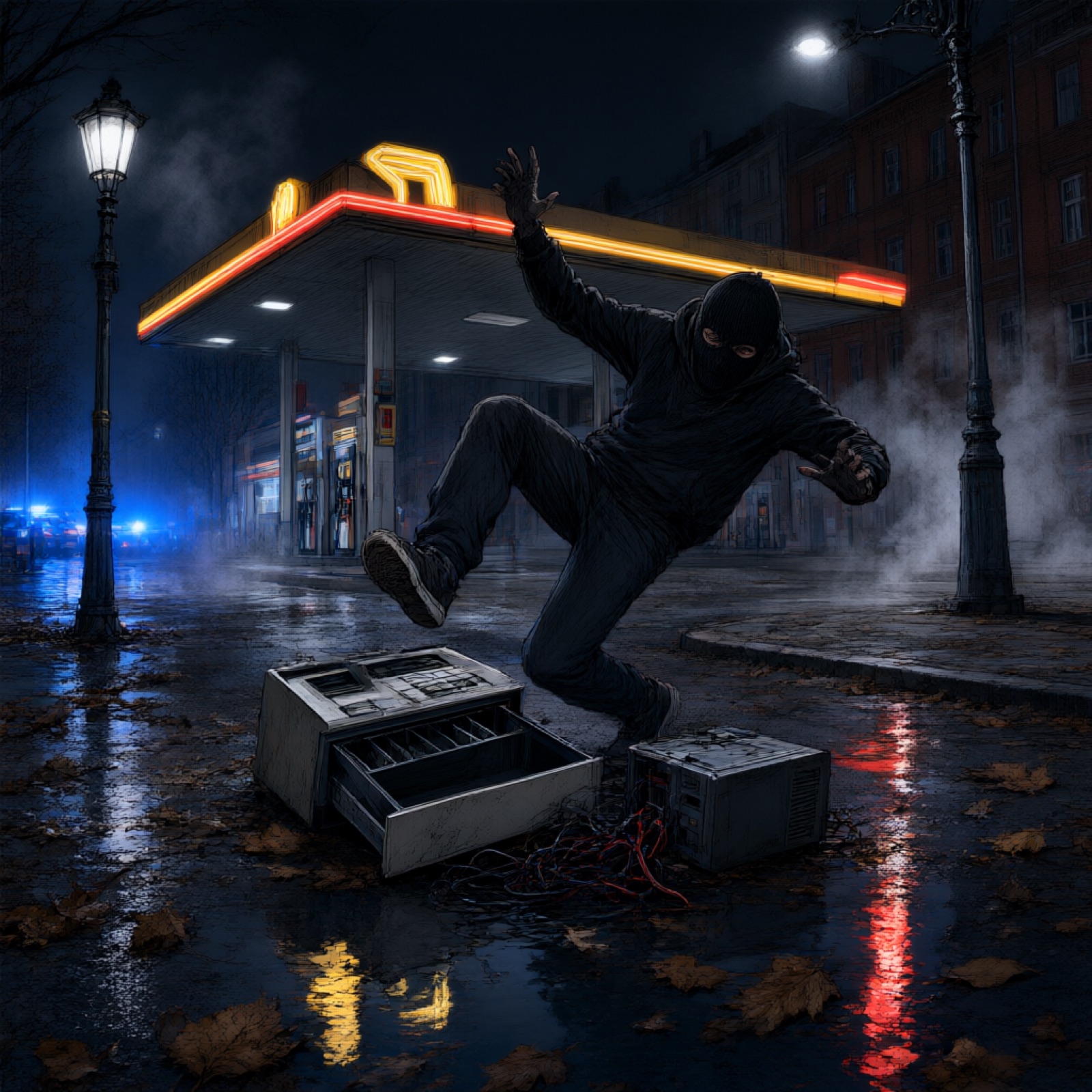
Ten to two. The petrol station on Kapweg sat in the fog like a stranded ship. The neon from the pumps cut yellow stripes across the wet tarmac, and the hum of the coolers was the only noise until the doorbell chimed.
The bloke came from Müllerstraße, hood pulled low, hands in his pockets. Nobody’s out jogging at that hour. No clubbers on the stagger home from Seestraße U-Bahn. Just him and the lit-up windows of the station, where the cashier sat on her stool staring at her phone.
He pulled the door open. Ding.
The cashier — Nadja, mid-twenties, her name badge crooked on her vest — looked up. Saw the revolver. An old Smith & Wesson, looked like an eighties model, black, heavy. You don’t carry one of those for show.
“Revolver,” the man said. Dead calm. Like he was handing her an invoice.
Nadja raised her hands. Slowly. “Till’s nearly empty. Night shift, you know.”
“Till.”
She picked the grey box up off the counter. The till was an old model, 2019 vintage, the keys worn smooth from years of hammering. She slid it across.
The man grabbed it. Turned. And then the thing that wasn’t in any of his scripts happened.
His left foot snagged on the card reader’s cable. It had been hanging half out of its mount for weeks — the technician had been a no-show twice, logged in the maintenance book. The man tripped. The till flew from his hand in an arc, smacked the grey-tiled floor, the lid sprang open. A scatter of coins, clink-clink-clink, one landing on the gum machine. And out of the cracked casing slipped a small black module.
The backup. Looks like an oversized SD card. Stores every transaction since the last system update.
The man swore. Grabbed for the revolver, which had nearly slipped his grip. Kicked the cable free. Ran.
The doorbell was still dinging as he belted across the forecourt, past pump four where an old oil stain mottled the concrete. A dark car — a Golf, looked like a 2018 — rolled up from the other side of the road, no headlights. The man yanked the passenger door open, jumped in. The Golf pulled away, turned left into Seestraße and swallowed itself in the fog.
Nadja stood behind the counter. Her hands weren’t shaking any more. She picked up the phone and dialled 110. As she spoke, she stared at the black module lying by the sweet rack. The robber hadn’t taken it.
Half seven, Kalle stood at the scene. The coffee in his hand was the third — the kind where the spoon practically stands up on its own. The fog had lifted, but the tarmac still glistened. A patrol car was parked across the entrance, lights off, the lads from the night shift leaning on the bonnet having a smoke.
“Morning,” Kalle said.
The younger one nodded. “Till’s still on the floor. Forensics are on their way.”
Kalle stepped through the door. The bell chimed. Nadja sat on a stool in the back room, a blanket round her shoulders. Next to her, Leni, just closing her notebook.
“Kalle. The robber got away with nothing. The till was nearly empty — seventy euro in coins, maybe. Left it all.”
Kalle looked at the floor. The grey box, the scattered coins, the black module. He bent down.
“And this?”
“Backup chip from the till system.”
Kalle turned the module in his hand. A sticker: Till System 4.2 — NordOst Petrol Chain. Below it, a serial number, a model designation and the chain’s logo — three pumps in a circle.
“Four point two,” Kalle said. “That’s not the latest. They upgraded to 5.0 last year.”
Leni looked at him. “How d’you know that?”
“Brother-in-law works in their warehouse. Wouldn’t stop moaning the new modules don’t fit the old casings.” Kalle rubbed his chin. “The till’s empty, the coins he leaves behind, the backup he doesn’t care about.”
“Could’ve been panic.”
“Could’ve been. But if I hold up a petrol station and that thing drops at my feet — why don’t I pick it up?” Kalle held the module up. “He didn’t want this. He wanted summat else.”
“The till was right there. What else does he want?”
“The data.”
The open-plan office at the station smelled of cold coffee and printer toner. Somewhere a printer whirred, complaining of a paper jam three days old. Kalle had plugged the backup module into Leni’s machine, and she was scrolling through the tables.
“Loyalty app,” she said. “Collect points. Every tenth coffee’s free. The app logs purchase behaviour: who fills up when, how much. Who buys a sandwich and a Coke Zero every morning at seven. Who hasn’t shown up for three weeks.”
“Holiday planning via petrol pump.”
“Exactly.” Leni typed. “The system dates from 2022. One of their own IT wrote it. Alone, three months. After that they just maintained it — until eight months ago. That’s when the redundancies hit. Ten people.”
“Let me guess. One of them made more noise than the rest.”
Leni turned the screen. Personnel file: Kluge, Rainer. 34. Employed 2020–2026. Dismissed on operational grounds. Two complaints to HR. One failed application for team lead.
“Name means nothing to me,” Kalle said.
“Nor me. But the tone of the complaints is interesting.” Leni read aloud: “I am the only one who understands this system. Without me, nothing works here. You’ll see.”
“Classic.” Kalle leaned back. “Bloke thinks he’s the star. They bin him, so he has to prove he was right.”
“Narcissistic profile,” Leni said. “Feels undervalued, needs recognition. The robberies are a performance.”
“Go on then — see if he’s still got a stage.”
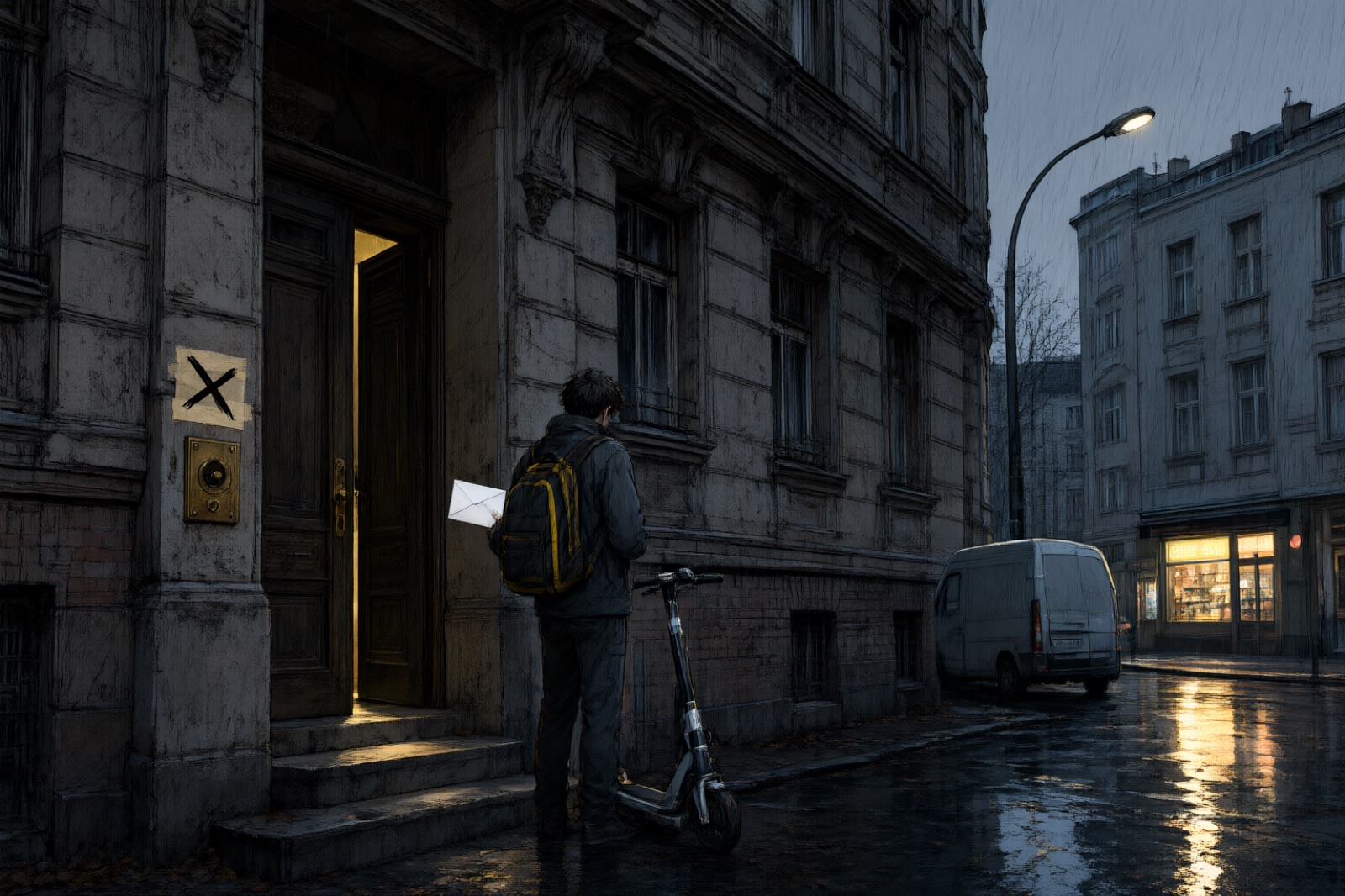
The corner shop at Kottbusser Tor had no name. Just a sign above the door: Drinks · Snacks · Tobacco. Underneath, handwritten on a scrap of cardboard: Today: cold Mate 1.50. The doorbell was the same one every Berlin corner shop uses — a bright, short pling.
Gül stood behind the counter. Late fifties, grey hair in a bun, a cardigan that had seen better centuries. She didn’t look up when Kalle walked in. Her hands were sorting deposit bottles into blue crates.
“Kalle. Been a while.”
“Gül.”
“What d’you want?” She reached for a pack of fags, pulled one out. The ashtray by the till was overflowing.
“Information.” Kalle laid both hands flat on the counter. The surface was sticky from some syrup someone had spilled who-knows-when.
“I don’t do information.”
“Yeah, you do.” Kalle let his gaze drift round the shop. A humming fridge. A shelf of tinned soups that had passed their sell-by in 2024. “Remember the thing with the food standards inspector? The unchilled storage?”
Gül lit the cigarette. The smoke drifted lazily up to the ceiling, where a water stain looked like a map of Brandenburg.
“That was settled.”
“I can unsettle it.”
She took a long drag. “What d’you need?”
“Petrol stations. Kapweg. Someone who knows the system. Ex-IT. Name’s Kluge.”
Gül blew smoke through her nose. A long silence. Outside, the screech of the U-Bahn pulling into Kottbusser Tor station.
“You’re askin’ the wrong bird. I don’t do petrol stations.”
“You do the whole manor.”
Another drag. Another pause. Then: “Kluge. Rainer Kluge. Used to be an IT bod at NordOst. Started turning up here six months ago. Nights. Met a bloke who drives a dark Golf. Always had a laptop with him.”
“What’d they talk about?”
“Jobs. Addresses. The next one’s due. That sort of thing.” Gül crushed the cigarette out. “The bloke’s got a thing. Signs every receipt he finds in the bin. With a biro. The Pump Handle. Like the receipt’s a bleedin’ autograph.”
“The Pump Handle,” Kalle repeated.
“Like the nozzle on the pump. The one that lets the petrol through.” Gül looked at him. “That enough?”
“Where do I find him?”
“Dunno. But the dark Golf parks up in Schulzendorfer Straße sometimes. Back building.”
Kalle nodded. “You were never here.”
“Where was I?”
“At home. With a clean fridge.”
Leni had carried on back at the station. When Kalle got back, she had three browser windows open, a spreadsheet and a printout of the loyalty app data.
“Anything?”
“Yes.” She pushed the printout over. Five addresses, marked in red. Three of them had a tick next to them. “The three with ticks — those got burgled. Each one on days when the car wasn’t at the petrol station. The customers were on holiday.”
“And the two without ticks?”
“Still pending.” Leni scrolled. “Kluge registered a website. Der-Zapfhahn.de. Password protected. No legal notice. The domain’s registered to a shell company in Potsdam.”
“He doesn’t just sign receipts. He signs the whole routine.”
“Right.” Leni leaned back. “And the dark Golf is registered to a Kevin Zabel. Twenty-five. No priors. Address: Turmstraße.”
“The driver,” Kalle said.
“The missing piece. And those two without ticks —” Leni tapped the spreadsheet. “Their last purchases are travel supplies: a full tank, three cans of Red Bull, sandwiches for the drive. Those flats are empty, or about to be.”
Kalle stood up. “Let’s get him, then. Before those two without ticks come due.”
The back courtyard on Schulzendorfer Straße was tight. Bikes chained to the wall, a bin overflowing, a dried-out fern in the stairwell window. Third floor, on the left.
Kalle pressed the buzzer. A handwritten label: R. Kluge, IT Consultancy.
Nothing.
Again. Longer.
Footsteps. The door opened a crack. A man, mid-thirties, unshaven, dark rings under his eyes. He was wearing a T-shirt with the NordOst petrol chain logo — three pumps in a circle. Probably a farewell gift from the office.
“Rainer Kluge?”
“Who’s asking?”
Kalle held up his badge. “Detective Chief Inspector Rieger. This is my colleague Weber.”
Kluge laughed. A strange laugh — not cheerful, not frightened. More like: finally.
“The backup chip.” He shook his head. “Knew I should’ve taken that. Silly mistake.”
“Can we come in?”
“Got a warrant?”
“Not yet.”
“Then come in.”
The flat was a server room with a kitchenette. Three monitors on a long desk, a laptop, cables everywhere — blue, yellow, black, like someone’s had a Technicolor dream about networking. On the wall, a whiteboard with a table. Addresses. Dates. Times. Next to it, a printout: Loyalty App — Export 04.11.2026. Five addresses in red, two of them with empty check boxes.
“Lovely décor,” Kalle said.
“I’m an IT consultant.”
“At two in the morning, at a petrol station on Kapweg?”
Kluge sat down in a swivel chair. Squeaky castors. “Do you know what a loyalty app like that is worth? Customer data on twenty thousand people? Who fills up where, when? Who tops up their tank for a long drive and then doesn’t show up at the pump for a fortnight?”
“Holiday planning via fuel card.”
“Precisely. The app is a goldmine. Every transaction says: this person isn’t home. And if they’re not home, you can break in.”
“And the cash from the till?”
“The cash is peanuts. Seventy euro. Won’t even cover the electricity for these servers.” Kluge nodded at the monitors. “This is the real business. The burglaries bring in five to ten thousand a pop.”
Kalle tapped a finger on the printout. “The fourth of November. You had the data long before this.”
“The data up to the fourth. My access was never shut off — they didn’t even change the passwords after they binned me. But an export is a snapshot. Whatever came in after that is only on the module.” Kluge smiled. “The last few days are the new absence windows, see? That’s what the show on Kapweg was for.”
Leni stepped closer to the whiteboard. “The red addresses. The ones with ticks — those were yours?”
“The ones with ticks are done. The two without ticks were due next week. A couple in Pankow who haven’t filled up since the third of November. And a single bloke in Charlottenburg whose car hasn’t been near a pump since the first.”
“Who drives the Golf?”
Kluge’s smile froze. “I work alone.”
“The dark Golf. Kapweg. Gül at Kotti saw you.”
The name hit him like a punch. His hands gripped the armrests of the swivel chair. “That old witch.”
“The name,” Kalle said.
Kluge stared at the floor. His shoulders slumped, like someone had let the tension out of a rope. “Kevin Zabel. All he does is drive. He’s got nothing to do with the burglaries. I told him it was market research.”
“Market research with a revolver?”
Kluge raised his hands. “The revolver was a replica. The till was just for show. The backup was the star.” He pointed at the whiteboard. “I wrote that system from scratch. 2022. Three months, on my own. Without me, the app doesn’t exist. And what do I get? Redundancy. Operational grounds. Thanks for twenty hours of overtime a week.”
“So you thought: I’ll show them.”
“I showed them what the system can really do. That the data is worth more than all the petrol the chain will ever sell.” Kluge smiled again. That laugh. “The Pump Handle. Because I open the nozzle and the data flows. Get it?”
Kalle pulled out his mobile. “My colleague Schneeweiß at the LKA is about to get a call. Kevin Zabel’s about to get a visit. And you’re about to get a cell — with a pen and a pad. In case you fancy signing anything else.”
Kluge stared at the whiteboard. The two empty check boxes were blinking back at him like dead pixels.
“Good plan, really,” he said quietly. “Just the backup chip.”
“The backup chip,” Kalle said, “was the script. You’re an IT consultant. You should’ve known every system’s got a weak spot.”
Note: All persons, places and events in this story are fictional. It was inspired by a public police report but does not depict any real events, persons or situations. Further information: Legal Notice.