The Bench on Gleditschstraße
The Bench on Gleditschstraße
The radio crackled at twenty past eight. Bodily harm, Gleditschstraße, corner Belziger Straße. A sixty-year-old, park bench, antisemitic background. Staatsschutz alerted as well.
Kalle left his coffee. The cup was still half-full, the foam already collapsed. “Right you are, mate.”
Leni didn’t look up from her display. The blue light reflected in her glasses. “Witness from the neighbour’s balcony. Second floor, number 14. corner shop operator on the corner Belziger as possible informant. Victim: Maurice Goldstein, 62, pensioner, former bookseller in Akazienstraße. Gave up the shop three years ago, rents went up, online trade, the usual stories.”
“Goldstein,” Kalle repeated. He pulled on his leather jacket, checked the badge at his belt. “Sounds like a long night. And a case that won’t let go.”
“Staatsschutz takes it officially,” said Leni. She pocketed her mobile, grabbed her jacket. “Hate crime. Section 46 StGB. Aggravating motive. The press office already has the template ready.”
“Press office,” Kalle growled. “They know more about our cases than we do sometimes.”
The car rolled over Kurfürstendamm, turned into Tauentzienstraße. Rush hour traffic backed up to Wittenbergplatz. Autumn light lay low and golden over the city, the plane trees on Gleditschstraße casting long shadows on the asphalt. Mist already crept over the ditches in the Volkspark, crawling up the slopes, but here in the streets it was just cool and damp. The kind of weather where Berliners turn up their collars and go quiet, where breath forms small clouds and streetlamps paint halos in the fog.
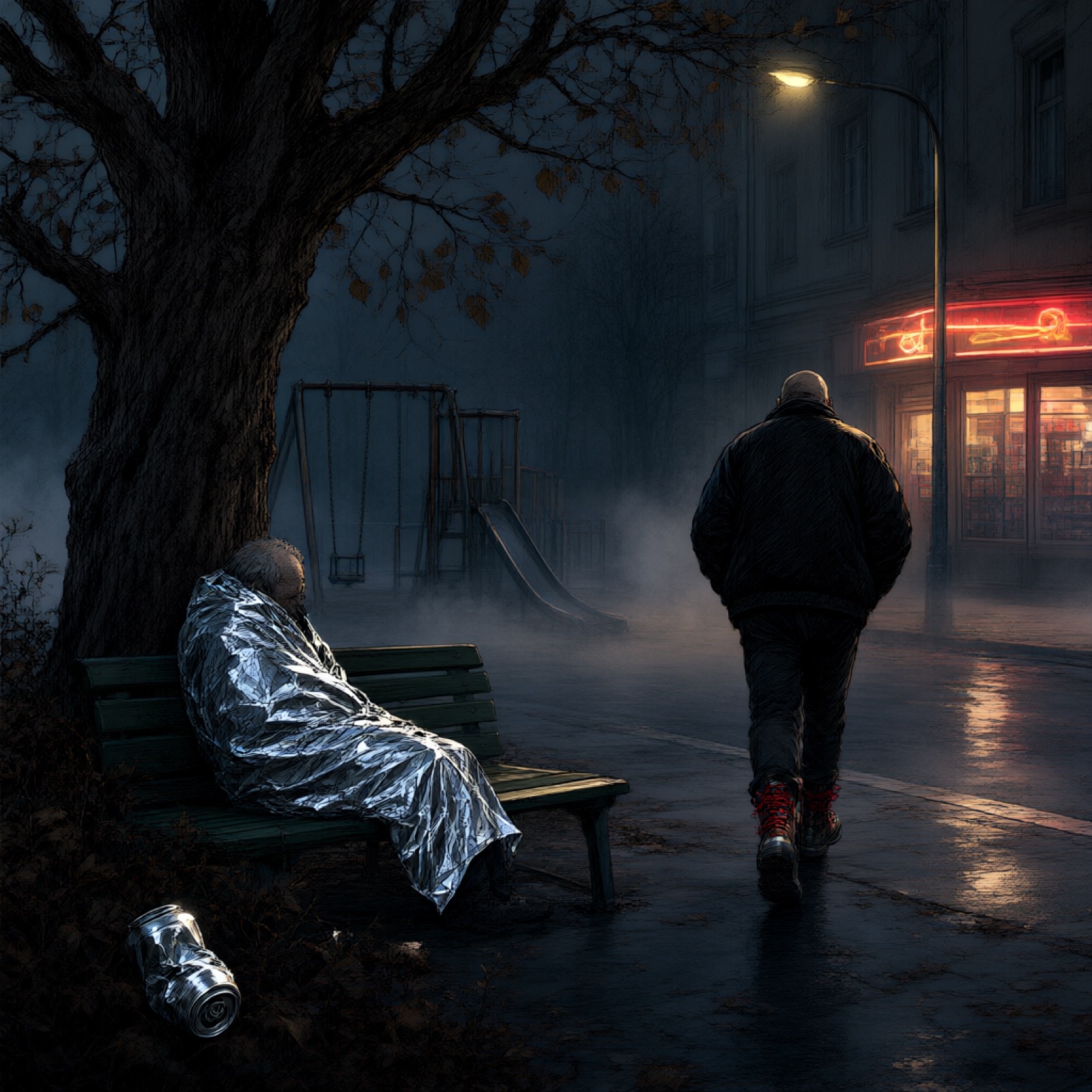
The bench stood under an old linden, right by the small playground with the bent slide and sandpits where no children had played at this hour for years. Maurice Goldstein still sat there, a rescue blanket over his shoulders, the silver foil rustling with every breath. A paramedic dabbed blood from his temple, a plaster sat crooked over his eyebrow. The beer can lay in the bushes, crushed, brand Berliner Kindl, the remaining beer soaked dark into the leaves. Someone had thrown it with force – you could see it in the deformation, the way the metal had torn.
Kalle showed his warrant card, the movement routine, done more often than drinking coffee. “Detective Chief Inspector Rieger. This is my colleague Weber.”
Goldstein looked up. His eyes were clear, despite everything. A face that had seen life – deep lines beside the mouth, a scar on the chin, grey hair tousled wild by the wind. “Maurice Goldstein. I’m waiting for my wife. She forgot where we agreed to meet. So I sat down. Every Monday. Eight o’clock. The bench under the linden. Thirty years now.”
“And then?” asked Leni. Her voice was calm, precise. No Cockney, no irony. Just there. An anchor.
“Then he came down Belziger.” Goldstein brushed his coat, a gesture as if brushing off dust, as if brushing off the attack. “Big. Broad. Bald head. Steel-toed boots, red laces – you don’t see those much anymore. The look… he wasn’t drunk. He was decided. Like someone with an appointment.”
“What did he say?”
“Nothing at first. The can. Full. Right in the kisser.” Goldstein exhaled, slow, controlled. “Then: ‘Dirty Jew.’ Then the fists. Two, three punches. I went down, on my knees. He kicked me too. In the ribs. Then he legged it, towards Hohenstaufenstraße. Didn’t run. Walked fast. Like someone catching a bus.”
Kalle noted in his small black notebook. Bald. Steel-toed boots, red laces. No alcohol. Targeted. No robbery. “Did he take anything? Watch, wallet, mobile?”
“My watch is still on my wrist.” Goldstein lifted his arm, a plain Seiko, scratches on the glass. “Wallet in the inside pocket. Mobile in the other. He wanted nothing. Just… that.”
“Just that,” Kalle repeated. “Beat him. Send a message.”
“Wasn’t a robbery, then.”
“No.” Goldstein looked at Kalle, long, measuring. “Never was. I know the type. They don’t want to have. They want to be.”
Leni photographed the bench, the can, the bloodstains on the slats, the imprint of a boot in the soft earth beside the pavement. “Staatsschutz takes it officially. Hate crime. Section 46 StGB. Colleagues from Staatsschutz are en route. Detective Chief Inspector Schröder. You know him.”
“Schröder.” Kalle raised his eyebrows. “The one with the file cover that always sticks. The one who nicked the Neukölln Nazi-shop case from under my nose in 2019.”
“He’s changed,” said Leni drily. “So they say.”
“People say a lot. Rarely true.”
They crossed to number 14. The balcony on the second floor, left side. A man stood there, mid-fifties maybe, grey jumper, a cigarette between his fingers. He wasn’t smoking, just holding it. When he saw the two, he pulled his head in, not fleeing, more… making himself small.
Kalle stopped, looked up. “Mate…?”
“Müller,” the man called down. “Werner Müller. I… I saw something. Maybe. Not much.”
“Everything’s something,” said Leni. She took out her notebook, no mobile now. Paper. Pen. Old school, but with witnesses often better. “Take your time. What did you see?”
Müller hesitated. The smoke from his cigarette drifted sideways, blown by the wind. “The bloke. The one with the bald head. He didn’t just come down the street. He came out the back yard. Number 12. Saw him come out. Checked his mobile once more. Then off. Purposeful. Like you said: like an appointment.”
“Back yard number 12,” Leni noted. “Anyone living there you know?”
“Commercial. Ground floor. Furniture. ‘Möbel Lorenz.’ Business during the day, usually quiet at night. But today… today there was light. First floor. Window open. Heard voices. Not arguing. Talking. Quiet. Businesslike.”
Kalle and Leni exchanged a look. No words. Not needed.
“Can you describe the man who came out?” asked Leni.
“Bald. Steel-toed boots. Red laces. Black bomber jacket. Tattoo on the neck. Couldn’t make out what. Too far. But…” Müller hesitated again. “He had something in his hand. A paper. Note. Read it, then tucked it in his jacket. Then over to the bench.”
“Cheers, Mr Müller,” said Kalle. “We might be in touch again. For a formal statement.”
Müller nodded, disappeared behind the balcony door. The light went out.
“Businesslike,” said Kalle as they walked back to the motor. “Not pissed. Not spontaneous. A job.”
“Lorenz,” said Leni. “Möbel Lorenz. Columbiadamm. Industrial estate Tempelhof. Fencing, logistics, fraud. He pulls strings.”
“And Denny Krüger’s the tool,” said Kalle. He opened the car door. “Steel-toed boots, red laces. Bald. Neck tattoo. Matches the priors.”
The corner shop “Eckstein” glowed in red-yellow neon into the dusk, a lighthouse in the mist. Inside: shelves to the ceiling, a mountain of deposit bottles at the door, the smell of cigarette smoke and greasy fryer fat, cheap coffee and stale beer. Behind the counter a man late fifties, grey hair, a T-shirt that had once been white, an apron over it that had seen better days. He polished a glass, not looking up. The bell on the door didn’t chime – Kalle opened it slow.
“Illya,” said Kalle. He stopped at the counter, not pushy, not friendly. Just there. “Long time no see.”
Illya lifted his head. His eyes were tired, the lids heavy. “Rieger. Weber.” He said it like a warning. Like a weather report: storm warning. “What d’you want? I’ve got peace. I want peace.”
“Peace when we’re gone.” Kalle laid his hands flat on the counter, the wood sticky from decades of beer and cola. “Just an hour ago. Bench by the linden. Bald head, steel-toed boots, red laces. Black bomber. Ran past your gaff. Towards Hohenstaufen.”
Illya set the glass down. The cloth he laid beside it, slow, deliberate. “Loads of people run past here. Joggers. Pissheads. Deliveroo lads. Why this one?”
“The bloke put someone in hospital.” Kalle lowered his voice. “Antisemitic motive. Staatsschutz is on it. Section 46. The bloke’s name is Dennis Krüger. Thirty-three. Priors: GBH, intimidation, theft. Lives Schöneberg, subletting from an aunt in Hohenstaufenstraße. Exactly the direction he scarpered.”
Illya breathed in sharp. His grip on the cloth tightened, knuckles white.
“Knows him,” said Kalle. Not a question. A statement.
“Maybe.” Illya dragged on his fag, smoking in an ashtray he’d set up. The smoke hung heavy in the shop, mixing with the grease smell. “Maybe not. My memory’s got holes, Rieger. Especially with people who owe me dosh.”
Kalle leaned against the counter. “Footy bets. Last month. Two-fifty quid. HSV vs St. Pauli. You put it on Hamburg. I was there when you filled the slip. ‘Hamburg wins, Rieger, the Pauli amateurs’ll never manage it.’”
“Was a good tip.” Illya’s voice stayed flat, but a muscle twitched at his jaw. “Till the ninetieth minute.”
“Till the penalty for Pauli. Two-fifty, Illya. Plus interest makes three hundred. Or you tell me where Denny lives. Exactly. And what he got up to this afternoon. And who rang him.”
Illya stared at him. No smile. No joke. Just that cold calculation in his eyes that Kalle knew so well. Informants aren’t mates. Aren’t trustworthy. Pursue their own interests. Cooperate reluctantly. Give info reluctantly. Only when Kalle or Leni apply pressure – old debts from favours, legal leverage, own emergencies, agreements – do they release information. Their intel is a service, not help. They expect a quid pro quo or their own skin saved.
“Pressure,” Illya murmured. “Always pressure.”
“Old debts,” Kalle corrected. “Favours. You know the rules. We do too.”
Illya stayed quiet a long time. The fridge hummed. Somewhere a bottle clinked. Outside a siren wailed, far off, towards Kurfürstendamm.
“Back building, third floor left,” Illya said at last. “Door rattles. But Rieger – he’s not alone. There’s someone else. One pulling the strings. Denny’s just the hand. The tool. The order came from above.”
Kalle nodded. Once. “Good job.”
He turned. Leni was already at the door, hand on the handle.
“Wait,” said Illya. “The three hundred. They stand. But…” He hesitated, rummaged in his jeans pocket, pulled out a crumpled bit of paper, slid it across the counter. “Denny got a call today at noon. About twelve. Changed after. Went out like he had an appointment. Not like going on the lash. Mobile lay on the counter. I didn’t look. But the number… wrote it down. For the eventuality that… well.”
Leni took the note, examined it, pocketed it. “Thanks, Illya.”
“Don’t forget the three hundred,” Illya called after her back. “I don’t forget nothing.”
Outside the mist had thickened. It tasted of rain and leaves, exhaust and wet asphalt.
“Pressure works,” said Leni in the motor, while Kalle started the engine. “Still does.”
“With Illya always.” Kalle pulled away, headlights pushing through the haze. “The bloke at the number. Who is it?”
“Let me check.” Leni tapped on her work mobile, fingers quick. “030 prefix. Landline. Address: Tempelhof industrial estate, Columbiadamm 47. Company ‘Möbel Lorenz.’ Owner: Lars Lorenz, 48. Priors: fraud, forgery, fencing, commercial fencing. Known as a logistician for… well. For people who need things moved. Discreet. Fast. No paperwork.”
“For who?”
“For structures. Networks. Not just one crew. He’s the interface.”
Kalle drove along Belziger, turned into Hohenstaufenstraße. Gründerzeit façades, renovated, expensive rents, balconies with flower boxes no one waters. In the back yard a light burned on the third floor left. The door rattled in the wind, a rhythmic clack-clack like a heartbeat in the silence.
“Dennis Krüger,” said Kalle. “First appearance. Let’s see if he comes back. Entry in the list.”
They buzzed. No response. Kalle knocked, firm, three times. “Police. Open up. Krüger, we know you’re in.”
Footsteps inside. Heavy. Slow. Then the door, a crack. A man, mid-thirties, bald head gleaming in the streetlight, steel-toed boots with red laces, tattooed neck – a gothic script, “Honour” or “Loyalty” or whatever these types imagine. Eyes bloodshot but alert. Watchful.
“What d’you want?” he grunted. His breath stank of beer and fags.
“Dennis Krüger?” Kalle showed the warrant, brief, routine. “Detective Chief Inspector Rieger. Colleague Weber. This evening, twenty-fifteen. Park bench Gleditschstraße. Maurice Goldstein.”
Denny’s face didn’t change. A mask. “Don’t know him. Wasn’t me. I was at home. Whole time.”
“Your aunt said you’ve been out since noon. Walk. Clear your head.”
“Right. Walk. Clear my head. That’s allowed, innit?”
“With a call at twelve? Möbel Lorenz, Columbiadamm? Landline. Your mobile pings the cell at Columbiadamm at twelve-oh-seven.”
Denny’s jaw tightened. A muscle twitched at his jaw, the only crack in the façade.
“Dunno what you’re on about. I was walking. In the park. Alone.”
Leni stepped forward, one step. Not threatening. Presence. “Dennis. We’ve got the mobile. The call. The cell. And we’ve got Illya. He’s noted your number, for when you don’t pay him the two-fifty. How long you reckon you stay out if Staatsschutz finds out you’re not just a thug, but a hired gun? That the antisemitic background wasn’t the motive, but staging? A cover?”
Dennis stared at her. The arrogance slipped. Not fear – calculation. A bloke weighing his options.
“What if I talk?” he asked hoarsely. “What do I get?”
“What you get, the Staatsanwaltschaft decides,” said Kalle. “Not us. But: cooperation gets noted. Non-cooperation too. Section 46 stays. Not negotiable. Hate crime. Minimum sentence goes up. Remand’s near certain.”
“The section…” Dennis laughed short, ugly, a sound like gravel in a gearbox. “The section’s the only thing that’s true. The job was: Goldstein. Beat him. Not kill. Send a message. The caller said: ‘He needs to understand.’ That’s it. No name. Number withheld. But…” He hesitated, swallowed. “The voice. I know it. From footy. Hertha. Ostkurve. Sits there sometimes. In the block. Row seven, seat twelve. The bloke with the grey hat. Always the same hat. Grey. Felt. Brim slightly bent up.”
“Lars Lorenz?” asked Leni.
Dennis went quiet. Looked away, to the side, at the wall. That was answer enough. Confirmation without words.
“Right,” said Kalle. “Come with us then. And your mobile stays. We’ll get it with a warrant.”
They led him off, handcuffs, in front not behind – Denny wasn’t a flight risk no more, he’d calculated and lost. In the motor, on the way to Section 42, Leni said: “Lorenz. Fencing, logistics. He pulls the strings. Denny’s just the tool. But the tool knows the craftsman.”
“Tool with steel-toed boots,” said Kalle. “And a bald head. And red laces. Section 46 sticks. Hate crime. That’s enough for remand. For a start.”
“And Lorenz?”
“We’ll get him too. Eventually. If the neighbour testifies. If Illya confirms his number. If Denny folds and describes the hat-bloke. If we get Lorenz’s mobile data. If, if, if.”
“Loads of ifs.”
“Berlin ain’t a village,” said Kalle. He turned into Parkstraße, the blue light throwing blue shadows on the façades. “But sometimes it’s smaller than you think. And the ways are shorter than the perps hope.”
At Section 42 Staatsschutz took over. Detective Chief Inspector Schröder himself – grey suit, file cover that didn’t stick, glasses he constantly pushed up. He took the protocols, nodded curt, said no thanks. Didn’t need to.
Kalle and Leni handed over protocols, logged the beer can in evidence, the mobile data on the server, Illya’s note in the file. At three in the morning they sat in the duty room, two cold coffees in front of them, steam dancing in the yellow neon tube.
“Goldstein,” said Leni. She stared into her cup. “The old man. He didn’t shake. Not once while telling it. Not showing the bruises on his ribs. He… waited. Like he was used to it.”
“Victims are trustworthy,” said Kalle. He didn’t even stir. “Always. That’s the rule. They give info willingly. Questioned respectfully, calmly, patiently. Leni-style.”
“And witnesses?” asked Leni. “Müller on the balcony. He made himself small. Pulled back. Fear?”
“Maybe. Maybe just… caution.” Kalle took a sip. The coffee was bitter, cold, perfect. “Rule of thumb: eighty percent of witness statements are reliable. Müller’ll testify. Maybe not everything. But the essentials. Back yard. Light. Voices. Businesslike. That’s enough for a search warrant at Lorenz’s.”
“And Illya?”
“Illya’s Illya. Informant. Not trustworthy. Self-interested. Talks only under pressure. Old debts. Betting debts. The three hundred quid he’ll collect. Eventually. His way.”
“We use him.”
“We use each other. That’s the system.”
Kalle set the cup down. The clink was loud in the small room.
“Good job today,” he said.
Leni looked at him. No smile. Just a short nod. A brief moment where the air vibrated different. “You too.”
Outside Berlin lay in the mist. Gleditschstraße slept. The bench under the linden was empty. Just a few leaves whirled in the wind, wet and heavy, red and gold and brown, the last autumn splendour before the grey.
Next morning, at the handover to Staatsschutz, Kalle laid the note with the number on the table. “Illya. The corner shop. He delivered. Under pressure. As always.”
Schröder took the note, examined it, filed it. “Unusual method. But results-oriented. The crown witness Krüger… he’ll testify?”
“He calculates,” said Kalle. “He calculated and lost. Now he calculates anew. Lorenz is the target. Krüger’s the way.”
“Berlin methods,” said Schröder. A hint of something in his voice. Recognition? Mockery? Didn’t matter. “Working for thirty years.”
“Sometimes,” said Kalle. “Sometimes not. But today they did.”
He went out. Leni followed. The sky was grey, the air smelled of rain, wet leaves, Berlin.
“Next case?” she asked as they walked to the motor.
Kalle shrugged. Opened the door, sat behind the wheel. “Right you are, mate. First coffee. Proper. Hot. Not this stuff.”
Leni got in, belted up. “They do it at the petrol station on the ring road. Two lefts, then right.”
“I know the way.”
“I know. Me too.”
The motor rolled off. Behind them lay Gleditschstraße, the bench, the linden, the mist. Ahead lay Berlin. Still.
Fictional Disclaimer: This story is purely fictional. All characters, actions, and dialogues are invented. Any similarities to real events or persons are coincidental and unintentional. The underlying police report served only as inspiration.