Paid in the Leg
Chapter 1: Two Shots, Six Paces
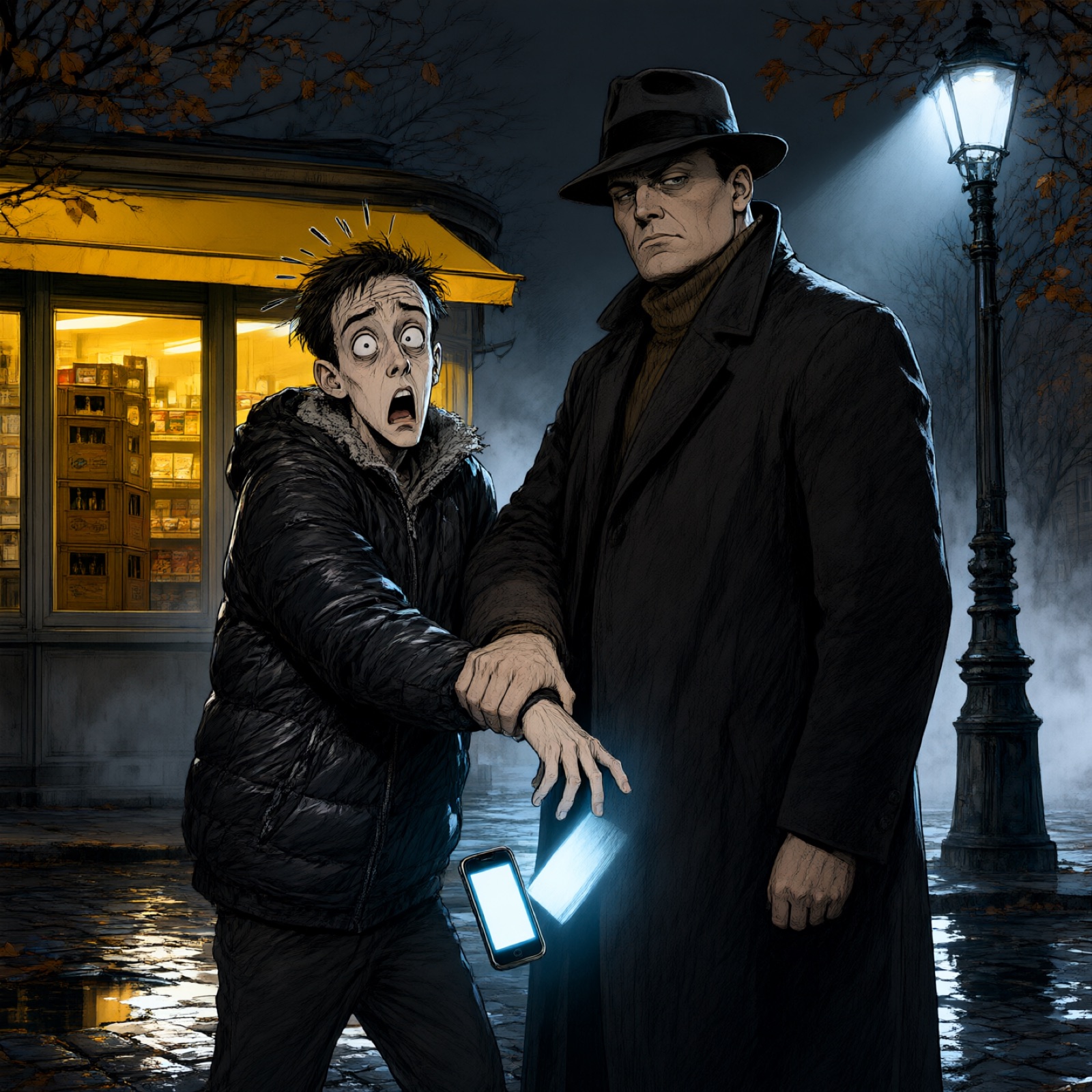
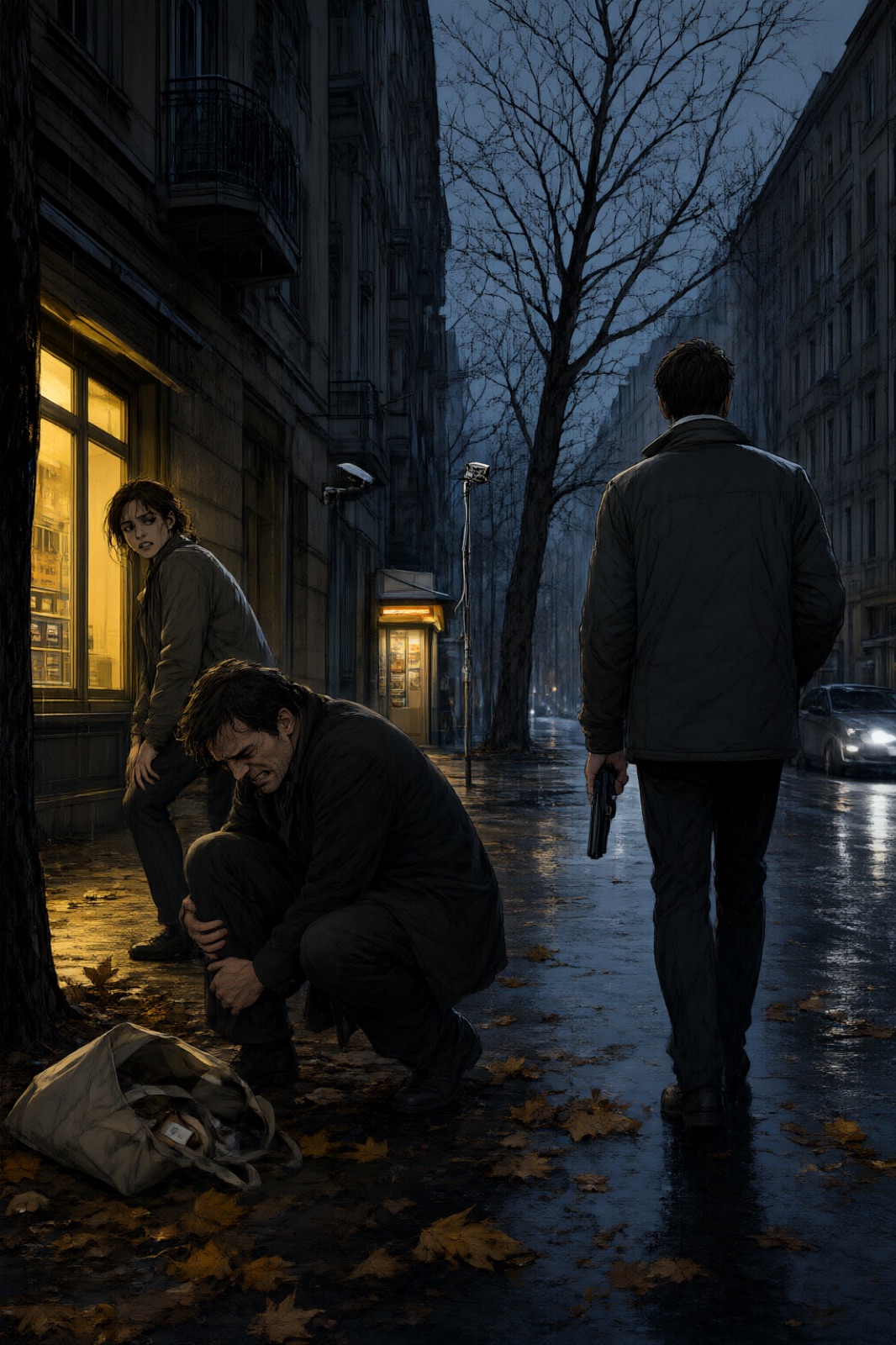
At ten past eight Goltzstrasse smelled of rain that never fell. It just hung there, greased the car windows and made the kerb slipperier than soap. Around the corner a radio was playing that nobody had switched off, and somewhere in a courtyard a man was throwing bins about as if he had a bill to settle.
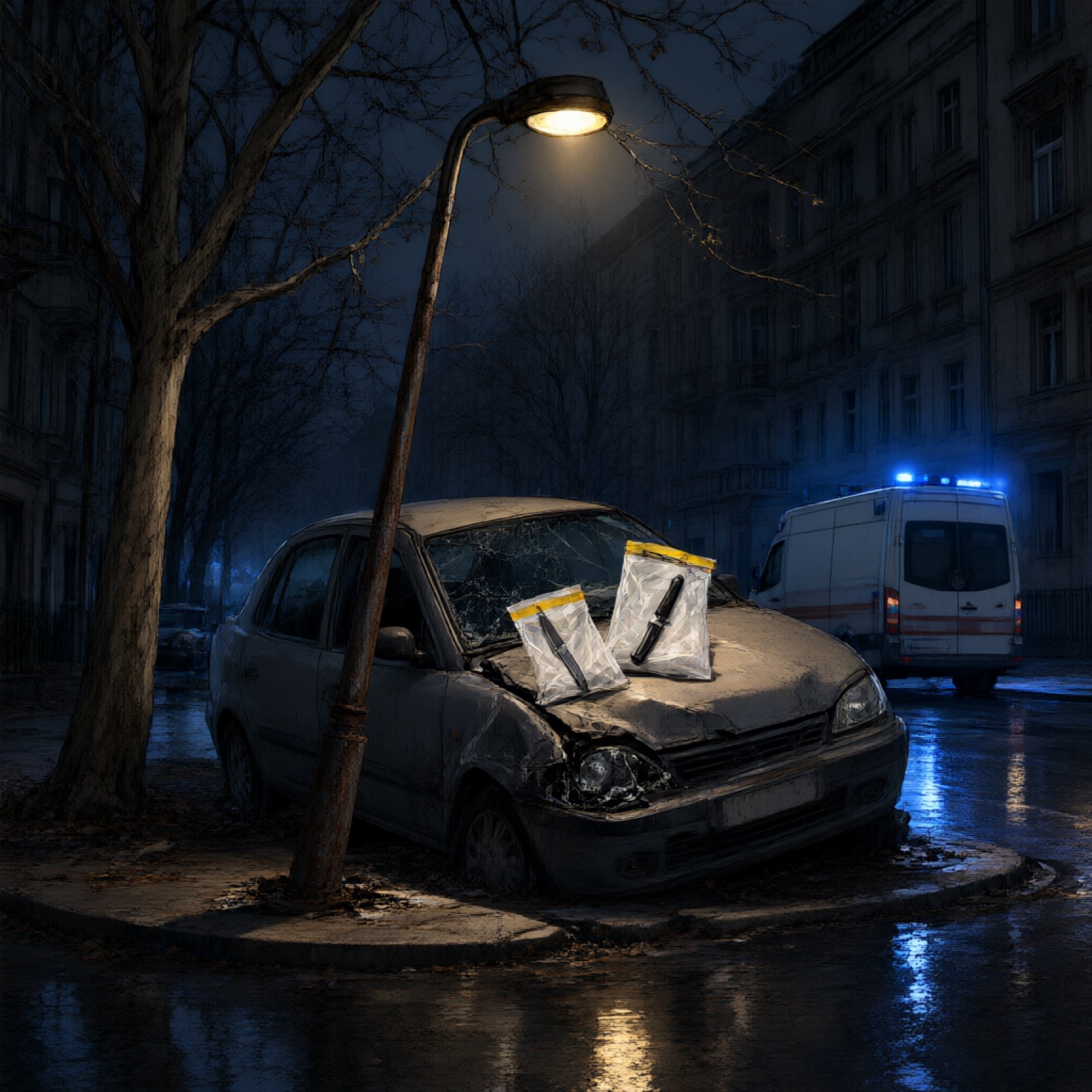
Kalle stood beside a patrol car with its blue light off and looked at two chalk outlines. The long one was the man. The short one was the girl. A hand’s width of pavement lay between them, and next to it, in the gutter, a glove with the fingers cut off, marked with a red clip by the scenes-of-crime lads.
“Six paces,” Leni said. She had borrowed a folding rule off the forensic team and was measuring from the first shell mark to the chalk foot. “Six, six and a half. Twice.”
“Same distance twice?”
“Same distance twice, same height twice. The casings are almost touching, like somebody dropped them.”
Kalle looked down the street, then back. “So he stopped and took his time. And then—”
“Then he walked off,” Leni said. “The witness from the corner shop says at a normal pace. He muttered something about a hat.”
“With or without?”
“He says with a hat. He also says the man looked like somebody popping out for a beer.”
Kalle took a sip from the cup he’d carried out of the office and still hadn’t opened. “Six paces, knee height, no hurry. I don’t know what that is, Leni, but it’s not an attack. Nobody doing an attack walks out the distance first.”
“Maybe it was practice.”
“Practice looks different. Practice has the shakes.” He pointed at the chalk. “This is bookkeeping.”
At the hospital in Am Urban the man lay in room 4 and didn’t say much, because talking hurt. His name was Torben Reimers, thirty-nine, a driver for a drinks wholesaler in Mariendorf, and he was still in work trousers with the fabric cut open above the knee by the paramedics. On the side table his phone had buzzed twelve times, because half the firm wanted to know what had happened on Goltzstrasse.
The girl was two doors down. Michelle Stober, nineteen, a shot through the left knee, through the kneecap, the doctor said. She wasn’t crying, which worried Kalle more than crying would have.
“I was waiting for him,” she said. “He’s my mum’s boyfriend. I only wanted to walk him to the bus.”
“And then?”
“Then it banged, and I turned round, because I thought it was a car.” She looked down at herself, at the leg under the blanket. “When I turned, it banged again. The second one was for me.”
Kalle sat down on the chair they keep for relatives, the one that’s too low. “Did you see the man? Before?”
“He came out of the light from that shop. He stopped.” She thought about it for a long while. “He stood there like a bloke in a queue who isn’t next. Dead calm. No gloves on him.”
“A jacket?”
“Grey. Dark grey. Quilted, like. And his shirt collar was up over it, one of them pale ones.”
Leni wrote it down without looking up. “You said: out of the light from that shop.”
“Yeah.”
“Which shop?”
“That one.” She nodded at the window, as if she’d forgotten she wasn’t lying in Goltzstrasse. “The betting shop. He’s always in there. I’ve seen him in there while I was waiting for Torben. He stands in there like a teacher in a classroom.”
Kalle looked at Leni, and Leni stopped writing.
At a quarter to eleven they were back on the street. The chalk was washed away, the glove was in a bag, the radio behind the corner was still going. Leni switched on her torch and swept the gutter grate, because she always does, although it has only paid off twice. This time she swept for longer.
“There’s paper down there.”
She fetched two colleagues with gloves, and then it was in an envelope: a betting slip, folded in the middle, one corner brown with something nobody wanted to examine. Date and time printed small and bold at the top. 19 Nov, 19:56. Stake twenty euros. Lost.
“Fourteen minutes before the shots,” Leni said.
Kalle looked up the front of the building. Above the door of the corner shop opposite hung a camera, black, with a cable somebody had fixed to the downpipe with zip ties, and the lens wasn’t pointing at the shop. It was pointing at the street.
“How long has that been up there?”
Leni raised the torch. “As long as the kiosk’s been there.”
“And it’s not pointing at the bit of street we’re standing on. It’s pointing at the two metres next to it.”
“At the pavement, exactly.” Leni lowered the torch. “I’ll ask in the morning whether it’s still recording. But the slip is what I’m touching first.”
Kalle put the cup in his pocket. “You know what I don’t like about this? The man put two people in the leg and then walked home. An attack looks different. A man doing an attack looks like he’s scared.”
“And what does a man look like who isn’t scared?”
“Like he’s writing something off.”
Chapter 2: Four Files, One Angle
On Friday at half eight Leni put four files on her desk, one printed, three out of the system. She didn’t stack them, she laid them side by side, because she says when you stack them you only see the edges.
The first case was four months old. 12 July, Alt-Tempelhof, a man with a shot in the right knee, ten at night, gunman on foot, nothing taken, no argument beforehand, nobody recognised anybody. The second: 3 September, Neukoelln, Weserstrasse, left lower leg, one shot, offender on foot, victim with gambling debts. The third: 17 October, Moabit, Turmstrasse, right knee, one shot, “no leads on the offender”.
Three cases, three stations, three times the same file-number format and three times the same line at the end: inquiries closed, no offender.
In all three scene sketches the distance between casing and victim was entered. 6.5 paces, 6 paces, 7 paces. And in all three reports was what the pathologist had written: entry wound from the front, slightly angled from above, at knee height.
“That’s the same tradesman,” Leni said, when Kalle came in at ten with two coffees, one of which he didn’t drink.
“Same gun?”
“Not in the files. The casings were only compared in two of them.” She picked up the phone. “Hendrik. Tell me about the casing comparison from 21 October.”
Hendrik Sander was on the third floor at Platz der Luftbruecke and took nine minutes, which for him was quick. He came back with a printout, held it in both hands as if it were heavy, and read it out like a man who doesn’t really like numbers but prefers them to people.
“Comparison report, 21 October. Casings from the 12 July case and casings from the 17 October case: same weapon. Firing-pin mark, extractor mark, the lot.” He looked over the top of the page. “And then nobody added the third case, because that one was in Moabit and the report was in Tempelhof, and in Moabit nobody knew the report existed.”
“And last night?” Leni asked.
“Give me the casing numbers and I’ll tell you tonight whether it’s the same one.”
Kalle sat down on the edge of the desk. “That’s not a run of coincidences, that’s a method.” He looked at the files. “With this sort of thing you always ask yourself: why does a man walk up to a stranger in the street and shoot him in the knee?”
“Maybe he’s not a stranger.”
At twenty past ten they were in room 4 in the Urban, and Torben Reimers said what he hadn’t said in the night.
“Four thousand eight hundred,” he said. “Twelve instalments, four hundred each. I paid eleven and missed the twelfth, then I went into the red, then it was four, and on instalment four I said no.”
“To who?”
“To him. To Rene.” Reimers looked at his hands. “I said it out loud, the shop was full. Five people at least, and two of them are neighbours of mine.”
Kalle leaned back. “What did you owe him at that point? Four hundred?”
“Four hundred. Over four hundred euros.”
“And what did he say?”
“He looked at me like a teacher who’s caught you copying. Dead calm. And then he said: then we’ll write it down differently.” Reimers swallowed. “I thought he meant in his book. I left. Michelle was waiting outside. Ten minutes later she’s in hospital.”
Leni looked up from her notebook. “You said Rene. Rene who?”
“Rene Zabel. The shop’s called Goldlinie. He’s the boss, but everyone says the till-keeper.”
Kalle looked at Leni. “Four cases in four months,” he said. “The three old files give no motive twice and gambling debts once. Not one of them names a man.”
In the car Leni said: “The slip is from Goldlinie. The shop is forty metres from the scene. The man has stood in that doorway like a teacher having a fag for years.” She pulled her belt on. “And the name’s been in the trade register since 2012, with nothing against it.”
Kalle said nothing. He watched Goltzstrasse go by, full of people with shopping bags, and then he said: “He collected an instalment with a pistol. Two people, one receipt. And we’ve got three more receipts in a drawer that don’t point at him, because nobody asked about the distance.”
“Until now.”
Chapter 3: The Statement That Came Back
At eleven they were back in room 6 at the Urban, because a girl with a shot-through kneecap doesn’t come down to an interview room. Michelle was propped higher than the night before, the leg on a wedge, and beside her sat her mother, who had apologised on the way in, for the jacket and for the time.
“You want to say something,” Kerstin Stober said. It wasn’t a sentence, it was a sentence she’d arranged on the stairs. “She can’t remember it properly any more.”
Leni pushed the water bottle across the bed without asking. “Mrs Stober, what’s happened since I saw your daughter here last night?”
“Nothing.”
“Michelle?”
The girl looked at the blanket. “It was dark. I only saw a man. I don’t know what he looked like.”
In the night she had said: dark grey quilted jacket, pale shirt collar, no gloves on the man, hands in his pockets, “like in a queue”. Now all of it was gone. Leni turned the pages of her notebook slowly, didn’t look up, and said: “I’d have said that too, if I was frightened.”
Kerstin Stober opened her mouth and shut it again.
“What happened at the bakery?” Kalle asked, and because he didn’t say it like a question but like a statement of fact, the mother answered before she noticed.
“Quarter to seven. He said my daughter should stop pointing. He said, I don’t want to come out my door any more, and then he picked up his paper and went out, normal like.” She looked at Kalle. “Grey jacket. Nothing else. Not a word about you, not a word about police. He said, if she keeps pointing, then—” She stopped.
“Then what?”
“Then it’s your turn.”
Leni looked at Kalle, and Kalle looked back, and neither of them was pleased that the threat confirmed the statement. Out in the corridor Leni said: “Good witness, that. I didn’t expect it. She remembered the jacket, not the man.”
“She remembered he walked out normal. Like on Goltzstrasse.”
At one they were in the Goldlinie, between two glass cases of betting slips and a screen showing a dog running across a lawn in slow motion. It smelled of condensed milk and cold smoke, though nobody was smoking.
Rene Zabel came from the back, wiped his hands on a cloth, folded the cloth and put it on the counter. Pale shirt, tie, sleeves rolled up a finger’s width. He looked like a man who doesn’t think much of kebab shops.
“CID. You want to talk about Thursday.”
“Let’s sit down,” Kalle said, and sat down already.
Jasmin Kluth stood behind the counter, twenty-four, a bangle, a biro behind her ear, and took a torn betting slip off a pile and ticked a box. She noticed Leni watching and smiled.
“I’ll tell you now,” she said, before anyone asked. “Rene was here. From eight till just before ten. He stands here and does the till.” She looked at him, not at Leni. “I told the uniform last night as well, but he didn’t want to write anything down.”
Kalle let her finish. “And on the phone? You’ve got a phone here?”
“‘Course.”
“Good.”
Zabel turned the biro on the counter slowly, with two fingers. “Mr Rieger, I understand it. My till takes money and three doors down something goes bang. But I can tell you where I was, and she can tell you too. We’ve got nothing to hide here, except the things you don’t say out loud.”
“Which things don’t you say out loud?”
“That people lose money here. That yesterday’s customer hasn’t paid four instalments and I’d have told him nine times anyway.” Zabel looked up. “I didn’t shoot him, I laughed at him. You can work with that or you can’t.”
Kalle looked at the walls, at the cameras, three of them, all pointed at the counter, then at the screen with the dog, then back at Zabel. “Where’s the camera that looks at the door?”
“There isn’t one. Data protection.”
“And these?”
“Counter.”
Leni looked at the pile of slips Jasmin was ticking. “What are you doing there?”
“Reconciling. The torn slips from the day before, we tick off what’s paid.”
“And the customer pays that afterwards?”
“Not only,” Zabel said, and then said nothing else, and that was the first time that day he’d said too much.
On the way back they passed the new betting shop on Akazienstrasse with the sign “First week: tick allowed”. Leni looked at it like an invoice. “Opened on the eleventh of the eleventh,” she said. “And Reimers humiliated him on Thursday in front of five people. That’s not a coincidence, that’s a calendar somebody’s been doing sums on in a temper.”
“Five people,” Kalle said. “And a girl standing next to him. What keeps me awake about it: he didn’t check who he was going to hit. He checked where he was standing.”
Chapter 4: Uncle Ali and the Second Till
At ten past three Uncle Ali stood in his corner shop pretending to be busy with the shelves, though the shelves have looked the same for weeks. The doorbell rang twice, because the spring doesn’t quite go back, and Ali said “yeah, yeah” before either of them had opened their mouth.
“You’ve got pictures of my door,” Ali said. “The camera. I know.”
“We’ve got a problem, Ali.”
“You’ve got a problem. I’ve got the trading standards.” He straightened a bottle that was already straight. “The second till. You know about it. Everyone knows about it. If I talk, I’ve got three people in the shop and a list of deadlines, and nobody from the police turns up with a mop.”
Kalle leaned on the fridge, and because Ali knew that lean, he kept wiping. “I don’t want the till. I want to know how the books work at Goldlinie.”
“What books.”
“Three doors down, Ali. Thursday, half eight—”
“Ten past eight,” Ali said, and then saw he’d started talking. He put the cloth down. “Ten past eight, two shots. I was in the doorway, I thought fireworks, then I heard the girl screaming, and then I saw the man walk off.”
“With a hat?”
“With—” Ali looked sideways. “Yeah. I saw it from the side, it was dark, I don’t know. Dark jacket, big, that’s all. He didn’t run, that I’ll tell you.” He jerked a thumb to the left. “He went back into the light.”
“Back into the light.”
“Yeah.” And then, because Kalle wasn’t leaving and because Ali is a man who’d rather solve a problem with a piece of information than with a summons: “Listen. You want to know who shoots. I’ll tell you how the shop runs, but you were never here. You’ve never been here.”
“I’ve never been here.”
“Right. Instalments. Tear a betting slip off, write the instalment on it with the pen, customer signs, he pays, and with us—” he made a motion with two fingers, as if ticking something off, “—with us it gets ticked. Not in the computer. The computer doesn’t know about instalments.”
“And if somebody doesn’t pay?”
“Then Zabel talks to him. Normal first.” Ali looked at his hands. “And if somebody says in front of an audience that the rate’s robbery, then he receipts it. Outside. He goes himself, understand. He doesn’t send a lad. The till-keeper receipts his own slips. Which is right, innit — whoever signs, he’s got honour.”
Kalle looked at him a second too long. “How do you know it’s called that? Till-keeper?”
“Because that’s what they say. Years now. In the scene they all say: go to the till-keeper.” Ali picked the cloth up again and rubbed the same spot as before. “The two knees on that Reimers stay stiff. You’ll get him for it, or you won’t.”
“For four hundred euros,” Leni said.
“For four hundred euros,” Ali said. “That’s why I said nothing. Over four hundred euros you think it’s a daftness. Over three people with a crutch you think different.”
Leni looked up at the ceiling. “The camera over the door, Ali. Is it recording?”
Ali stopped. “It records.” He went to the till, pulled a drawer open, reached under the clothes pegs and the cigarettes, and put a card on the counter with a battery compartment clipped to the middle of it. “Two weeks. I wipe it when I swap the card. Thursday’s still on there.”
“And you want what for it?”
“I want the gentlemen from Kreuzberg to stop parking outside my door,” Ali said, “and I want nobody opening a file about cigarettes without the duty stamp. And if that’s too much, I’ll have the card back.”
Kalle took the card. “Ali. Was I here?”
“Not a word. You’ve never been here.” The bell rang twice behind them.
In the car Leni put the card in the reader in the glovebox. “He’s right. Thursday night’s on it. Timecode runs, because the recorder pulls it off the network.”
Kalle didn’t start the engine. “And?”
“Eight oh nine: a man comes out of the Goldlinie. Height, walk, quilted jacket. No hat, Kalle. No hat.” She looked up. “Eight fourteen: same man back, into the light. And his right hand is in his jacket pocket again.”
Kalle looked at the street. “Four minutes fifty-seven.” He turned the key. “Now all we need is somebody to swear he was at the counter while he was outside. And that’s the girl with the biro.”
Chapter 5: The Till, the Receipt, the Kid
At half five Leni sat in front of the magistrate on Grunewaldstrasse with three things on the table, and all three of them held: four sketches with the same distance, a casing comparison with the same weapon, and a video that puts a man in a quilted jacket in front of his own door at ten past eight, when his staff swear he was at the till. The magistrate read the report twice, looked at the file, and signed.
At twenty to eight the door of the Goldlinie was open and there were six officers inside, which the dog on the screen didn’t notice.
Zabel stood at the counter and said he had a lawyer and the lawyer was in no hurry, and Kalle said fine, then we’ll have a word with the technical lads in the meantime. Jasmin Kluth sat at the back on a crate of water bottles and looked at her hands.
There was a card in the back of the terminal. Leni pulled it out with the cloth and read it off the laptop, because that’s the sort of thing she does on site and not back at the lab. The till log had every transaction, every payout, every void, all of it to the second.
“Nineteen oh three,” she said. “Last transaction at the counter till. Nineteen fifty-six: the slip from the pavement, twenty euros, at the self-service terminal. Twenty oh three: that’s a void. And then thirty-three minutes of nothing. Twenty thirty-six, next transaction.”
Zabel stopped turning the biro.
“Miss Kluth,” Leni said. “At midday you told me Mr Zabel stood at this till from eight until ten. At this till, between eight and nine, there were two transactions. The video from opposite shows him outside at nine minutes past eight and back inside at fourteen past. Do you want to think about it, or shall I keep adding up?”
Jasmin looked at Zabel. Zabel looked at the wall, where the jacket hung on a hook, dark grey, quilted, with a collar that looked like autumn.
“He told me to say it,” Jasmin said. “He said I’d stand for it, because he gives me the job and because I didn’t see anything anyway.” She looked at her hands. “I didn’t even see him outside. I said it because he said it.”
Kalle went to the counter and looked at the steel cash box under the top, the one where the notes go that don’t fit the rack. It was open, the way it is every evening at that hour.
On top of the notes lay a pad. Torn betting slips, perforated edge up, an elastic band round them, and on each slip handwriting that looked like it came off a form: name, instalment, amount, date. A tick beside it, in biro, in the order the instalments came.
Kalle turned the pages slowly. Bode, S. 3/12, 34. Pfaff, E. 2/6, 29. Klatt, M. 9/12, 41. And then Reimers, T. 4/12, and the tick was missing.
On the next sheet it was there. In pencil, thin, across the line: 19.11.
“He ticked the instalment off the same evening,” Kalle said. He looked at Zabel, and for the first time that evening Zabel didn’t look back. “That’s not bookkeeping. That’s an invoice for a leg.”
Leni had turned the cash box round by then, and inside, under the pad, lay an envelope, and in the envelope lay a pistol, 9x19, with a number somebody had filed off long before this evening.
“Mr Zabel,” Leni said, and put the envelope beside the till. “Your jacket was on that hook and the video’s got it. Your till has a thirty-three-minute hole. Your pad has four names, and three of them have a knee injury, one shot, six paces and no motive in the file.” She looked up. “Are you going to tell me you were four times unlucky on the same evening with the same man and the same leg—”
“No,” Zabel said.
He said it calmly, and then he sat down without being asked, and looked at the counter where the dog was still running. “I’m sorry about the girl,” he said. “She didn’t have an instalment.”
Kalle looked at him. “And that’s the whole difference?”
“That’s the whole difference.” Zabel looked at his fingernails. “That I didn’t mean the girl doesn’t fix her knee, I know that. But I didn’t look who I was going to hit. I looked where I was standing.”
Leni bagged the pistol and wrote by hand what she’d type up later. “You didn’t look four times.”
Outside it was a quarter past nine and four degrees, and Goltzstrasse looked like any street on a Friday where nobody knows anything has happened. The transport van stood on the corner. Ali stood outside his shop with his hands in his pockets and nodded as Kalle went past, not like a friend, but like a man checking that a deal still holds.
Michelle Stober had rung in the afternoon, and they’d gone back to the Urban for half an hour. She’d said she wanted to give evidence. She’d sat up in the bed while her mother told a colleague from the bakery about the man in the grey jacket, and then she’d said: “If he didn’t look properly, it could have been anyone. I want that in the file.” Leni had written it. She’d written it the way Michelle said it.
Kalle zipped his coat up and looked into the shop, where the light was off now except one tube over the counter. “Four people with wrecked knees so one man can say his till is hard.”
“And three of them in four months,” Leni said. “If Sander matches last night’s casings tonight, we’ve got four and proof they were all fired from the same weapon.”
“And if he says they’re different weapons?”
“Then we’ve got four cases built to the same recipe, and that’s enough for a charge in every single one.” She held the car door. “I’ll ring Sander while you drive. And I’ll tell you now: the girl goes into the till log. I’m not having a statement where she’s one injured party out of eight.”
Kalle watched the van pull slowly out of Goltzstrasse. “You know what bothers me most about him?”
“You always find something.”
“He ticked the instalment off the same evening. In pencil. Like he’d done what he does every day anyway.” He got in. “Have we got a pencil anywhere?”
“In your pocket. Blunt since June.”
Kalle took the key out of his jacket as late as he could manage. On the way to the corner two men came out of the new betting shop opposite, saw the tape next door, saw the van, and walked faster. The dog was still running across the lawn.
“Good job today,” he said, as he got in.
Leni looked out of the window. “The distance was bookkeeping,” she said. “And I found it because you saw a bit of paper in a drain and I saw where the casings were lying. You don’t have to give me that.”
Kalle started the engine. “I drive, you talk to Sander.”
“I drive, you talk to Sander. It’s your turn on the phone, I did the form last week.”
He drove.
Note: All characters, places and events in this story are fictional. It was inspired by a public police report but does not depict real events, persons or circumstances. More: Legal notice.