The Acid in the Lock
The first thing Kalle noticed was a laminated sheet beside the doorbells: office hours of the property management company, Tuesday and Thursday, two till five, and underneath, “In emergencies contact the caretaker”.
Three forty-seven, four degrees, fog between the trees on Benschallee. Zehlendorf smells of wet leaves in November, and of the diesel from the S-Bahn that sits idling down at Mexikoplatz.
Two patrol cars outside, one parked crooked with a wheel on the pavement. The young officer held them at the door until he recognised the faces. “Second floor, left. Door was open. We went in when we heard the noise.”
“What noise?”
“A wardrobe, I think. Or a chair.”
In the stairwell the old yellow light that never quite gets bright. On the landing, three men, cable ties round their wrists. The older one broad, cropped hair, a gold chain across his T-shirt. The middle one gaunt, a bomber jacket, a beanie, sweat on his forehead. The third in tracksuit bottoms looked like a man disturbed brushing his teeth.
On the step beside the older one lay a gold ring, a woman’s. Not placed there. Dropped.
“Who opened the door?” Leni asked.
The thin one shrugged. “We only wanted to water the flowers.”
Kalle stopped. “In a flat where nobody’s home?”
“They need water.”
“The flowers are plastic.” The thin man flinched like someone pulled by the ear. “They’ve been standing there two weeks. They don’t need water, they need a layer of dust.”
Leni walked past them without a glance, up the two steps to the flat door. The lock intact, the door open. She bent to the cylinder, held the torch at an angle, said nothing and took a photo.
The flat smelled of cold coffee and of the perfume in the bathroom that nobody had used for two weeks. In the living room the wardrobe stood open, the drawers pulled out to the stop, one lying on the carpet with its inside facing up. On the fridge a postcard from Portugal.
In the bedroom, on the floor, a sports bag with the zip open. Inside, gold: a ring, two wristwatches, a chain with a pendant like a half moon. Kalle thought of the flat in Dahlem the week before, and the woman who kept saying “my father’s” about her watch collection, as if that were a brand.
“That’s not from this flat,” he said.
Leni came out of the bathroom. “No. The drawers here are empty but not turned out. Nothing in the sideboard. They needed five minutes, not fifty.”
“And the watch?”
“Comes from Dahlem. I’ll ring them later.”
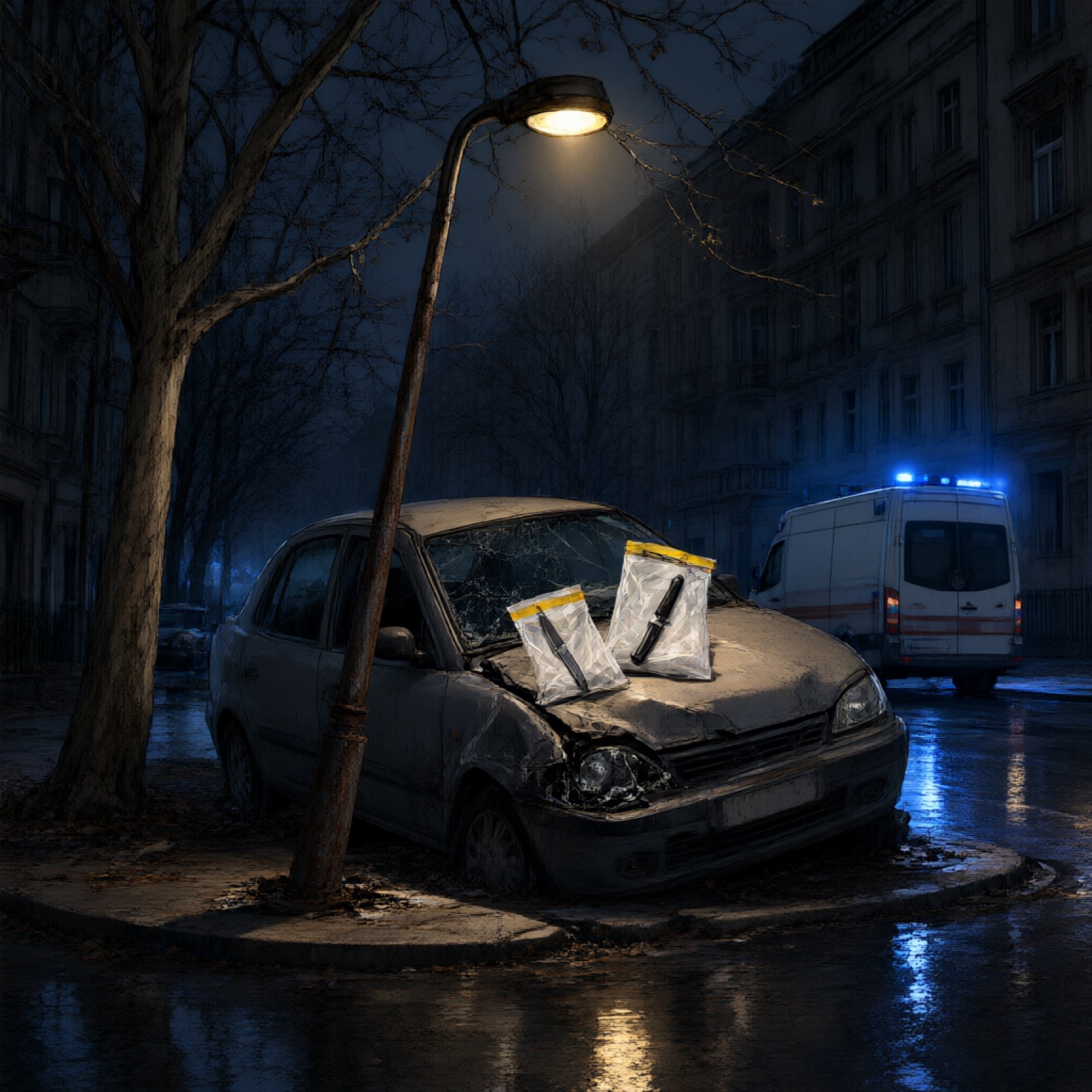
On the landing, under the radiator by the window, Leni found the knife. Open, twelve centimetres, blade grey, handle wrapped in gaffer tape. She photographed it before she touched it.
“That’s yours,” she said to the older one.
He looked at the window. “I don’t know.”
“It’s under your radiator. You’re sitting two metres away.”
“I don’t know,” he said again, quietly, without defiance.
At ten past four Leni went into the courtyard. Cobblestones, two bins, a bicycle without a saddle chained to the downpipe.
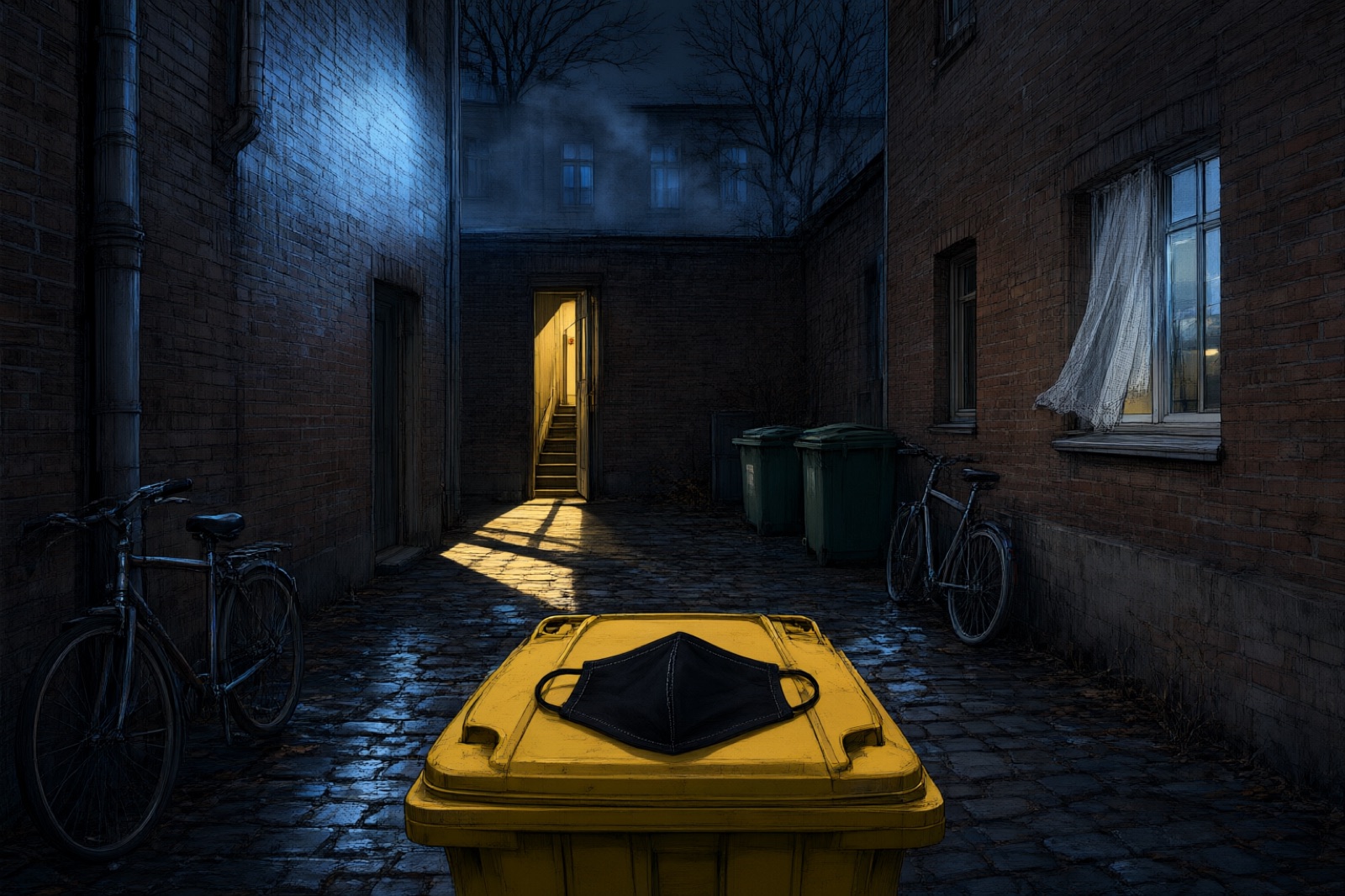
Between cardboard and wet leaves, in the bin with the yellow lid, lay the mask. Black, fabric, lined inside. Leni lifted it by the edge and turned it into the light.
The seam ran twice. Not once, like a mask you hold getting out of a car. Twice, parallel, even stitches, and at the edge where the cloth lay double, a chalk mark: a B with a line under it.
“Kalle.”
He came down the three steps, hands in his pockets. “Is it one of the cheap ones?”
“It’s our tailor’s.” She held it up. “Double seam, hand-sewn, the thread doubled at the bottom so it doesn’t run. And the chalk. He draws the size before he cuts, and he doesn’t wipe it off. I saw the photo in the file, in March, Schillerstraße. Four masks, all with the B.”
“Benny.”
“Benny.”
“He’s inside, isn’t he.”
“He got probation.”
Kalle breathed out through his nose, the way he did when commenting would have outlasted the annoyance. “A bloke who sews masks is really just a tailor with bad customers.”
“You’re serious?”
“He never robbed anyone. He sewed. And now his work’s in the bin, and the three upstairs aren’t wearing masks because they were in the stairwell, not in the flat.”
“One of them had one in the yard.”
“One. And he’s gone.”
Leni looked at the ground-floor window, where the curtain now hung still. “He’s not gone. He waited, and he chucked the mask when he heard the siren.”
Above them a window opened. A man in a dressing gown over tracksuit bottoms, hearing aid behind his ear. “Are you the police? I’m Klose. My wife made the call.”
“Come down. But put something on first.”
Gerd Klose came down in a coat over the dressing gown. “I don’t normally hear anything. The heating, the S-Bahn, the bloke upstairs. But that was a drawer. Twice. And then another one.”
“What time?”
“Half three. My wife says three thirty-one, she looked at the clock when she dialled.”
“And you were sure the flat was empty?”
“‘Course. The Rehbergs are in Portugal. Two weeks. And the management has the list of when people come back, for the meter reading. It’s in the hall, next to the letterboxes.”
Leni looked at Kalle. Kalle looked back.
“Not all of it,” said Klose. “But the flats with meters. November, December, that sort of thing.”
At twenty past four they went up floor by floor, door by door, with the caretaker’s key from the key box. First floor right: nothing. Second floor left: the hole in the rubbish. Third floor right: the cylinder had a ring on it.
It was not a scratch. A pale, dull ring around the core, two centimetres wide, and at the edge the brass was no longer smooth but pitted. It smelled faintly of lemon.
“Four of them,” said Leni. “This one, first right, third right, fourth left.”
“That’s the whole building.”
“That’s half of it. The other half haven’t gone away.”
Kalle crouched by the door and looked at the ring like a stain on a carpet. “And that works with acid?”
“With gel. Liquid acid runs off — a mess in the stairwell, and the neighbours would have smelled it. Gel stays where you put it. You paint it round the core, it sits there like toothpaste, and over two or three weeks it eats into the pins. The cylinder looks fine. It isn’t.”
“And then?”
“Then any key that roughly fits will do. Or a cap you tap on. Two minutes, no noise, no scratch. The door opens, and when you close it, it looks untouched.”
Kalle stood up and brushed his knees. “That’s not a burglary trick. That’s trade work.”
“That’s why it worked.”
In the hall, under the glass frame beside the letterboxes, hung the notice. White A4 in a plastic sleeve, headed “Nagel & Partner Property Management — November meter reading”. Below it a table, eleven lines: flat, name, return.
Rehberg, 2nd floor left, 29.11. Sandmann, 1st floor right, 24.11. Ohlbaum, 3rd floor right, 21.11. Krantz, 4th floor left, 26.11.
Leni read the notice twice, then looked down the stairs at the three men and back up. What happened in her face was what Kalle called “Leni’s bookkeeping”: everything got filed, and you heard nothing.
“Kalle.”
“I see it.”
“Four flats. Four doors. Every return date after the twentieth.”
“And all of them empty.”
“And how long has that notice been up?”
Kalle looked at the corners, not yet curled. “A few days. Not two weeks.”
At five they were at the station, heating on three, coffee that tasted of the machine. René Kappler repeated his flowers, three times, and Leni let him. Bogdan Wrona, forty-six, said nothing for two hours.
Then Leni put the watch on the table. Silver, a lid that sprang open, and inside, in tiny letters, “H. Reimers 1974”.
“That’s from Dahlem,” she said. “That flat was done last week. And Mr Reimers is not your uncle.”
Bogdan looked at the watch. His jaw moved once.
“I bought it.”
“From who?”
He said nothing. Leni laid the knife photo beside it, then the cylinder photo, then a charge sheet from another case she knew he would read.
“I did not buy it,” said Bogdan.
“Where did it come from, then?”
“Package.”
The word came out the way it does when a man says something he has rehearsed and then forgets he rehearsed it.
“What kind of package?”
“Address. Date. Door. Nine hundred.”
Piotr, his brother, forty-three, looked at him as if he had been betrayed. Perhaps he had.
“Nine hundred euros.”
“Cash. In a kebab shop at Mexikoplatz. The man brought a cloth bag, inside a paper with the address and a key. He said, don’t use the key, only try, does it turn.”
“And did it?”
Bogdan looked at her directly for the first time. “Two minutes.”
“What was his name?”
“I don’t know.”
“What did he look like?”
“Young. Thin. He talked like a man selling something. And he had stuff in his bag, cloth, thread. I thought, this one is a tailor.”
Kalle, at the door, made a sound, short, without humour. Leni looked at him, and he shook his head once: not now.
At ten past eight they stood outside a shop on Teltower Damm, between a bakery and a phone shop, the window lettered “Locksmith · Cylinders · Emergency opening 24 h”, and underneath, “since 1994”.
Detlef Bohnsack opened before they knocked. Grey moustache, checked shirt, work apron, a bunch of keys on his belt that rattled with every step.
“Police? About the door on Benschallee?”
“How did you know that?”
“Because I service the cylinders in that building. Eleven years. The management calls me when one sticks.”
He let them in, shut the door, wiped the counter although nothing was on it. On the wall a board of cylinders labelled with tape: “Long plate 40”, “Old bit key”, “Kaba 30/35”.
“You know those cylinders.”
“I know the cylinders in forty buildings.”
“And you know the acid.”
Bohnsack looked at her two seconds too long. “I know acid. I don’t sell it.”
“You sell cylinders. And you buy gel.”
Kalle leaned on the counter. “Mr Bohnsack. I’ve no interest in talking down thirty years of your working life. But four doors in one building, all with the same ring, and all four serviced by you. That’s not a statistic. That’s an address.”
Bohnsack said nothing. His eyes went to the drawer, then away, then back.
“I’ve got an apprentice,” he said.
“Since when?”
“March. The lad’s twenty. If there’s a case, he’s out before he gets his papers. Because of me. Because of something I—”
He stopped.
“We’re not talking to the chamber of crafts,” said Leni. “We’re talking to the prosecutor. That’s a difference, but not the one you mean.”
Bohnsack looked at her, and then did what people do who have kept order for thirty years and suddenly realise that order has nothing to do with them: he opened the drawer.
The receipt lay on top, between two invoices, creased by a paperclip. “Blankenburg sanitary wholesalers, 2 kg gel acid, 14.10.” Underneath in biro: “for servicing”.
“Two kilos,” said Kalle.
“A cylinder takes twenty grams. I didn’t buy it for servicing.”
“For how many?”
Bohnsack looked at his hands. “Four in that building. And five in another.”
“Which one?”
“That I’ll say when I’ve spoken to a lawyer.”
“Fine,” said Leni. “Then we’ll talk about the four for now.”
He fetched a notebook with a cardboard cover and turned the pages. Dates, door numbers, and beside each one, “150”.
“Who paid?”
“The one with the sewing machine.”
Kalle looked at Leni. She nodded, barely.
“What’s his name?”
“I don’t know. He puts the money on the counter, he doesn’t talk much. Once he said, wipe the fingerprints when you’re done. I said, I don’t leave fingerprints. He laughed.”
At twenty to ten they sat in the car outside a rear building on Schillerstraße. The flat was on the third floor, up over the courtyard with the bicycles. Benny Schröder opened the door in a grey T-shirt, hair greasy, eyes red, as if he hadn’t slept.
“I haven’t done anything.”
“Three people said that tonight already,” said Kalle. “Two of them were lying.”
At the window stood the sewing machine, a Singer, grey, with gold on the casing. Beside it a crate of black offcuts. On the table, scissors, chalk, a tape measure.
Leni went to the shelf without asking and pulled out a grey folder, the label in block capitals: “Packages”.
“You’ve got a folder. With a label.”
“I’m tidy.”
“You’re a businessman.”
Eleven sheets, each in a plastic sleeve, the same handwriting: address, “return”, “door”, price. Benschallee 14, 2nd floor left, 29.11., “Kaba 30/35”, 900. Am Fischtal 6, 29.11., 900.
Kalle held a sheet against the window. “You sell flats with nobody in them.”
“I don’t sell flats. I sell dates.”
“For nine hundred euros.”
“For nine hundred you get a flat where three men can work for two hours without anyone coming up the stairs. That’s a price, not profiteering.”
Leni kept turning pages. Behind the last sheet, in the same sleeve, lay a printout. Two pages, a table, at the bottom the footer: “Nagel & Partner Property Management · Machnower Straße 41 · November meter reading”. Top right, in biro: “reading 21.11.”.
She laid the printout on the sewing machine and said nothing.
Benny looked at it. Then he looked away.
“Where did you get the list?”
“From someone who has the keys.”
“That’s not an answer.”
“That’s the answer I’m giving.”
Kalle sat down on the sagging sofa and looked at him for a long time without saying anything.
“You know what bothers me? Not the money. Not the eleven flats. It’s that you still sewed the masks. Those three out there could have gone in without masks, the building was empty. But you sewed, because that was your part. And then you sat down and thought: I only prepared.”
Benny looked at his hands. “Preparing isn’t illegal.”
“No. Neither is sewing. But somewhere between preparing and sewing there’s a lock that no longer locks, and a family coming home on the twenty-ninth to find their drawers on the floor.”
Leni took the ledger out of the kitchen cupboard, between two cups, a slim notebook with figures: 900, 300, 150. Beside each figure a date, initials, sometimes a name. Against Benschallee it said “Wrona”.
At a quarter past eleven the property management office was a ground-floor room with a counter like a bank that no longer exists, a printer still warm.
Rainer Zobel, sixty-one, thin, grey overall coat, glasses on a cord, stood behind it and said: “I only passed on dates.”
Leni put the printout from Benny’s folder on the counter. Beside it a second one, which she had pulled from the printer because the paper jam hadn’t let go of it: “November_returns”, eleven lines, the same eleven.
Zobel looked at the printout. Then he looked at the door.
“The list is up in the hall,” said Leni. “Since the seventh. You typed it, you put it up, and you sold it before that.”
“I didn’t sell any keys.”
“You have the keys. You’re the caretaker. With that bunch on your belt you can get into every flat in the building, the management knows it, the tenants know it. You didn’t sell anything you didn’t have.”
Zobel sat down on the chair behind the counter, slowly, like a man with a bad back.
“Three hundred an address. Eleven addresses. Three thousand three hundred.”
“What for?”
He looked at the printer. “My car. Gearbox. I drive a 2009 Passat. The repair is two thousand four hundred, I take home eleven hundred, and I’m sixty-one.”
Kalle, at the door: “And you thought eleven flats would buy a gearbox.”
“I thought nothing would happen. They’re dates. If someone breaks in, that’s his business.”
“They’re not his dates,” said Leni. “They’re the dates of eleven families on holiday. You told the burglars when they could come, and when the people come back, so they’d be finished in time. That’s not information. That’s an invitation.”
Zobel looked at her, and for a moment there was something in his face that Kalle didn’t like, because it wasn’t remorse, it was relief.
“And the acid? I knew nothing about that.”
“We believe you,” said Kalle. “That’s the only thing we believe.”
At twenty to seven eleven plastic sleeves lay in a row on the desk at headquarters, like cards in a game nobody wanted to win. Leni had made a list: four crews, nine addresses matched, with names, with warrants. Two addresses had no buyer. One of them was Am Fischtal 6, return the twenty-ninth.
“The eleventh is missing,” she said. “No name in the ledger, no initials, just the address and the nine hundred.”
Kalle looked at the row. “Then we wait.”
“We can’t wait. They come home on the twenty-ninth.”
“Then we wait before that.” He took the sheet for Fischtal out of the row and put it at the end, where it belonged. “Two weeks. Camera in the hall, a word with the management. And if someone touches that cylinder, he’ll have the bad luck of me being there.”
“That’s a plan.”
“It’s a Thursday.”
She put the sleeves back in the folder.
“The tailor,” he said.
“What about him?”
“I nearly felt sorry for him. Two years of masks, and then he sells dates like a travel agent.”
“He cost four families their flats.”
“I know.” Kalle took his coat. “But he made that seam properly. Doubled. Credit where it’s due.”
Leni switched off the light over the desk. “Say that again in court.”
Outside it was still foggy, and somewhere in Zehlendorf a train went by with nobody in it.
Note: All characters, places and events in this story are fictional. It was inspired by a public police report but does not depict real events, persons or circumstances. More: Legal notice.