The Fake Branch
Chapter 1: The Envelope Is Gone
The stairwell at Kienitzer Straße 34 smelled of floor wax and cabbage, though nobody in that building had cooked cabbage for years. Kalle took the steps two at a time, which at thirty-nine was a bet against himself, and stopped on the third floor to get his breath back.
Fourth floor. The bell panel said “Mertens”, typed. Underneath, a strip of tape with the name “Berger”, crossed out twice.
“I was expecting you,” said Hildegard Mertens, before Kalle had his mouth open. She still had her coat on. Two cups stood on the table. The white envelope was gone.
“You dialled 110, Frau Mertens. So here I am.”
“I dialled the branch. They put me through.” She pushed a chair out, not for herself. “Sit down.”
Kalle laid the folded leaflet from his jacket pocket on the kitchen table, beside the cups. “I’ll leave that with you. Prevention stuff.”
“I’m not senile,” said Hildegard.
“Nobody said that.”
“You thought it.”
At 14:52 the phone had rung, and the display showed the number of the branch on Hermannplatz, a number she had known by heart for fifty-eight years. A man on the line, polite, in the tone of a dentist just before the bill: irregularities. A debit of 1,200 euros, Istanbul, yesterday evening. Had that been her?
“I’ve never been to Istanbul. Wanne-Eickel once, in 1979. That was enough.”
The man had laughed, briefly. Then: the card would have to be swapped, a colleague would come round, with ID and a briefcase, she only had to put the PIN in with it, in an envelope, for her own safety.
“A briefcase,” said Kalle. “A brown one, with a lock. Anybody still carrying one of those is either from a bank or from a very different line of work.”
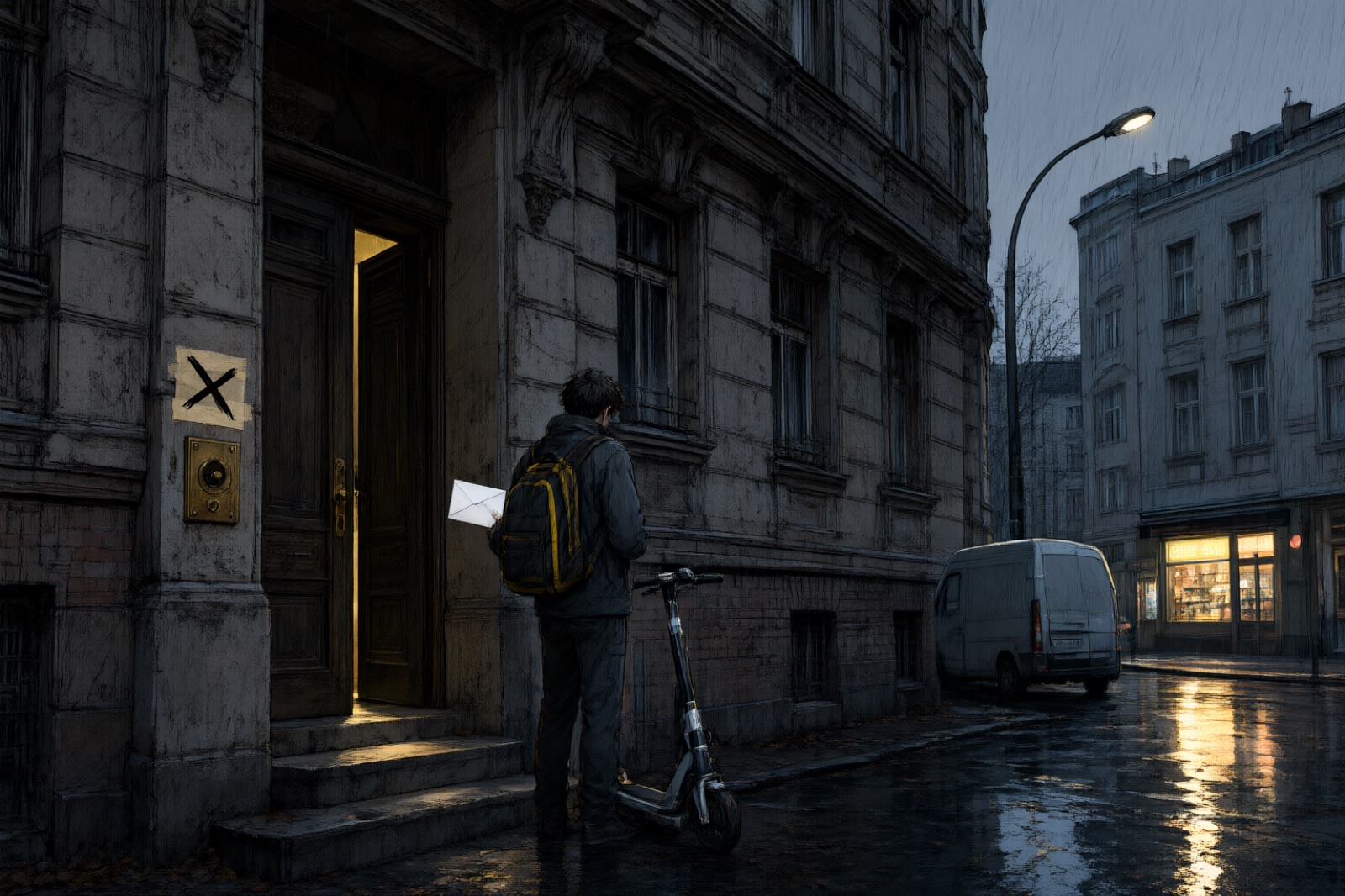
At 15:20 the bell had gone. The courier was young, twenty-two maybe, with a rucksack and a jacket too thin for November. He held up the ID so briefly that she only saw the edge, put the envelope in his bag – and then did something that gave him away, though he meant well: he tore a receipt off a pad and laid it down. Security Service Nordstern, number 4471, a stamp set crooked across the corner, a phone number underneath.
“For your records,” he had said.
“For my records,” said Hildegard, and pushed the receipt across the table. “I keep everything. Fifty-eight years of receipts, bills, guarantee slips.”
Kalle picked up the sheet. Thin carbon paper, the stamp not quite straight. At the bottom: Service Centre Nordstern, 030 44 871 210.
“And the display?” Leni leaned over the phone. Hildegard pressed the key for the call list without looking. 17 Nov, 14:52, the branch number. Leni photographed the display, then the receipt, then the display again, because the flash had turned the first shot white.
Kalle dialled the number on the pad, on speaker. Two rings, then a woman’s voice, bright and friendly: “Service Centre Nordstern, your bank will be with you in a moment.” Then music, three seconds, an accordion.
Leni was already on the phone to the bank’s fraud unit, a man called Rönne. Card blocked at 16:33. At 16:41 Rönne rang back: one withdrawal, 15:47, cash machine at Sonnenallee 221, 1,000 euros. A second attempt at 15:49, declined, daily limit.
“Forty-six minutes,” said Kalle into the kitchen, because he didn’t know where else to put it.
Hildegard straightened the cup, whose handle had been straight already. “Don’t tell me how it stands. Tell me what you’re doing now.”
Chapter 2: Three Cash Machines, One Hour
At 17:05 Leni sat in front of a pile of paper she would rather not have printed. Rönne hadn’t just sent Hildegard’s data, but every comparable case from the past three weeks, because somebody at the bank had apparently been thinking.
Fourteen accounts, fourteen index cards from hell, each with a first name out of an old will, and an address.
“Fourteen since 27 October,” she said. “And every one of them has a receipt.”
“Three cash machines.” Leni pulled the lamp closer. “Fourteen cards, twenty-seven withdrawals, three machines. The self-service lobby on Hermannplatz. The petrol station on Grenzallee. And a machine in the back room of a corner shop on Sonnenallee, which doesn’t belong to the bank but to a company that pays rent to the shopkeeper. That’s why the trail goes quiet there – it isn’t a branch.”
“And the clock?”
“Always between 16:00 and 18:00. First attempt somewhere between 16:38 and 17:24.” “That’s not chance. That’s a shift.”
Kalle looked at the wall clock. “I had this in my drawer at lunchtime. Prevention leaflet, folded card, ‘Hanging up is the best return.’ Lovely and colourful.”
“And now?”
“Now it’s three cash machines and fourteen cards. Now it’s a case.”
“What’s missing,” he said, “is the man who rings the bell.”
At 18:40 Sander rang, LKA, Division 2, the man who keeps the case numbers. “Sixty-one cases since September, four hundred thousand in losses. Old buildings, landlines, all over seventy. That’s a target group, not a random draw.”
“You’d never remember all that.”
“That’s why it’s in the spreadsheet.”
Chapter 3: The Man with the Rucksack
The machine on Sonnenallee was the only one of the three with a camera on it that didn’t belong to the bank. Which is why they were standing in a corner shop the next morning, a place that smelled of wet leaves and a delivery van’s engine: banana crates by the door, a bell strip over the entrance, porridge oats next to batteries next to phone cases priced in marker pen.
“Police,” said Kalle. “The cash machine.”
Adnan Kaya didn’t look up. “Machine is at the back. Stay as you are.”
The back room had no windows. Above the grey box, three metres up, in the corner: a camera.
“The camera is not mine,” said Adnan from the doorway.
“The camera is yours. The wallpaper is yours. The machine belongs to the company, and you take the rent.”
“Camera is broken.”
Kalle looked at the monitor under the till, where four pictures ran in camera grey. Picture two was showing Kalle’s coat.
“Your broken camera is very taken with me.”
Adnan put the newspaper down. “I do business. Not police. If I do police all the time, people stop coming.”
“Since when have you been selling the fags without the tax band?”
Adnan’s eyes went sideways, to the till, back to the counter. “Those aren’t for sale.”
“Adnan. You don’t smoke. You’ve asked me twice whether I smoke, because I smell of smoke.”
Then he said something in Turkish, short, and pulled open a drawer under the counter. “One carton. My wife ordered it.”
“What’s the man in the picture called?”
“The name I don’t know. But his time I know.” He took a memory card out of a box of clothes pegs. “Every Tuesday, Thursday too. Between half four and half five. Always with the scooter. And he counts the receipt from the machine with his finger.”
The camera set its own clock. 12 Nov, 17:12. Ten seconds, the back room didn’t need more. A man, headphones round his neck, rucksack with a yellow stripe, a cap. Card against the reader, PIN – and then he didn’t look at the screen but sideways, at the banana crates in the doorway. At the end he reached into the rucksack and pulled the card back out.
“He takes it with him,” said Leni. “Into the next week.”
At midday Kalle dialled the number on the pad again. “We are a service centre,” said the woman, single words, no warmth, a script. “Your bank will be with you in a moment.”
Leni had the companies register open. Nordstern Telefonservice GmbH, Turmstraße 41. Managing director: Yvonne Kessler. Founded March 2023.
“Two years without winning a customer,” said Leni. “Guess what they live on.”
Chapter 4: The Branch That Isn’t One
Above a shop with coffee machines in the window, second floor, a brass plate by the lift: NORDSTERN TELEFONSERVICE GMBH.
An old travel agency, you could tell from the worn counter. Nine desks, some with headsets, a map of Berlin with districts marked by pins. The woman at the front desk stood up before the door was shut: white collar, glasses on a cord.
“Yvonne Kessler.” She shook Kalle’s hand the way they teach on a course: three centimetres, two seconds.
“No thanks. What do you do here?”
“Appointment setting. We call for tradesmen and arrange visits. Bathrooms, windows, heating. The trades don’t have time for the phone. That’s all.”
Kalle put the receipt on the desk. She looked at it like a bill that wasn’t hers.
“Security Service Nordstern. Number 4471.”
“That’s not our number.”
“It is your number. I rang it at lunchtime. I heard ‘Service Centre Nordstern, your bank will be with you in a moment’, with an accordion.”
“Then somebody is using our number. Number spoofing is a mass phenomenon, it has been for years.”
“You say ’number spoofing’. The people I usually talk to say ‘somebody else was on the line’.”
Leni walked slowly through the room. She saw the shift plan on the whiteboard, twelve names, three crossed out. Then a desk behind the partition, with a self-inking stamp on it, grey plastic, the size of a slice of cake, and beside it a bundle of beige carbon paper.
“We’re a service provider,” said Kessler. “Not a call centre.”
“Will you still be running in December?”
“Not from December.” She stopped herself, but a moment too late. “The client is stopping. That’s the business. You grow with a win-back contract and you grow out of it.”
At 15:10 they were in the branch on Hermannplatz. Frauke Deitmer, fifty-one, navy blazer, a pen cap in the corner of her mouth.
“Yvonne Kessler. Thrown out in 2023. Twelve thousand four hundred euros from an account whose owner had died two weeks earlier. The daughter noticed.” She put the pen down like something indecent. “Settlement, paid back, dismissed. The rest was up to the prosecutors.”
“And the index?”
“She kept a book. Not in the system. On paper.” Frauke laughed without warmth. “Little ring binders from the stationer’s. Who has how much. Who has no children. Who lives alone. Only her book had numbers in it.”
She looked at the counter. “She always said the old ones are the most honest customers.”
Kalle looked out at Hermannplatz. “A ring binder. In Wedding, behind the partition.”
Chapter 5: Twenty-Five Euros an Envelope
The petrol station on Grenzallee was one of those where the machine had said “coffee” since September and had always dispensed tea. After four it was the brightest spot on the street, which is why they were parked opposite at 15:55.
“When he comes, you ask him. I’ll stand between him and the pavement,” said Leni.
At 16:35 he came from the south. E-scooter, no helmet, rucksack with a yellow stripe. He folded the scooter down and walked to the door without hurrying.
Kalle was close enough when the machine beeped. The young man put a card in – it didn’t come back. Then he pulled a second one out of a card case, a grey plastic box with clear sleeves, the kind insurance men carried under their arm in the nineties.
“Evening,” said Kalle.
The young man looked up, found Kalle, found Leni, found the fence to his right. “I was only …”
“Put the card back in the case.” Kalle said it quietly, the way you talk to a dog pulling on the lead. “And then tell me your name.”
His name was Emil Tietze, he was twenty-two, in his third term of urban planning in Halle, and since 9 October he had collected twelve envelopes a week. He’d bought the card case himself. On Amazon, he said, as if that were the statement that mattered.
At 17:20 Leni put the card case on the table and opened it like a book. Twelve cards. Each in a sleeve. On each sleeve a sticky label with a street name in capitals, and four digits underneath.
“How do you sort them?”
“By street. So I don’t go round the same neighbourhood twice.” Emil looked at his hands. “If it didn’t fit, the woman always rang straight away.”
Then he talked. About the voice messages, eleven some days, one on others, a woman’s voice, short: three addresses, Kienitzer, thirty-two, now. About the 25 euros an envelope, cash, at the end of the month, in an envelope, with a receipt he signed. About the office door on the second floor, where he put the envelopes in a basket by the printer. About the woman with the glasses on a cord.
“What does she say to you?”
“She says: we’re a service provider, not a call centre.” Emil did it in a voice that copied hers without knowing it did. “And I’m not to unsettle the clients. We’re doing a card campaign for the new card, she said. Because of the fraud in the summer.”
“The chip,” said Kalle.
After half an hour Emil asked the thing Kalle had come to hate.
“The cards – what were they?”
Leni pushed the printout across the table, the creased line with the name Mertens, Kienitzer 34, born 1942.
“Grannies,” said Kalle. “Twelve grannies. And every card has a PIN stuck to it.”
At 17:50 he rang Brandt. “Rieger. You’ve got a courier, a card case and a stamp, and you want to go in.”
“Yes.”
“And a self-inking stamp in an office with nine desks gets you a warrant?”
“That gets me a warrant. And the coffee.” Leni looked at the ceiling. “A cup of water,” she said.
Chapter 6: The Card Index
At 18:40 Kessler was already in her coat, handbag over her arm, keys on the desk. “I was just leaving. We close at six.”
Kalle put the warrant on the desk.
The search didn’t take an hour. Cable ducts, a photocopier out of colour, a fridge with three milk cartons and a bottle of sparkling wine with a sticky note on it: 12.12. – do not touch.
Behind Kessler’s chair, the shelf with the pigeonholes, the kind every post office has. Only there were no names on them: Neukölln-South, Tempelhof, Steglitz, Reinickendorf, Spandau. In the pigeonholes, envelopes, bundled, with rubber bands.
Kalle pulled one out. Not a lining – a card, a PIN slip, a piece of card with “Receipt: 4471” on it. That was the order of things: collection, withdrawal, bundle.
“I want to see the book,” said Kessler behind him, and for the first time her voice was something other than polite. “The one with the addresses. That’s what you came for.”
Leni found it in the filing trolley, right at the bottom, under three rolls of wrapping paper: a ring binder, A5.
Five entries a page. 412 lines. Name, street, number, floor, age. In a second column, in pencil: “widowed 19”, “no children”, “savings approx. 40k”, “hard of hearing”, “always calls back”, “landline”. At the top: “Mertens, H., Kienitzer 34, 4th floor, alone, 84, hearing good.”
Kalle read it out loud, slowly. “She graded them. Like wines.”
“I advised them,” said Kessler. “Eleven years.”
On the desk a clipboard. First page: “Round 12”. Under it, columns ruled with a ruler: machine, time, cards, total. Three machines. In the last row, in neat figures: 412.
In the drawer, in a folder with an elastic band, three sheets: a booking confirmation for 12 December, 19:00, twenty people, Restaurant Alte Turnhalle. A copy of a settlement dated 4 September. A tax demand from 21 October, back payment, deadline in red.
Together: 180,000 euros.
“You booked for the twelfth.”
“I always booked properly.”
Chapter 7: What Was on the List
The interview began at 20:10. Kessler’s solicitor said three times that her client was making no statement. Then Kessler said she would make one.
Leni laid the things out in a row: the ring binder, the clipboard, the receipt. “You knew the names. The accounts. The hours when people are at home.”
“I listened for eleven years. When somebody tells you after twenty minutes how much they’ve got, then there’s nobody else they tell it to.” She looked at her hands. “That was my job. Listening. And then writing it down.”
Kalle sat back. “You were pushed out in 2023. Twelve thousand four hundred.”
“I paid it back. The bank kept the money and threw me out anyway. That’s the German solution: get it all back and give no explanation.” She looked up. “At forty-six with a dismissal on your record, no bank takes you on. They want an explanation, and the explanation is your face.”
“And then you did the phoning yourself.”
“Then I registered a business and did win-back. A heating firm, old customers with maintenance contracts. Properly.” She looked up. “Until the firm said we’re packing it in. End of the year, no renewal. And in September the settlement came, in October the tax demand.”
Leni pushed the copy across. “180,000 by December.”
“If one in four pays, that’s three hundred thousand. I need one hundred and eighty.” She said it like a result. “It’s not greed. It’s arithmetic.”
“The woman on the list. Kienitzer.”
Kessler looked past Leni. “I didn’t pick her because she’s old. Because she’s alone.”
“That’s worse.”
“I know.” She looked at him. “Don’t help me now.”
Kalle rang Hildegard Mertens. She picked up after two rings, in a voice that hadn’t been asleep.
“We’ve got them.”
“And the others? The ones on the list?”
“Four hundred and twelve. We’re ringing all of them. By Sunday.”
A short silence. “And I read your leaflet. ‘Hanging up is the best return.’ I didn’t hang up. I rang back. That was better.”
Kalle looked at the windscreen, where a tram was reflected that wasn’t there. “That was a lot better.”
He hung up. Leni looked at her phone, then at the clock. “Forty-two addresses tonight. I’ll start with Neukölln.”
Kalle started the engine. “I’ll take Wedding.”
“You’ll take Neukölln. In Wedding they’re the ones who still haven’t got a phone.”
“You and your daft ideas,” said Kalle, and pulled out, heading for Wedding.
Note: All characters, places and events in this story are fictional. It was inspired by a public police report but does not depict real events, persons or circumstances. More: Legal notice.