Fire Under the Arts Pages
Kalle’s phone went at twenty-four minutes past one, and by the second ring he knew the night was gone. Leni sat beside him in the car without a coat, with a scarf she had clearly grabbed in the dark.
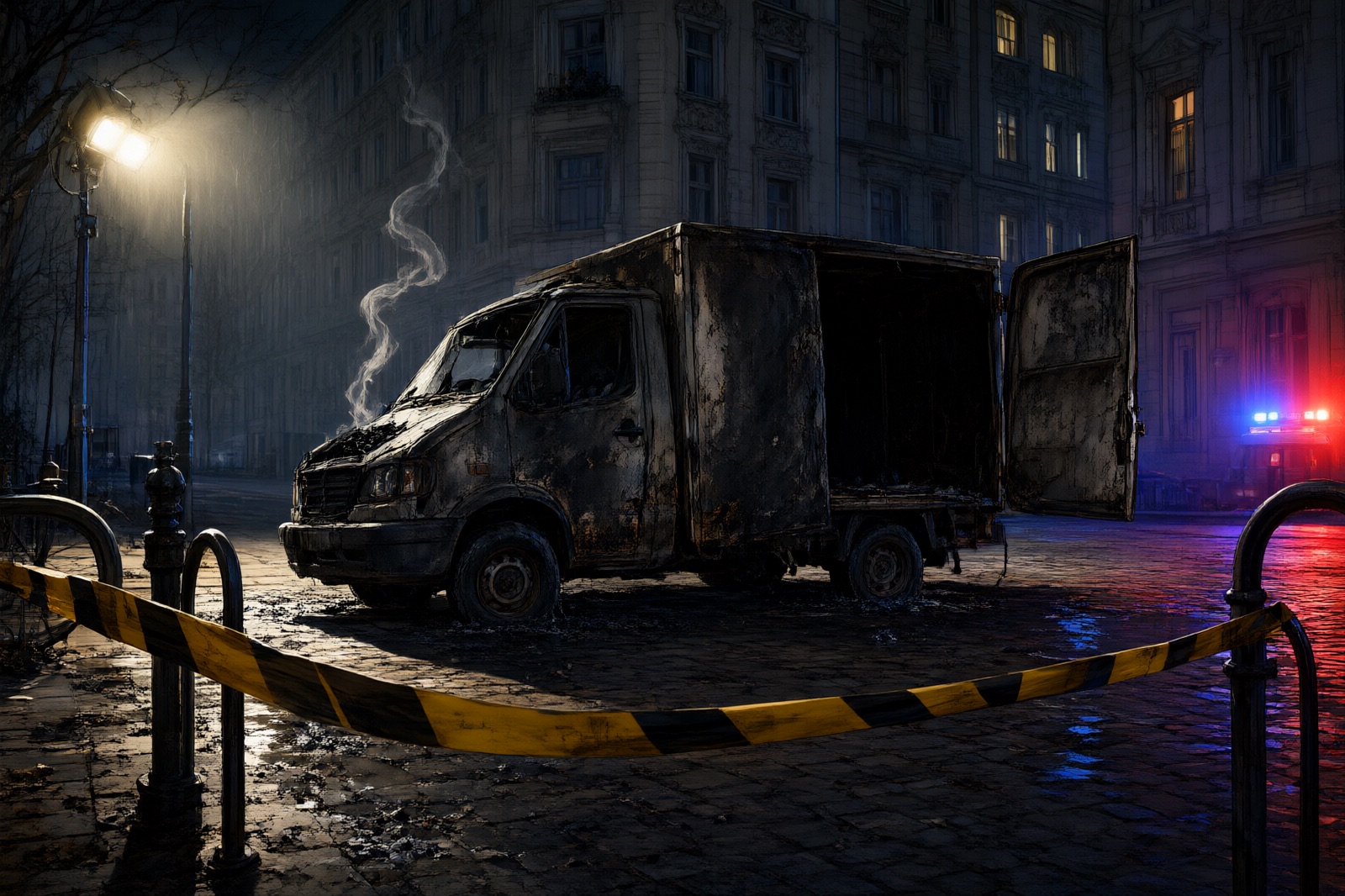
In Wundtstraße it smelled of burnt paper. Paper smells sweet when it burns, a bit like old pastry somebody forgot in the oven.
The van stood half on the pavement, a white Sprinter with flattened tyres and no driver’s side. A station officer in a yellow jacket came across the road, pulled off his helmet and looked like a man who had been saying the same sentence for three hours.
“Nobody inside. Nobody hurt. The load was paper, that’s the point.” “Paper burns like paper. We were lucky the neighbours were quick.”
“Political?” Kalle asked.
“I’m fire brigade.”
“You’re honest. So am I.” Kalle shrugged. “A magazine, at night, a van full of copies, and nobody saw a thing. That smells of conviction, mate, not of chance.” He looked at the officer. “A city magazine writes about rents, about people getting chucked out. These days something catches fire faster than you can say arts pages.” Leni, behind them, without looking up: “Or somebody simply got annoyed.”
She was already at the back of the van with a torch and a face Kalle had known for years: the face of a woman who has just found something.
“Kalle.”
He went over.
On the asphalt behind the van there was a patch. About the size of a palm, greasy, dark, with an edge like spilled oil. Leni knelt. She always had an evidence bag in her coat, and Kalle had stopped finding that funny.
“White spirit,” she said, holding the bag up. “Have a sniff. Briefly.”
Kalle sniffed. Sharp, a bit like a workshop. “So not a petrol bomb from the filling station. That’s something off a shelf.”
“Three metres further on, in the gutter, there was the tray.” Leni put the torch into the channel. “Aluminium, a grill tray, dented. There was wax in it. And in front of it a tea light, squashed. That’s the fuse.”
“A tea light.”
“A tea light. It lights, it burns for twenty, thirty minutes, then the wax is gone and the flame has something to feed on. You can walk home and go to bed.”
Kalle straightened up. In house number 36 a woman came down the stairs in a winter coat over her nightdress, glasses in hand.
Gerda Kalischke, seventy-four, second floor, awake since half twelve. She had seen the fire, yes, and she had seen something before that, and was she doing anything wrong by saying so?
“You’re doing everything right,” said Leni. “What was before?”
“A man. At the car. Just before one, I hadn’t looked at the clock, but it was the time when the last bus has gone.” She held her glasses up to her eyes as if they could look backwards. “A cap. Dark cap. And a bag, a cloth bag, with a big nought on it.”
“A nought?”
“A nought. White. Big. Like from a shop.”
“Colour of the car?”
“Blue. Dark blue, I’d say.”
The Sprinter was white as a fridge. Leni wrote it down anyway. “Noted,” she said calmly. “And the man – did he run?”
“No. He walked. Nice and steady down the road towards Kaiserdamm.” Kalischke pulled her coat tighter. “He wasn’t young. Young ones walk different.”
At twenty past eight they were in the editorial office on Windscheidstraße, third floor, rear building, next to a photocopier that looked as if it had been repaired once and had taken it personally. Kalle had bought six coffees on the way, at the corner shop on Kaiserdamm, because that is where he always buys coffee and because at the till he had seen a face he was going to need later. Six cups for three people was arithmetic with a reserve.
Hedwig Sander, sixty-one, white hair, red cardigan, glasses on a cord, took two. “You’re here about the van.”
“We’re here about the van,” said Kalle. “And because your magazine was in the van. Six hundred copies, according to the driver.”
“Six hundred. Issue two hundred.” She said it like a birthday. “Our anniversary. We had the party on Thursday, the delivery came from the printer yesterday, and last night the van burns. Welcome to Charlottenburg.”
“So your paper has enemies.”
“Magazine,” said Sander. “It’s a magazine. Papers print what happened yesterday. We print what happens next week.”
Kalle took a mouthful. The coffee was hot, sweet, no arguments. “Right. Magazine. Enemies.”
“We’re a city magazine, six thousand copies, four people, two of them part-time.” “Our enemies are people we don’t print. That’s the whole list. I don’t know anybody who’d set fire to the copies.”
Ronny Pahl came out of the next room, thirty-four, a football club jacket, gloves. He had loaded from twenty to ten until twenty past ten, six hundred copies, six pallets. Then he drove it to Wundtstraße, because there was no room in the yard – the neighbour’s pallets had stood there since Monday – and because there is always a space outside his front door. Parked at twenty to eleven. Then home.
“You left a van full of magazines on the street overnight?”
“The van’s been standing there for three years, every week. Nothing ever happened.” Pahl looked at his gloves. “It’s not insured. It’s a 2011, nobody insures that for theft and fire any more.”
Kalle nodded slowly. “And who knew the copies were in there?”
Pahl shrugged. “Whoever knows me. Whoever was at the party. Whoever was in this office.” He looked at Sander. “Bertram was still here on Friday. For his proofs.”
Kalle heard the name and said nothing. Leni wrote it down, in order.
On Sander’s desk lay a proof of issue 200, open, with a coffee ring on page 3, round as a target. Kalle pointed at it. “Who did that?”
“Me. Every morning, same place, same page.” Sander sighed. “Page 3 is the satire. I read that first.”
“Satire about what?”
“About an author who thinks he is the centre of the city.” She said it without pleasure. “That was Anke’s idea. He’s named in it, all four columns. It was the editor’s idea and I let it through because I found it funny.”
Kalle looked at Leni. Both thought the same thing, and he said it anyway: “Then we know where the motive lives. We just don’t know where the man lives.”
The corner shop on Kaiserdamm belongs to Süleyman Aydın, fifty-one, grey pullover, thin gold chain, a newspaper on the counter that he does not read but uses as camouflage. Kalle had bought six coffees off him at a quarter to eight and had been very friendly. Sülo had been very friendly back and had said very precisely nothing.
By ten past eleven Kalle was no longer friendly.
“Sülo. Two bottles of white spirit. When?”
“I sell plenty white spirit. Autumn, everybody cleans the grill.”
“Nobody cleans a grill in November.”
“The people who shop here do everything at every time of year.” “Yesterday you said you only wanted coffee.”
“Yesterday I was polite.” Kalle put both hands on the counter, calm, not threatening, the way you lay a table. “Today I’ve been sent by the trading standards office. The second till under the counter, the out-of-date tobacco at the back of the shelf – they’ll like that. So will the tax office. So will your landlord, who doesn’t know you sublet.”
Sülo was quiet for twenty seconds, which is long in a shop with a humming fridge.
“Twenty-one forty-seven,” he said then. “Two bottles, one litre, the cheap one. Plus firelighters, the blocks, and a pack of tea lights. Twelve euros twenty.”
“Who?”
“A gentleman.” Sülo said the word like an insult. “Not a local lad. Coat, cap, leather bag. Mid-fifties. He turned the bottles round like he wanted to check them. And he had a cloth bag, one of those from a party, with a big nought on it. White.”
Leni looked up from her notebook. “The bottles. Did you wrap them?”
“I wrote the price on them. With a marker. The label printer’s been broken since September, I tell everybody, nobody believes me.” Sülo pointed at a bottle on the shelf with “2.80” in blue marker, crooked, with a small hook at the end of the eight. “Two eighty. Always.”
“And the customer – would he recognise you?”
“I recognise him,” said Sülo. “He doesn’t recognise me. People like him don’t see the shop, they see the bottle.”
Kalle put his cup by the till, carefully, like a tip. “Sülo. If I show you a photo, will you tell me the truth or will you tell me something?”
“I tell you what I see. Whether it’s the truth, that’s your job.”
At twenty past one Leni sat in the editorial office over page 3. The coffee ring had lifted the print; the letters underneath looked as if under water. She read the satire twice.
It was called “The Man Who Invented a Hallway”, and it was not kind. It described an author who had been writing about Charlottenburg for twenty years, always about himself, always in the first person, and who in one nine-thousand-word piece had spread a single stairwell over four pages and called it a chronicle. In the third column there was a sentence that was no longer satire but a verdict: “B. K. does not write about the city. He writes about the shadow the city casts on him.”
“B. K.,” said Leni.
“Bertram Kühl.” Sander stood in the doorway, proofs under her arm as always. “He’s written for us for nineteen years. He wrote the cover story for issue 200. Eight pages, about his father, the war and a house on Suarezstraße. Some of it genuinely good. And then on Thursday at the party he saw the display copy with page 3 on it, because we hang the display next to the cloakroom, which in hindsight was Ronny’s idea.”
“And?”
“And he went white. Not pale. White.” She said it flatly. “He said he was withdrawing the cover story. He left at half nine with a cloth bag full of his proofs, and I thought: fine, he’ll cool off, he’ll talk tomorrow.”
“Did he?”
“He has an appointment on Monday.” Sander paused. “I shouldn’t have printed it. Page 3. I’ve known that since last night.”
Leni went to the author file, a wooden cabinet of index cards, like a library from 1985. Kühl, Bertram. A photo stapled to the card, passport size, dark parka, navy wool cap, leather bag over the shoulder, clean fingernails, looking into the camera as if into an audience. Fifty-three. Suarezstraße 12, rear building, third floor.
At half three Leni laid the photo on Sülo’s counter. She put three others beside it, all mid-fifties. Sülo looked for five seconds.
“The second one.” He pushed the picture with the parka forward. “The one with the bag. He stood the way a man stands when he’s waiting to be asked something.”
“You’re sure?”
“I’m sure it’s him. Whether he did it is your business.”
Suarezstraße 12 was an old building with a courtyard, green stuff growing in yoghurt pots on the windowsills, and a stairwell that smelled of coal even though nobody has bought coal for years. Kühl opened the door in slippers with a book in his hand, as if he had been waiting for them.
The flat was tidy, like a study expecting visitors. Four metres of bookshelf, alphabetical. On the desk a laptop, a cup, a roll of brown parcel tape printed CAUTION GLASS, a biro lying across it. In the kitchen, visible through the open door, a shelf of tins and an opened pack of aluminium grill trays, ten in the pack, seven left.
“Tea?” he asked. “I only have Earl Grey.”
“No, thanks,” said Kalle.
“I don’t drink it either.” Kühl smiled as if he had won something. “Sit down. I assume it’s about the van.”
“It’s about the van.”
“Awful.” He sat, folded his hands. “Six hundred copies. And the piece I spent two years on wasn’t in any of them.”
“You withdrew the cover story.”
“On Thursday, at the party, at a quarter to ten. I told Hedwig I didn’t want my text in a magazine that mocks me on page 3. She said the one had nothing to do with the other. I said: for me it does.”
“And then you went home.”
“On my bike. Twelve minutes. I’ve lived here for twenty-six years, I know every traffic light.” “I was here all night. I worked on a piece until just after one, then I slept.”
“Can anyone confirm that?”
“I live alone. The caretaker goes at ten. I could show you my laptop, but that only proves I typed. I type a lot.”
Kalle walked along the shelf to the bound volumes, one per year. “You’ve got them all.”
“I have everything I wrote. And everything the others wrote about me.” Kühl turned the cup in his hand. “Do you know what that feels like? Nineteen years of work, and then a satire says you write about your own shadow. Written by a forty-four-year-old who’s been here three years.”
“That’s annoying,” said Kalle. “It’s not a reason to set fire to a van.”
“I didn’t set fire to a van.” Kühl looked at him, and there was nothing in that look of a man lying. There was a man who could not believe he was being asked. “I’m an author. I write about fire. I don’t make any.”
In the hall, on a hook by the door, hung a cloth bag. Grey, with a big white nought. Leni looked at it two seconds too long, and Kühl saw that she was looking.
“That’s from the party,” he said. “They gave them out. Two hundred of them, with a nought for two hundred issues. I have three.”
Leni went over and smelled it without asking. White spirit smells like a workshop that has closed down, from a metre away. She said nothing. She just zipped her notebook shut, and that was the sound Kalle had been reading as an answer for years.
At ten to six Leni rang the prosecutor. By twenty to seven she had a warrant for the flat and the cellar.
They found: the roll of parcel tape, the pack of grill trays, the bag with the ring of petrol at the bottom. None of it was proof. Parcel tape is in every household, so are grill trays, and a bag is allowed to smell of whatever it likes.
Kalle stood in the courtyard and looked at the bins. Between the blue one and the yellow one lay a yellow sack, half open, with the neck of a bottle sticking out.
He called Leni.
She pulled on gloves, took the bottle by the base, held it up to the courtyard light. One litre, empty, it had held a clear liquid, the smell was still there, sharp and unmistakable. And on the label, in blue marker, crooked, with a small hook at the end of the eight: 2.80.
Leni turned the bottle in her hand. “That’s Sülo’s handwriting.”
“That’s Sülo’s handwriting,” said Kalle.
At five past eight Bertram Kühl sat in the interview room without parka, without cap, in a pullover too warm for the room. His arms lay on the table the way he would have described them in one of his pieces.
Leni put the bottle on the table. Then the roll of parcel tape. Then the photo from the index card, the one Sülo had touched with his finger. Kalle stood by the wall and said nothing. That was the hardest part.
“Two eighty,” said Leni. “He writes it in marker because his label printer is broken. Every bottle, since September. You bought two at a quarter to ten on Friday. This one is the third.”
Kühl looked at the bottle the way a man looks at a manuscript somebody else has written.
“You happened to drive past my house,” he said at last.
“No,” said Leni. “We didn’t happen to drive past.”
Kühl told it in order, the way he told everything: with dates, with times, with a small pause before the full stop. Thursday the party, the display copy, page 3. Friday the decision, the white spirit, the shop, the bicycle behind the van as far as Wundtstraße. Saturday night the tray on the asphalt, the bottle on top, the tea light in front, lit, and then away. He had known it would take half an hour. He had even hoped it would take longer, so that he would be home when it went up.
“Why at all?” Leni asked. “Six hundred copies. You said your piece wasn’t in any of them.”
“Because then they’d have had to write about the issue.” Kühl looked at his hands. “Some paper would have reported it. ‘Magazine van burns.’ And in every one of those reports it would have said what was in the issue. And then somebody would have asked: what was in there that made someone burn it? And then somebody would have read page 3. But first somebody would have read my piece. Eight pages. About my father.”
Kalle said from the wall: “So you started a fire so they’d print you.”
“I started a fire so they’d read me.” Kühl looked up. “That’s different.”
“No,” said Kalle. “It’s not.”
On the stairs Leni asked: “So? Was it politics?”
Kalle shook his head. “Arts pages.”
He went to the door and held it open, and Leni put the bottle back in the bag, carefully, with both hands, the way you pack something you will need again.
In the corridor, under the neon, she said: “He was right, by the way. About the hallway. It really does smell of coal.”
Kalle looked at her. “Good job today.”
They went down the stairs, past the bell with the name on it. Kalle said “Magazine”. Leni pretended not to hear.
Monday, at the corner shop on Kaiserdamm: “Sülo. That trading standards thing was a bluff.”
“I know,” said Sülo, without looking up. “You bluff badly. But the label printer really is broken.”
Note: All characters, places and events in this story are fictional. It was inspired by a public police report but does not depict real events, persons or circumstances. More: Legal notice.