Delivery Service with Loot
Chapter 1: The Dot That Won’t Sit Still
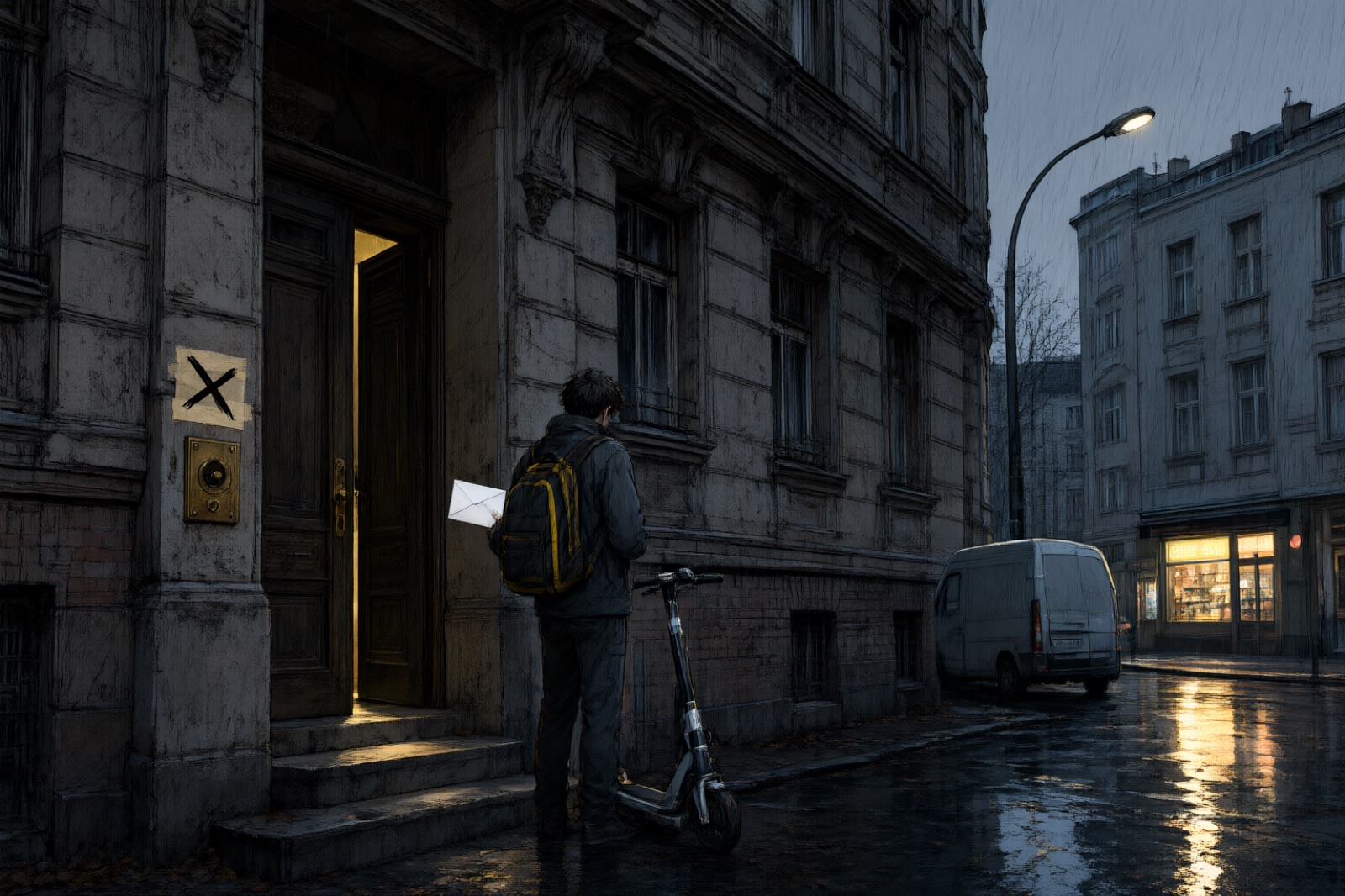
It wasn’t rain, only air that had decided to get wet. Kalle stood outside the bookshop on Weserstraße, collar up, looking at the window display: damaged copies in a banana crate, three crime novels with price stickers, a stack of children’s books with folded corners. Next to it, where the cargo bike usually stood, a damp outline on the paving, two metres long, four dark patches at the corners.
“Six grand for that thing,” he said. “I could get a small car for that. With a roof.”
“It is a small car,” said Leni. “Just without an engine.” She was crouched at the kerb with the two halves of a U-lock in her gloves, the way you hold something out of a museum. “Clean cut. Angle grinder, not bolt cutters. Twenty seconds, I’d say.”
Bettina Rauhut stood in the shop doorway and wouldn’t let the lock out of her sight, as if staring hard enough could weld it back together. Forty-eight, wool scarf up to the chin, reading glasses on a cord, ink on her fingers from stamping.
“I locked it at six minutes past half seven,” she said. “By four minutes past eight it was gone. The box was full of books for the market on Maybachufer.”
Then she held out her phone like somebody who would rather slam it down. On the screen a grey map, a purple dot on it, and the dot was moving.
“I lost two bikes in October. Both outside my door, both with a box. On the third one I sewed a tag into the lining. The glue’s still there, you can feel it through the fabric.”
“And the dot,” said Leni, “jumps.”
“It only updates when there’s a phone nearby. At night in a courtyard there might be nobody with the right operating system.”
The dot travelled from Weserstraße to Pflügerstraße and stopped. 20:26.
“Son,” Kalle told the display, “you’ve earned yourself a break.” Then, to Bettina: “We’ll get the bike back. Even if we have to fetch it off the water.”
They walked down the block, Kalle with his hands in his pockets, Leni holding the shared screen the way you hold a train app that has finally gone green. The dot stayed put. Quarter past ten. Still there.
At 22:40 it moved, two streets over. Leni was already on the phone.
Chapter 2: Six Cans and a Caddy
The yard at Pflügerstraße 12 belonged to a tyre service that stank of rubber and casting resin. A lamp over the gate had three of its four tubes working; in the light, tyres lay in stacks, tyres in half-circles, tyres with a cord tied round them like parcels.
The bike was gone.
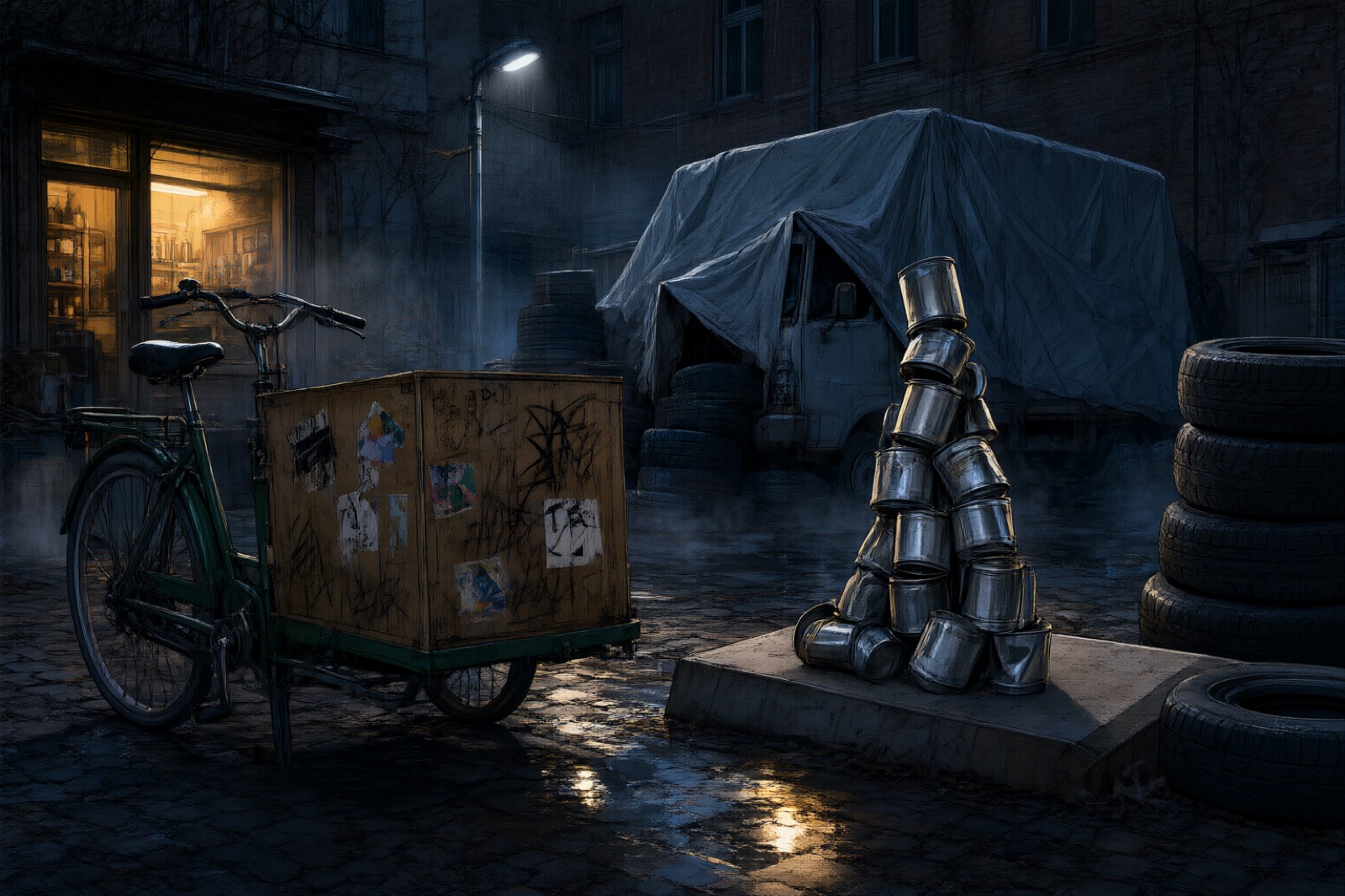
Leni walked along the ground, no torch, just her eyes on the concrete, the way some people find figures in wallpaper. By the loading ramp stood a tower of crushed cans, all the same colour. Six. Scratch marks on the edge of the ramp, at cargo-box height.
“He reloaded here,” she said.
“Six cans. Eleven drops round the houses and that’s not even one night’s worth.”
“Not in one night. In three. Two a night, and the can goes on the floor where you took it out of your hand, because cans rattle in a box.”
Behind the tyres, half under a tarpaulin, stood a van. Kalle lifted the sheet: a VW Caddy whose front end had been thinking hard about its own grille and fallen asleep doing it. Bonnet open, front left wheel crooked, a length of timber wedged into the rear wheel arch. On the back, the plate: B–KL 3341.
Leni pulled the driver’s door open and dropped the glovebox. Inside lay an angle grinder with a grey-scuffed disc, and beside it a plain card, white, no printing, a phone number in the middle and nothing else. She took both.
Then she tapped, waited. “Marvin Klose, thirty-three, Friedelstraße. Fraud in 2021, dropped. And since the fifth of November this car is on the register with front-end damage.”
“Thirty-three,” said Kalle. “On file since the fifth with no front end. And now he’s out driving at night.”
The corner shop was officially called Eck-Kiosk and in the neighbourhood just “Yusuf”. The door bell hung on its cable and no longer rang. Yusuf stood behind the counter, grey jumper up to his neck, newspaper on the shelf, looking past the two of them as if his business were with the television. Kalle bought a bottle of water and set it on the end of the counter, where it stayed.
“I’ll give you three things,” he said. “One: your second till is not my business today. Two: the out-of-date energy drinks on the bottom shelf are not my business today. Three: I’ve just seen Marvin’s Caddy. He’s called Marvin, yeah?”
Yusuf looked at the bottle, then at the damp patch on the ceiling, as if his alibi hung there.
“Marvin. Sister’s boy, the one from the tyre place. But clever he is not. He puts the thing in the yard and puts the thing back in the morning like I have no eyes. Fur hat in November, like the winter is in Moscow. I say: boy, you live in the same neighbourhood as your bike. He says: nobody needs it, it is night. Tamam. He drives.”
“Drives what?”
“Bike with a box.”
“With what in it?”
Yusuf shrugged. “At night a bloke comes, takes two cans, always two. Then off he goes. The customers don’t buy here, or we’d all be richer.” He looked at the warrant card properly for the first time. “Caddy’s wrecked, everybody knows. What’s in the box, nobody knows. That’s the rule.”
“How does he get the yard?”
“Contract with the tyre place. They asked him Monday and thought, then it goes away.”
“Someone’s coming about the till next week.” Yusuf nodded without looking up. It wasn’t a deal, but they both knew it was one.
At 23:32 the dot was moving. Not fast. Along the canal, north, in waves, like a man working his way past eleven courtyards.
Chapter 3: The Library by the Canal
On Maybachufer it smelled of water that had stood in one place too long, and of the kebab shop wiping its floor at that hour. The dot had crossed the canal, gone under the trees, further north, then back, then a few metres slowly, then short and jerky like a man waiting for something.
“He goes right down the last walkway,” said Leni. “Then back, like he’s ticking off courtyards.”
They waited at the corner of Weichselstraße. When the cargo bike came round, it looked like a small house that had lost its way: dark green frame, a plywood box covered in marker scribbles, and inside nothing but a rubber mat with a fold of light lying on it, like the bottom of an empty bath.
The rider had a cap on and heard nothing. Kalle stepped out in front of him, not dramatically, just into the lane: “Police. Switch it off and get down. Then we talk.”
The man looked at him, looked at Nadine Kroll coming from the other side, let the handlebars slide through his fingers, and in the same moment the bike tipped he came forward. Not with a strap, not with a knife. With his hands, which became fists. He caught Kalle on the upper arm, Nadine on the chin, and when she took his arm and pulled it behind his back he opened his mouth and bit.
It wasn’t a beast in the night. It was a thirty-three-year-old man in a softshell jacket who wouldn’t stop opening his mouth. Once they had him on the paving he stopped. Nadine was bleeding on the back of her right hand, not much, but steadily, and she stood up anyway before Leni could ask.
“Leave it,” she said. “I’ve got a colleague in the car. She can patch it.”
The search wasn’t a find, it was a read-through. Thirteen zip bags in the inside pocket of his jacket. The phone, in a case with a crack at the corner. And in the gallery a photo timed 21:12, no flash, the box filling the frame with marker all over it, and underneath it a message, already sent.
Leni held the phone at an angle so Kalle could read it in the streetlight. The contact was saved as “Fahrplan” — timetable. The message was the photo and three words.
Then she knelt by the bike, lying on its side, and looked into the box. Two corners of the rubber mat had been torn out, resin stuck to the edges, dark, hard, with the prints of bags in it. The box had been wiped. But a box never comes properly clean.
Kalle looked at the three threads in the chat, names and times. “Round three,” said Leni. “Eleven stops. 22:52 to 01:30.” She pointed at the last entry. “And the customer doesn’t write to the courier. The customer writes to the timetable. Two bags, 23:30, back door. Signed T.”
Kalle picked the cap out of the gutter and turned it over. A brand on the front, a sweat line inside the back.
“When you’re standing in some bar’s back kitchen at half eleven with that box,” he said, “and somebody grabs your arm, it’s not because you’re delivering books.”
Klose sat in the back of the patrol car with a grazed lip that was getting more interesting by the minute and said nothing worth writing down. But he looked out at the bike, and Kalle saw that he was thinking about the box.
Chapter 4: The Man from the Kanalratte
The Kanalratte was a place on the corner that looked like the back door of a place. No sign on the façade, two flags, a doorman who at nine in the morning wasn’t working but sorting speaker cables with a cigarette in the corner of his mouth, the ash far too long.
Tobias Rehberg came to the bar in a cashmere scarf, chewing gum. “Coffee? We haven’t made any yet.” After that he said nothing until Leni laid the phone on the counter like a menu: one window, one line.
“Who’s T?”
Rehberg chewed. Then he nodded, small and honest, the way a man nods when he understands how much has just been wrecked. “Me. Sit down, yeah? Ten minutes, that’s what I can give you. Then I’ll make you a coffee.”
He said it like customer management, not a confession. Since October, two bags a week, cash in an envelope, back door — the till doesn’t see it, and the people who come won’t walk in the front and get their habits into a file. He ordered “house shelf”, never the bags with the stickers. He had never seen the courier without the box. The box was the bar.
“And the timetable?”
“The number is the timetable.” He tapped the screen. “I write to it, I get my slot. I had a small breakdown once and rang it ten times. Nobody ever picks up. I reckon the name is the whole plan. It never writes back anything that isn’t a time.”
“You call it ‘he’. Do you know who it is?”
“I know it runs Mondays, Wednesdays and Fridays.” Rehberg glanced at the doorman, still tugging at his cable. “And I know the lads in the scene have a name for the bike. They say they’re coming with the library. The box with the book stickers on it; there are people laughing out of windows. That’s not the kind of joke you forget.”
Kalle kept to himself that the box really had carried books. It was the only thing all day that had come his way.
“You’ll get a summons,” said Leni. “And you owe me a coffee.”
Rehberg nodded and looked like a man who has already decided whether he’s going to think about this again today. He didn’t look again.
Chapter 5: What Was in the Box
At eleven Marvin Klose sat in interview room 3 with a lip that looked like a crease from lying down too long. In the first two minutes he explained that he had “borrowed” the bike, because it was standing there and because he hadn’t broken anything. He said “borrowed” three times, each with a different emphasis, as if the third time might make it true.
Kalle put the two halves of the lock on the table. “Borrowed. With an angle grinder out of the glovebox. I’ve never seen anyone borrow anything that thoroughly.”
Klose looked at the halves, looked away, looked at the table. He was one of those who had known everything on the pavement at night and by daylight was waiting for the right words for his version. The cap lay in a bag as an exhibit, the marker on the brim run.
Leni put the photo in front of him. 21:12, the box filling the frame, the edge of the loading ramp, the tower of cans on the left. He had sent it to “Fahrplan” an hour after the round-three PDF, to show what he was bringing.
“You took the bike because it has a box,” she said. “Not because it’s worth six thousand euros. Because you can put things in a crate that won’t go in a rucksack. Am I right?”
Klose looked out of the window.
“The Caddy’s finished. The fifth. I had a load on, I came up too close. And then I’ve got two weeks with no run, because I can’t carry people in the Caddy and I can’t carry loads on a pushbike.” He snorted. “Sounds daft, innit.”
“The number on the card,” said Leni. “Where did that come from?”
“On the windscreen. Under the wiper, driver’s side. I thought, parking ticket, council, something. But there was no council on it. Just a number.” He looked at his hands. “I wrote to it and back came: Monday. I send my hours, I get a plan. Like a haulage firm. I’ve never seen him.”
“You did three rounds.”
“Two and a half. On the third you picked me up, right by the canal where I was going to stop. First I wasn’t going to do anything. Then there was this hand on my arm, and then it had already happened.”
The rest was work, not story. Six hundred a night, cash, in an envelope. Two cans in the saddlebag, because at night you don’t think about filling up, you think about getting on. The man with the card who never rang, only wrote. Three PDFs, one per round, eleven lines with an address and a time, and at the bottom a line that was always different: settle on delivery.
“And the box?” asked Leni.
“Wipe it. That was the first instruction. Before the plan.”
Leni set the business card next to the lock: card stock, one number, no name, no logo, just the digits at a size you don’t have to read in the dark, only dial. “Out of the machine at the station. Prepaid. That’s where it ends for us.” She put down her pen. “But you’ll manage.”
Kalle stood up. “I’ll call the doctor who’s waiting for your lip. And Klose: six grand of bike, thirteen bags, a bite out of somebody’s hand. That doesn’t add up.”
Chapter 6: Round Four
At 16:40 the cargo bike stood outside the bookshop in a parking space too narrow to believe. The box still had its writing on it: a stick figure with a book, above it the name of the shop in large, crooked freehand. The rubber mat was in the property store.
Bettina came out of the back yard with a wheelbarrow full of books, saw the bike and said nothing at first. Then she put the barrow down and walked round it slowly, the way she had walked round the one before, the one that went in October and never came back.
“The sticker,” she said, pointing at a torn corner. “I’ll put a new one on. The market put that there. The market was the only one who paid.”
Kalle laid the two halves of the lock on the crate. “For the insurance. They like it when you’ve got everything.”
“And the one who took it?”
“Been in since this morning. He never touched your books, he only needed the box. The damage to the lining is the one thing he can’t make good.” Kalle looked at the bike. “And for the next few weeks, write down every night where the bike is standing. Just write it down. No discussion.”
Bettina nodded, took the lock, put it in the till, and pushed a damaged copy across the counter at him, three euros, a goods train on the cover. “For you. You won’t last two pages, but put it on your desk and it’ll think about you.”
Leni, running a finger along the bookmarks on the shelf, said: “One thing I can’t wave off. Two colleagues have been reading the courtyards. Behind the Caddy, two stacks of tyres under plates that don’t belong to the tyre service. The yard isn’t just a loading point, it’s a store. That’s a second case.”
“And the one with the card?”
“Probably sends again Monday. New number, new card, new plan. The prepaid’s dead, and he’s never seen any of them. He’s got handwriting, not an address.”
Kalle put his jacket on and looked at the bike, which once again looked like a thing that carries people’s things about. “Then next week we ride the round with him. Once, before he stops.”
Outside it was dark as four o’clock, the rain off, the air merely damp. The Kanalratte was shut for stocktaking. In the property store, on the seized phone, a message gathered itself at 01:00 from a sender saved only as “Fahrplan”. Eleven lines. A suitcase full of numbers.
Kalle didn’t look at it. Not yet. He had the printout of 21:12 with him, the box filling the frame, the stick figure and the book. The library. You can laugh at a name. You can also keep it, until the man comes who thought it up.
Brandt was on the phone for two minutes, holding her glasses steady with two fingers. “Rieger. Three nights, eleven stops, a box, a bite. Everything I asked for. And the number?”
“Dead,” said Kalle. “But numbers travel.”
Note: All characters, places and events in this story are fictional. It was inspired by a public police report but does not depict real events, persons or circumstances. More: Legal notice.