Wheels Over the Abyss
The fog lay heavy over Kladow that November morning like a wet grey blanket thrown over the whole peninsula. Kalle got out of his Golf, pulled up his collar and felt the cold crawl through his too-thin coat at once. He lit a cigarette, which made a small protest and went out again in the damp.
„Bicycles," he muttered into the mist. „You’re having a laugh. In this town, nicking bicycles like there’s no tomorrow. What happened to banks? Jewellers? Armoured vans?"
„It’s not about the bicycles, Kalle," said Leni, standing calmly beside him and studying the scene: a tidy single-family house on Gatower Straße with its garden gate standing wide open. „It’s about the value. The people round here keep their treasures in garages better secured than the National Bank’s vault. Fourteen grand for a race bike isn’t even unusual. And then someone takes the lot without a single alarm making a peep."
„Fourteen big ones for a pushbike," repeated Kalle. „And I thought I’d heard everything since someone nicked the sign off the zoo."
The air smelled of damp leaves, of metal, and of that very particular autumn smell Berlin does better than any other city. Kalle crouched over the severed lock on the garden gate: clean cuts, no sign of force, no scratches beside the keyhole. „Professional," he concluded. „Not an amateur job. A surgical strike, at night, when the air’s quietest. They know what they’re doing."
„Seven bikes," said Leni, reading the list out loud. „Three race bikes, two gravel bikes, a mountain bike, and a fixie that cost more than my first car. All out of that garage. The owner, Mr Steinmetz, was on his way into town, but he’ll be along any minute."
„Right then," said Kalle, and stepped aside as a silver-grey Golf rounded the corner and braked beside them. A man in a tidy coat, around sixty, with an honestly worried face, got out. „Mr Steinmetz? Detective Chief Inspector Rieger. This is my colleague Weber. We’d appreciate it if you could tell us what happened."
Mr Steinmetz drank the coffee a constable had fetched and talked as though he’d been waiting all night to say it. That was the pleasant side of victims like him: they wanted to help, and they hid nothing. „The bikes have been in the garage since Monday," he said. „My son’s training for a city cyclocross, we wanted to take the sprinter to the shop on Saturday. And last night—" He shook his head. „At four the dog barked. I got up, but there was nothing to see. Just the fog. And I wondered whether I was dreaming."
„The dog," repeated Leni, making a note. „What kind of dog?"
„An old wire-haired dachshund. Barks at everything that moves. Birds, postmen, the moon." Steinmetz smiled sadly. „And at men with bolt cutters who don’t crack my garage lock but simply cut through it as if it were butter."
„Did they take anything else? Tools, spare parts, an e-bike?"
„Not a nail. Only the seven bikes. As if they’d had an order."
Kalle felt a small crack run through the bodywork of the theory. An order. Not a spontaneous opportunist grab, but a precise list. He glanced at Leni, who was thinking the same thing: seven bikes, seven models, seven brands — all with a particular profile: carbon frames, light rims, modern groupsets. Things you don’t flog at a flea market, but export.
„Mr Steinmetz," said Kalle. „Who knew the bikes were in there? Who’s been chatting to you lately? On the bike, over coffee, at the gate?!"
The owner thought. „The mechanic from my bike shop, who fitted the new brakes. And the bloke from the garage opposite who offered last week to buy my old bike. He was there the day my son brought the race bike home." He shrugged. „You mention these things to people."
„Names? Shops? Number plates?"
„The mechanic’s called Rüdiger, from the shop on Imchenallee. And the other one was a skinny bloke, around thirty, in a cap. He gave me the creeps, but I didn’t think much of it." Steinmetz shook his head. „If I’d known they were up to something like this…"
„You couldn’t have known," said Leni softly. „You’ve helped us. That’s more than most people do."
The neighbour up the Imchenallee, a few houses along, was the classic witness you only trust with care. „I clearly saw the van arrive," she said energetically, arms folded. „A big, silver Mercedes transporter. And I remember thinking: what’s that doing on the Imchenallee at three in the morning?"
„Three o’clock," said Leni. „You’re sure it was three?"
„Quite sure. I had to get up, you know, my bladder. Half past three or so. Or was it quarter to four? I’m not an alarm clock, I’m a human being."
Kalle didn’t write anything down and had to grin. „And the colour? You said silver. Could it have been grey?"
„Silver, grey — in that fog?" The neighbour shrugged. „I only know it was as pale as the fog itself. What can you see in such muck?"
Afterwards they went to the supermarket cameras on Heerstraße. The footage was grainy, but it showed what the neighbour hadn’t seen: a dark van turning into the Imchenallee at 03:12. Grey, not silver. And a licence plate starting with a B and ending in a digit that caught both their eyes.
„Grey instead of silver," said Kalle. „But the direction’s right. The lady hit the bullseye, only missed the paint. Eighty percent right — that’s a dream score for a night-time witness."
„The camera doesn’t lie," said Leni. „But witnesses lie twenty-seven times an hour, just not always on purpose. We’ll keep the footage. That van is our fingerprint. And it feels like a pattern, Kalle."
„A pattern?"
„Eight months ago, in Gatow. Three race bikes out of a garage, same method: lock cut through, only the expensive bikes taken, neighbours swearing they saw a silver van." Leni held out her phone. „Same grey box. Same handwriting." Kalle took the phone and stared at the screen for a long time. „Then let’s have a word with the mechanic on the Imchenallee. Rüdiger. He knows what bikes are worth — and maybe why exactly the most expensive bikes in Kladow keep disappearing."
Rüdiger, the mechanic at the bike shop on Imchenallee, was around fifty, with a face that looked as though it had seen many a badly adjusted brake and a smile that grew a little shorter at the sight of Kalle’s badge. Behind him stood racks of rims, chains and hubs. It smelled of rubber and oil.
„Course I know Steinmetz," said Rüdiger, polishing a spoke with a rag. „Fitted the new brakes for his son last week. Clean race bike, honestly bought, properly maintained. Anything wrong?"
„Seven bikes are gone," said Kalle. „Out of the garage opposite. All as expensive as Steinmetz’s. Makes me wonder who in Kladow knows exactly when which bikes sit in which garage."
„How should I know? I see the bikes, not the garages."
„Rüdiger," said Leni, and her voice stayed as calm as ever, „you’ve got a warranty claim from two months ago in your book. You replaced a customer’s carbon frame whose serial number later turned up in that enquiry in Gatow. I’ve read the file. You knew how to move such frames — no invoice, no name. You just weren’t clever enough to check the number against the database before you had it repainted."
The rag in Rüdiger’s hand stopped moving. He stared at Leni, then at Kalle, then at the rag. „That was… a favour. An old customer made me an offer. I didn’t ask where the frame came from. Naive, I know. But I’ve got nothing to do with it."
„Nothing to do with it," repeated Kalle, and leaned over the workbench. „It’ll be different tomorrow morning when I get a search warrant in here, with a sniffer dog that can smell numbers. It’ll find so much carbon in your workshop you’ll be riding your own chain in prison. Or you tell me now who in this city orders the expensive bikes and who picks them up. Your choice, Rüdiger." The mechanic was silent for a long while. Then he pulled an old planner from his breast pocket and laid it on the bench. „I’ll tell you one name, that’s all," he muttered. „Boris Nowak. Everyone who deals in pricey bikes knows him. They call him ‘Bicycle-Boris’. He doesn’t do small stuff. He’s got an eye for carbon and a van that always smells of fresh paint. Where he lives, I don’t know. But I know where he brings his bikes when the list is full."
„Where?"
„The old warehouse by the water square. There’s a yard that looks abandoned, but at night the black vans drive in. They take everything with two wheels and a handlebar. And I once saw his name on a box of labels — on a box that had no business being there."
Kalle took the note and pocketed it. „Thanks, Rüdiger. And the frame?"
„The frame never existed for you," said Rüdiger. „And I never existed for you. Deal?"
„Deal," said Kalle. „This time."
Who Boris Nowak was, they found out across long night shifts and from files that smelled of damp paper. He wasn’t your average thief. He was a former race mechanic who, after a worn-out career with Continental and a sour word with the team management, had decided it would be fairer if the expensive bikes rolled into his garage rather than those of bank directors. With two mates from the scene and a precise plan he had built a network that stretched from Kladow to the eastern edge of the city: some reconnoitred garages, others cut locks, and he himself ran the list, calculated the values and knew exactly which bike crossed the Baltic to the West and which landed in a workshop where serial numbers were filed down until nobody recognised a thing.
„A nerd with consequences," said Leni, closing the file. „He loves his craft. It’s the only thing we can use against him."
„What do you mean?"
„When someone puts that much time into perfection, he can’t resist showing off his best work. He’ll strike again. Not because he has to, but because he can." Kalle pulled on his jacket. „Then let’s make sure the welcome is ready."
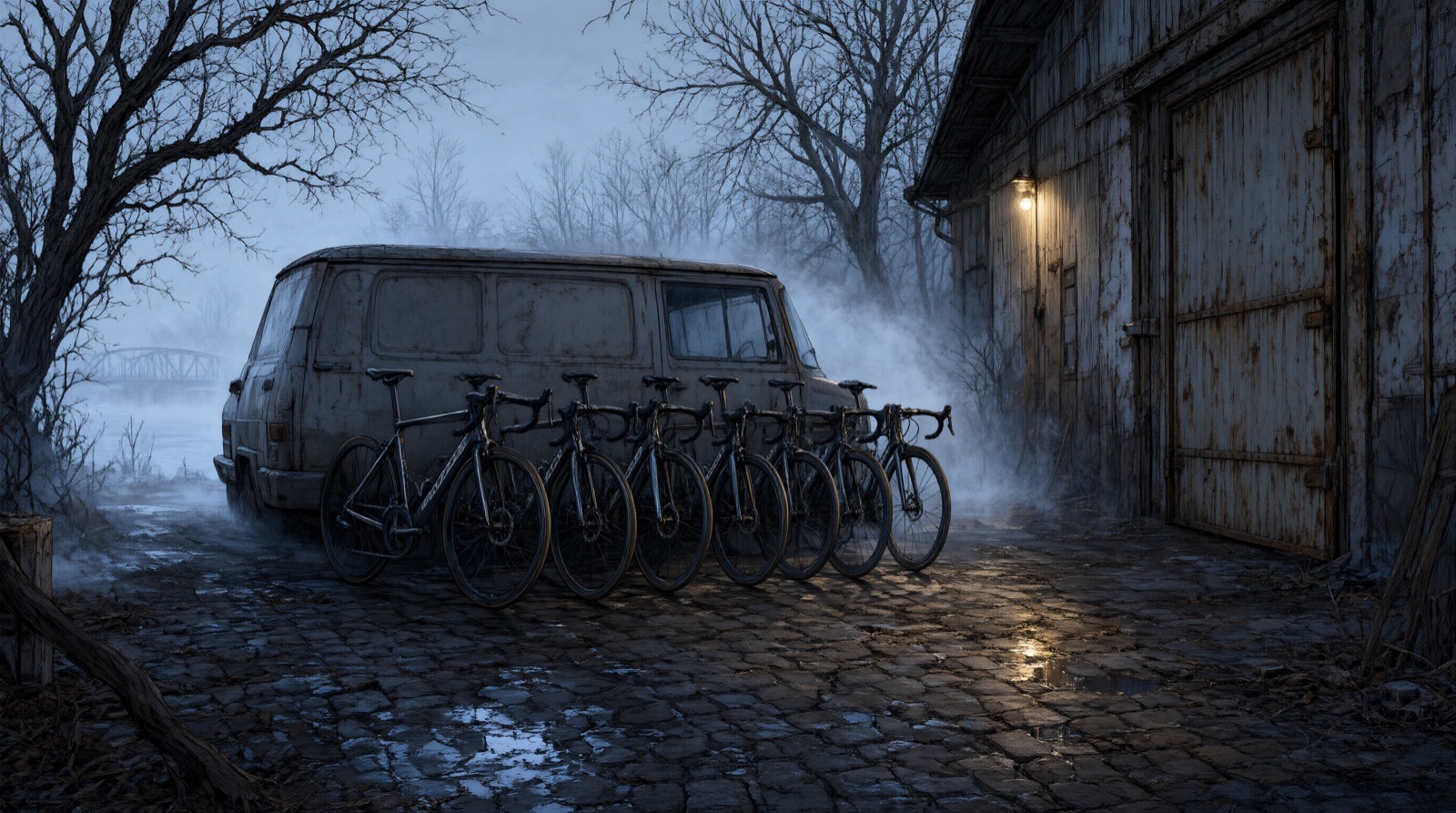
The surveillance at the old warehouse lasted three nights, and on the third night he came. A grey van that circled the block twice before turning into the yard. Kalle and Leni sat in an unmarked VW, which smelled of bad coffee and three nights without sleep. When the garage door rolled up and the impatient light of a torch swept the yard, they saw them: seven bikes, high-end, lined up like goods in a shop window.
„Those are Steinmetz’s," said Kalle quietly. „The right ones." Leni gave the signal over the radio. The cordon in front of the yard closed as the commander spoke the words. The van accelerated at the last second, tore past the barrier, ignored the red lights and swerved with screeching tyres onto the riverside road, where it vanished into the fog. „Lost him," said Kalle. „No," said Leni. „Seen him. And the fog doesn’t forget a face." She held up the photo the VW’s camera had taken as the driver got out. A man around forty, wiry, short grey-flecked hair, in a black windbreaker that smelled, by his own words, of fresh paint. „Boris Nowak," said Kalle. „Binoculars, laptop, coffee. We didn’t catch him this time. But the trail? The trail always leads back to us. And the warehouse knows where he wants to sell his bikes tomorrow." He left the coffee cup standing and grabbed his jacket. „Come on. We’ve got what’s ours to get." The story didn’t end with a pair of handcuffs, but with the certainty that Berlin never slept. Kalle knew they would catch Boris. Maybe not today, maybe not tomorrow. But soon. And the wheels over the abyss of the Havel would not stay hidden in the fog forever.
Note: All characters, places and events in this story are fictional. It was inspired by a public police report but does not depict real events, persons or circumstances. More: Legal notice.