Backyard Feud
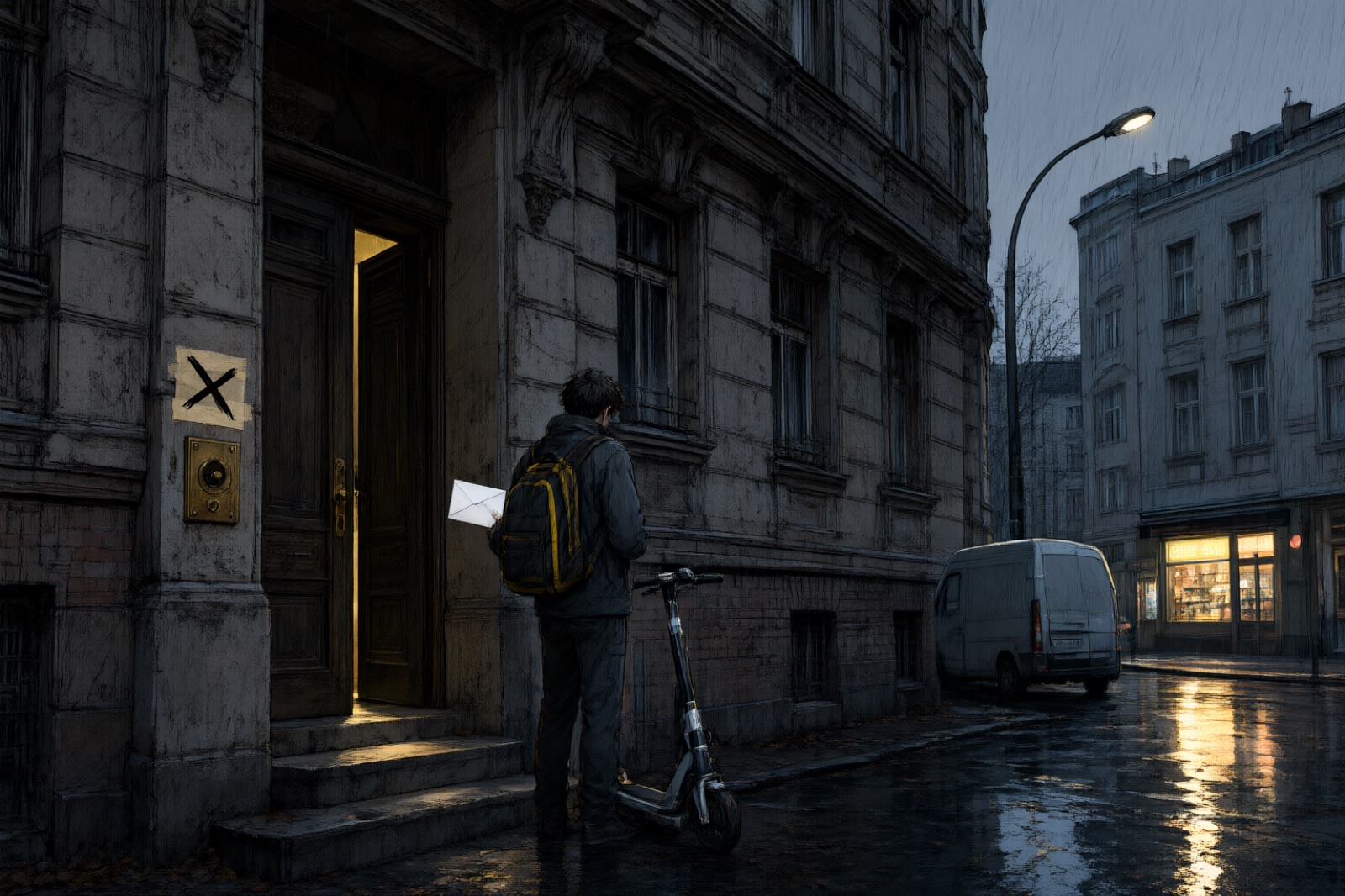
The Pappelring in Britz looked like a street that had personally invited autumn to move in: chestnut trees, wet leaves on the pavement, and a block of flats whose front building had seen better days, while the backyard behind it had never seen good days at all. Kalle parked the Golf at the kerb and studied the blue light pulsing in front of the stairwell. „Threat," he said. „Two neighbours. One with an axe-like object. One with a gun. Sounds like a perfectly normal Tuesday evening in Neukölln."
„It’s Thursday," said Leni.
„Even worse."
In the stairwell they were met by a young man who looked as though he’d rather be anywhere else: sports bag on his shoulder, ambition in his eyes, and a story he’d already told the patrol twice and could still start over from the beginning. Milan Erhardt, 31, tenant on the third floor, in the building for three years. „I was off to training," he said. „Football, SV Britz. Then I ran into Mr Kaltwasser in the stairwell, and he asked me whether I could turn the music down at ten in the evening. I said the music is turned down at ten, it’s just the telly that’s on. And from there it turned into an argument."
„A threat," Leni clarified, „needs more than a loud telly. What happened then?"
„Then Mr Pappke from the first floor joined in. He always joins in when something kicks off in the building. He said I should shut my mouth or he’d teach me a lesson. Then Mr Kaltwasser went into his flat, and when he came back he had this thing in his hand – like a small axe, a hatchet sort of thing, gleaming. He came at me with it. And at the same moment I heard a click from the first floor, like someone racking a gun."
„A gun," said Kalle.
„That’s what it sounded like. I ran up the stairs, locked my door behind me and called the police. That’s all I know." Erhardt looked at Leni. „It’s not like I’m making a racket all the time here. I come home at ten, shower, sleep. Who wants a fight over that?"
„We’ll find out," said Leni. „Promise."
On the ground floor lived Mrs Lehmann, 67, drinking her coffee from a mug that read „I have it all under control – just not the stairwell." She received the two detectives as though she’d been expecting them. „Of course I saw it," she said. „I sit at the window, I see the yard. It was half past four when the young one came back from sport. And then Kaltwasser came out with his thing from the flat… I tell you, that was an axe. Like from the Middle Ages. And Pappke up at the window called down to me to keep out of it. And I hadn’t even said anything."
„And the gun?" asked Leni. „Did you hear something being racked?"
„I heard something," said Mrs Lehmann. „But I thought it was Kaltwasser dropping his toolbox. He’s always hammering something. Only: yesterday he wasn’t hammering. And Pappke walked through the stairwell all afternoon muttering. If you ask me, he just wants attention since he retired."
„Thank you, Mrs Lehmann," said Leni, and noted: the core of the statement was believable, the ’toolbox’ detail doubtful. Eighty percent right – more than you can expect from a yard witness. „And the mug," she added, „is brilliant."
„My nephew gave it to me for my sixtieth," said Mrs Lehmann proudly. „He knows me."
Jürgen Kaltwasser, 48, lived on the second floor and received the visitors with the face of a man who hadn’t voluntarily answered a question in twenty years. His kitchen smelled of cold coffee and warm resentment. „I did nothing," he said. „I told the young man the music was too loud. You’re still allowed to say that. And if you happen to be holding your hobby tool on the way to the toilet, that’s still not an attack."
„On the way to the toilet," repeated Kalle, „you carry a hatchet?"
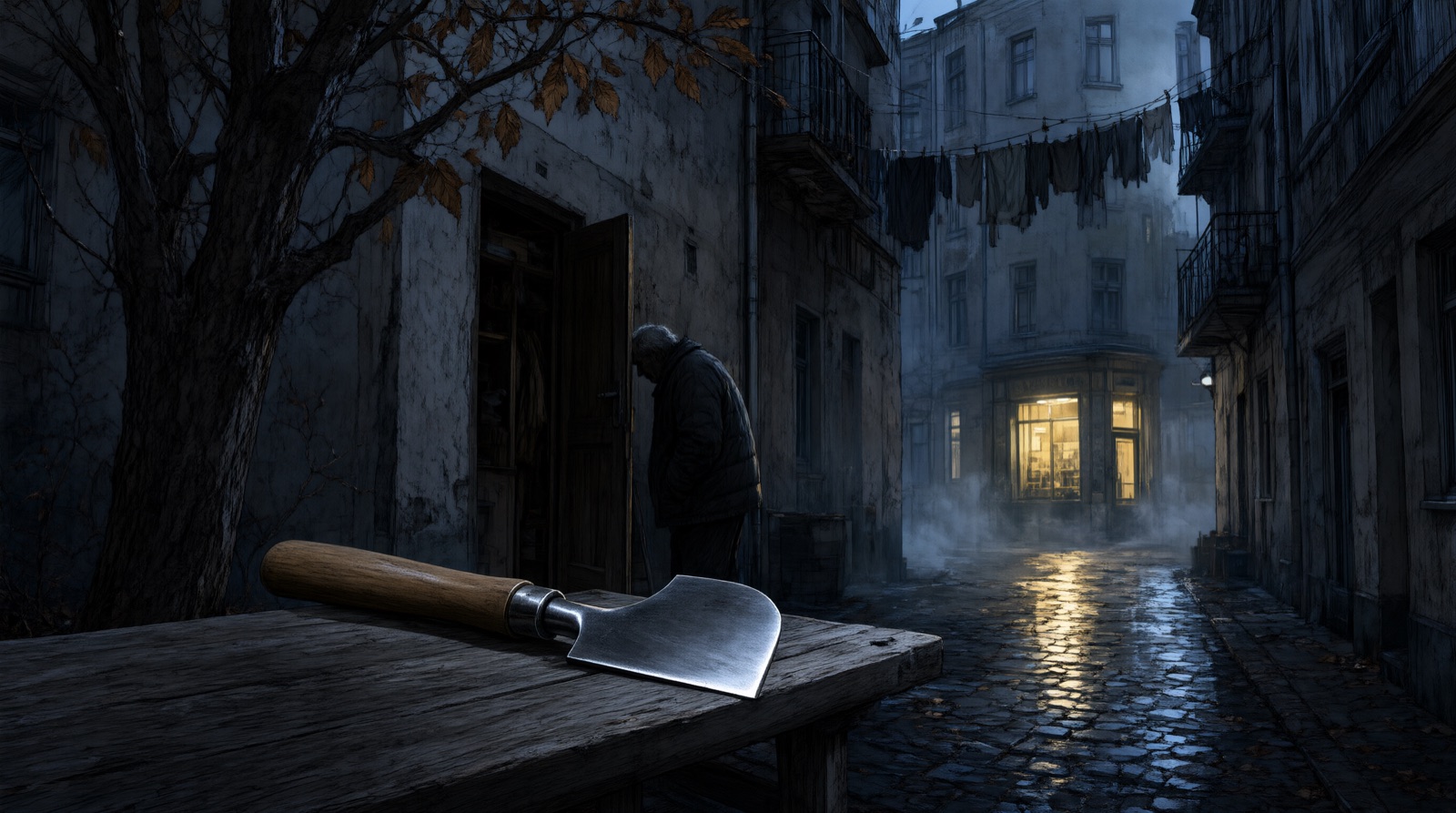
„It’s not a hatchet, it’s a woodworking axe. My father lived with it. He was a cabinetmaker. And I was just cleaning it."
Leni raised an eyebrow. „At half past four?"
„Clean tools are good tools."
„Mr Kaltwasser," said Leni, „Mr Erhardt experienced you as a threat. You approached him with a sharp object. If that’s how it’s told in court, you’re in a bad spot. Unless you tell us what really happened."
Kaltwasser was silent. Then he opened the door to the storeroom, where a shelf stood that, between work gloves and antifreeze, showed conspicuously tidy little packages – small white bags with a label Leni recognised at once: a pharmacy label, in clean handwriting, with a batch number that didn’t come from the regular supply chain.
„That’s for my mother," said Kaltwasser quickly.
„Your mother lives in Köpenick," said Leni, who knew the building’s file. „And she has a prescription for oxycodone that happens to match the batch we seized three weeks ago in a raid in Kreuzberg?"
„That can’t be."
„Yes, it can," said Kalle. „And now you’ll tell me where those bags come from. Or I’ll put you in a cell tonight with a window to the yard, where you can count the chestnuts."
Kaltwasser looked from one to the other. Then he said quietly: „From the corner-shop bloke. From Kreuzberg. He delivers the packages, I store them, three times a month he picks them up. He pays cash and never asks what I need the space for."
„Name?" asked Kalle.
„He just calls himself ’the pharmacist’. But I once drove with him when he took a delivery near the Landwehrkanal. And I saw the name on a receipt: Mende. Karlheinz Mende."
Kalle leaned back. A smile that wasn’t a smile crossed his face. „Mende. Well, well. He’s been steadily expanding his network. First Kreuzberg, now Britz. The man delivers like the post – only undeliverable."
Leni put the bags into an evidence pouch. „That gives us the connection," she said. „And a reason to take the neighbourly dispute seriously that isn’t one."
In the yard, two crime-scene officers had gathered around the hatchet, which Kaltwasser had carried out himself and laid on the bench by the bins as if it were a pumpkin for the autumn fair. The younger expert, bespectacled, held the tool up. „Curious piece," he said. „Japanese steel, hand-forged. You don’t cut wood with that – you cut an impression." Kalle surveyed the yard: bikes in the rack, washing on the line, chestnuts on the ground. „The whole yard is a stage," he said. „One plays the medieval craftsman, one plays the guard, and the young bloke on the third floor is the audience. Except the audience doesn’t want to see hatchets." Leni nodded. „And the lead role, as always, goes to someone who isn’t in the play at all: the pharmacist from Nelkenzeile."
On the way to the door, Leni’s phone rang. She picked up, said ‘yes’ twice, hung up and turned around. „The station at Section 48 reports: a Mr Karlheinz Mende has just voluntarily appeared at the station and asks whether he might speak with the detective in charge about the delivery to Mr Kaltwasser. He ‘heard about the matter in the stairwell’ and would like to ‘clear up any misunderstandings’."
„Voluntarily," said Kalle. „That bloke’s got a network thicker than the cotton in his vest."
Mende sat on the same wooden bench where Milan Erhardt had sat that afternoon. He looked older than at the raid in Kreuzberg, but not in a worse mood: tired eyes, a friendly smile, and hands resting quietly on an energy drink he’d brought himself. „Chief Inspector Rieger," said Mende, nodding to Leni. „Chief Inspector Weber. You look as though you’ve had a long day. May I offer you an energy drink? I have another one in my rucksack."
„Mende," said Kalle. „You’ve announced a voluntary statement. You know that’s a good idea."
„I know you’re good detectives," said Mende. „So let’s skip the surprises. Mr Kaltwasser told you I bring him packages. That’s not quite right: he occasionally brings me medications that I collect for my patients. A few older people in that building need help obtaining things. I’m not a dealer, I’m a distributor. I told you that in Kreuzberg."
„In Kreuzberg you swapped a corner shop for fentanyl," said Leni. „Here you have a courier who covers you while holding an axe. That’s not a distribution network, that’s a shadow."
„A shadow needs light," said Mende amiably. „And you, Chief Inspector, are the light. So you’ll keep watching me, keep checking, keep finding nothing – because I do nothing illegal. I’m a service provider. And service providers who don’t betray their customers are as rare in Berlin as honest builders. That’s why people come to me."
Kalle looked at him for a long moment. Then he stood up. „Mende, today you get a free ride home. And a message: the next time I find one of your courier drivers threatening someone with an axe in a stairwell, he won’t be in the storeroom. He’ll be in a cell. And the cell, Mende, has no window to the yard."
„Thank you for the information," said Mende, and drank his energy drink. „And for the escort. The streets are full of autumn leaves today."
Werner Pappke, 52, on the first floor, confessed within twenty minutes: the starter pistol had lain in his bedside drawer since his son bought it at a flea market ten years ago, and the ‘racking’ had been the safety catch clicking as he stood at the window watching the commotion in the yard. „I just wanted some peace in the stairwell," he said. „You can’t have that much noise every evening."
„You didn’t point a weapon at anyone?" Leni asked.
„No! I was just looking. And Kaltwasser had his tool in his hand, that’s all. He’s not a murderer, he’s a moaner."
„Mr Pappke," said Leni, „you’re being reported for threat. So is Mr Kaltwasser. The proceedings will clarify whether the moaning became a crime. And if you help us by giving your statement the way it was – that helps you too."
Pappke nodded wearily. „I can’t sleep," he said. „Since the pension started, the night is too long for the day. And then the noise…"
„Then you go for a run around the Britzer Garten tomorrow morning," said Kalle. „That knocks you out better than any starter pistol."
That evening they sat in the station at the Pappelring, windows fogged with the breath of autumn, coffee black as the night outside. Leni had sorted the reports, labelled the bags, filed the Kreuzberg connection. „Mende stays free," she said. „Again. But now we know he works in Britz. And we know his couriers know he’ll leave them out to dry when it gets hot."
„A distributor," said Kalle, „who expands his network and doesn’t protect his courier drivers. Eventually someone like that makes a mistake. And when he does, we’ll already be there."
„Do you think he’ll be back?"
„Mende? He always comes back. He’s like autumn: unavoidable, but punctual." Kalle finished his coffee and set the cup down. „Right then. Tomorrow morning we’ve got two interviews, one search and the question of what happens to the axe in the storeroom. But that’s a case for tomorrow. Today: coffee."
„Good work today," said Leni.
Kalle nodded. That was all.
Note: All characters, places and events in this story are fictional. It was inspired by a public police report but does not depict real events, persons or circumstances. More: Legal notice.