The Return of the Tap
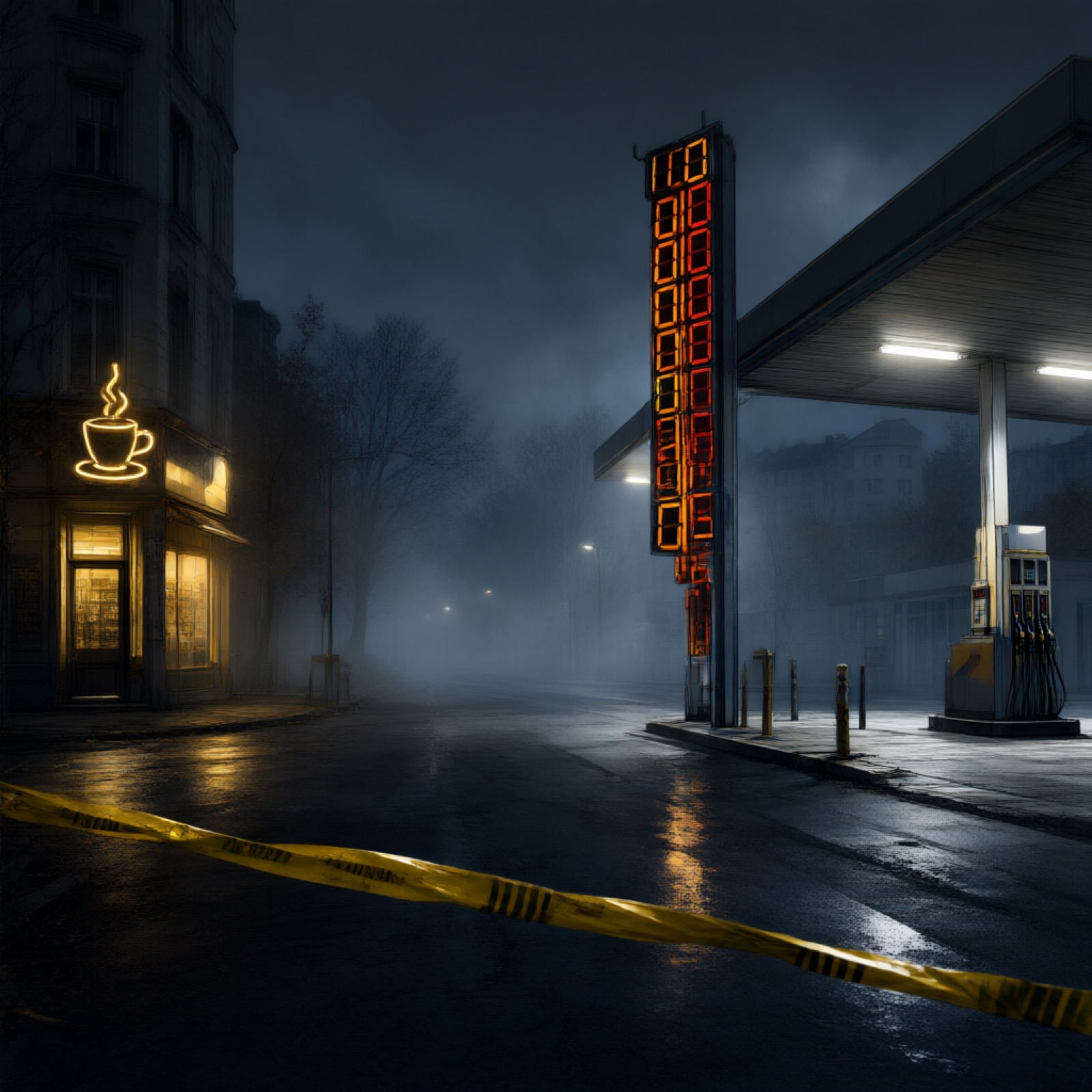
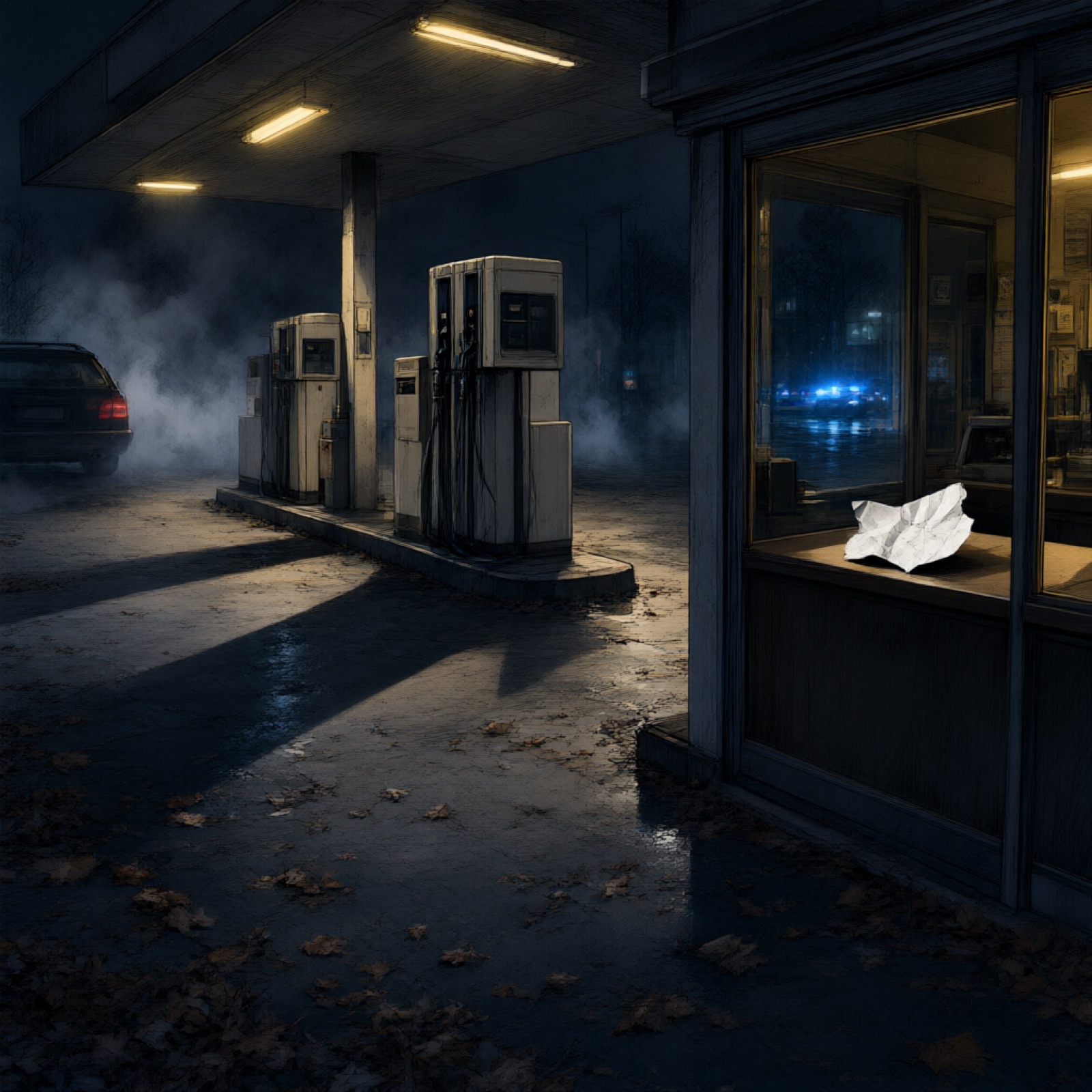
At quarter past one the phone yanked Kalle out of a dream where he was ordering a currywurst and never getting it. Outside, November had turned Friedrichshagener Straße into a wet, glistening canyon. The petrol station at the end of the road stood under the yellow glow of its own canopy like it was the only warm thing in the entire borough. Two patrol cars in front, blue lights silent in the fog that swallowed the blue before it reached the trees.
“Shots,” Leni said as he got in. “One round, into the ceiling. Nobody hurt. But the weapon was real, says the cashier. Blank-firer, looks like the real thing, makes noise like the real thing, just doesn’t fire bullets. Purpose: make an impression. Worked. She opened the till, the men took the money and legged it. One of them left something on the counter. A note. It says — wait — ‘The Tap was here.’” She looked up from her phone. “With an exclamation mark, Kalle. The bloke uses exclamation marks on his threats. That’s either mental or a lead. Or both.”
“Both,” Kalle said. “And I know who.” He leaned his head against the window as Leni steered through the empty streets. “Tankstellen-Tom. The geezer who gave us the slip three days ago. Real name Thomas Nowak. Ex-IT bloke from a petrol station chain. Packed it in when they slapped a written warning on him — for reporting a security hole. Since then he’s been knocking over petrol stations like other people post on Instagram. With a signature. New alias, new town, same theatre. He’s signed off as ‘Tankstellen-Tom’, as ‘Petrol Bert’, and now he’s the Tap. The bloke collects stage names like other people collect loyalty points. And every time he leaves a calling card. Because it’s not the money he’s after. He wants applause.”
The cashier was called Sabine Krause, twenty-six, with the kind of face only people who’ve just had a pistol shoved in front of them have. She sat in the petrol station break room on a stool, a wool blanket round her shoulders that a paramedic had given her. Her hands lay flat on her knees, still, as if the trembling was something she’d postponed until later.
“Ms Krause,” Leni said, pulling up a second stool. “Detective Chief Inspector Weber, this is Detective Chief Inspector Rieger. Tell us what happened. At your own pace. We’ve got time.”
Sabine nodded, twice, without lifting her head. Then she breathed out. “I was restocking the shelves. Round the back. The doorbell went and I thought: finally a customer, it’s been dead for two hours. But when I came through to the front, there were two of them. Black balaclavas, black jackets. One was holding a weapon. Shoved it right in my face, so close I could smell the lacquer. Then he said: ‘Open the till. Now.’ No discussion. No please. Just the sentence. Like he’d learned it by heart. And then he fired a shot into the ceiling. So loud — my ears are still ringing. The ceiling panel’s got a hole in it. Above the coffee machine. There’s this black hole now where there used to be white plaster. And then he waited. Just stood there, the weapon still raised, and waited for the echo to die. Like he was listening. Like theatre. Someone checking the acoustics.”
Leni looked at Kalle. Kalle looked at the ceiling panel. A hole, fist-sized, black, edged in yellow light leaking from the neon tube behind it.
“And after the shot?” Leni asked.
“That’s when I opened the till. Everything out. Notes, coins, receipt rolls. The second man collected it all. No hurry. No rush. The one with the gun just stood there. And then he pulled out the note. From his jacket pocket, folded, dead neat. Laid it on the counter. Tapped it twice, with his index finger. Like it was a receipt. And then they were gone. Didn’t run. Walked. Brisk, but walked. I heard the doorbell and the car pulling away. And then it was quiet. Just the ringing in my ears and the hole in the ceiling. And the note.” She looked up. “I thought: who does that? Who shoots a ceiling and leaves a signature? He wants to be found, doesn’t he? He wants someone to come looking. Like a game. But it’s not a game, is it? There was a weapon. It smelled. Of oil. Of metal. Of something real.”
Leni waited. Victims give you everything if you let them. You just have to listen.
“The weapon — he held it in his right hand?” she asked.
Sabine thought about it. “Yes. Right. And when he fired, he flinched for a second. Not from fear. From the bang. Like he wasn’t expecting the bang himself. But then he smiled. Under the mask. I could see it in his eyes. The creases. He smiled. Because it went bang. He liked the noise. He found the noise beautiful.”
Kalle stood on the other side of the break room, looking out the window. Across the road, there was a light on in the corner shop called “Nachtbeleuchtung”. The woman who ran it had lied about her CCTV last time. This time she wouldn’t lie. This time he knew how to crack her open.
“The note,” he said. “Let’s have a look.”
Forensics had already bagged it. A receipt from a bakery two streets away. On the back, in block capitals, ballpoint pen: The Tap was here! And underneath, smaller: P.S.: The app says thanks.
Leni read the second line aloud. “The app says thanks. Kalle, that’s not just a signature. That’s a statement. He’s copied the customer data from the loyalty app. Again. Just like the first four times. But this time he’s bragging about it. He wants us to know. He wants us to chase him. And to be too late.”
Kalle picked up the coffee cup from the table, took a sip, pulled a face. Petrol station coffee. Tasted of midnight and bad decisions. “The bloke thinks he’s three steps ahead of us. But he’s making a mistake. Same mistake every time. The scout. The little motor. He’s parked up somewhere every job, watching. Like a director at his own opening night. He’s Tom’s weak spot, because he keeps the whole show running. No scout, no timing. No timing, no theatre. No theatre, no Tom. We find the scout, we’ve got Tom. And the scout’s sitting somewhere in Köpenick right now thinking he’s invisible. But he ain’t. Because blokes who sit in cars at night staring at petrol stations get noticed. Always. By someone. Somewhere. And I know exactly who.” He set the cup down and looked out the window, straight into the warm, murky light of the “Nachtbeleuchtung” across the way. “Come on, Leni. Let’s go over. The lady’s got something to tell us. And this time without the nonsense about the broken camera.”
The corner shop owner was called Ms Nowak. No relation, as she’d stressed last time, but that didn’t make it any better. She stood behind the counter, arms folded, wool cardigan over her nightdress, the same suspicious look as three days ago. The telly above the fridge was on mute. The neon sign flickered to the beat of a loose connection.
“Ms Nowak,” Kalle said, leaning on the counter. “We’ve been here before. You, me, the camera that doesn’t take pictures. Except this time someone fired a gun. Into a ceiling. D’you know how loud a shot like that is? Louder than a fridge. Which by the way you still haven’t cleaned, going by the noise it’s making. But you didn’t hear any robbery. Same as last time. No shot. No car. Nothing. That right?”
“I was out the back. Stock sorting. No one comes in at this hour. And if —” she hesitated — “if someone’s shooting, I call the police. And then you turn up. Which you have. Any more questions, or can I get on?”
“You can get on,” Leni said, stepping closer. “In a minute. But first, tell us about the car that was parked outside your door tonight. Not the estate car the offenders used. The small dark one. I wasn’t outside your door when it happened, so I’m guessing. But my guesses tend to land: parked fifty metres further down, same as last time. A driver in it who waited until the offenders came out, then drove off the opposite way. Same car. Same spot. Same theatre. And I know your CCTV is working. I switched it on myself three days ago. And if it’s ‘broken’ again, we’ve got a problem, Ms Nowak. A big one. Because obstructing an armed robbery investigation isn’t a minor offence. And the tax office — well, let’s not go there. You know how much cash goes over this counter. Or rather doesn’t. Depending on which till you’re using.” Leni laid a business card on the counter, blank apart from the police logo. “Call me when the camera’s working again. Or call me because you remember what you saw. Or call me because you don’t fancy a tax audit. I’m flexible. But I need a number plate. Or a description. Or a name. Something that gives me the man in the small dark car. You’ve got until tomorrow morning. After that, I’ll be ringing someone else. Someone interested in your bookkeeping. Good night, Ms Nowak. The night is long. And the fridge is still humming. But you knew that.”
Outside, on the pavement, Leni stopped. “You think she’ll ring?”
Kalle zipped up his leather jacket. The fog had thickened, the yellow glow of the petrol station now a diffuse stain in the darkness. “Last time she lied and then coughed up the CCTV anyway. This time she’ll lie until she clocks that the lie costs more than the truth. The woman has no problem with lying. But she does have a problem with costs. And a visit from the taxman costs more than a number plate from a car that’s not hers. She’ll ring. Maybe not tonight. But tomorrow. When the coffee’s gone cold and the phone’s gone quiet. Then she’ll ring. Because she’s clever enough to know I’m not joking. And because she knows: if she gives me the scout, I’m gone. If she doesn’t — I stay. And I can stay a very long time.”
By three in the morning four files lay on the table in Section 13. Four petrol station robberies in three weeks. Three in Berlin, one in Potsdam. All in the same handwriting: alias, signed receipt, app data copied, minimal cash haul. And now the fifth, with a shot fired. The offender was escalating.
“He’s speeding up,” Leni said. She’d drawn the overview table on the whiteboard, using coloured markers from her desk drawer. Leni liked whiteboards. They gave her the feeling that data had a shape and shapes led to solutions. “Between jobs one and two: eleven days. Two and three: seven days. Three and four: four days. Four and five —” she tapped the board with the marker — “three days. He’s accelerating. Not because he’s getting greedy. Because he knows we’re on his tail. He wants to pull off his big coup before we catch him. The app data from five petrol stations is enough for a burglary spree that’ll carry him through the whole winter. Fifty holidaymakers who won’t be home next week. Fifty empty flats. Fifty undisturbed loading jobs. That’s the plan. Not the till. The flats. And he’s got the addresses. He just needs one more data set. One more petrol station job. And we know which one.” She tapped the screen. “The one at the Müggelseedamm junction. The only one in Köpenick he hasn’t hit yet. The one with the brand-new app interface. Only went online in October. He’s got no access to that one yet. And that’s where he’ll hit tonight. Or tomorrow. But soon. Very soon. Maybe too soon to stop him. But not too soon to surprise him. Kalle, we have to be there before he is. And when he shows up, we don’t open the door. We shut the trap. Once and for all.”
“The station’s already booked,” she said, putting the marker down. “Since we came out of the corner shop. On spec. Camera access, four angles, three cars from the control room. The cashier’s been briefed. She does her job and looks like nothing’s happening. All we have to do now is get there and wait.”
The petrol station at the Müggelseedamm junction was as quiet at twenty past three as an aquarium after closing time. The yellow canopy light reflected off the wet tarmac, no car, no customer, just the young cashier behind the security glass, briefed by the control room, whose only job tonight was not to make a mistake.
Kalle and Leni sat in an unmarked car on the car park of the closed supermarket opposite. They’d been waiting a quarter of an hour. Coffee was long gone. Kalle hadn’t said a word the whole time, which meant he was focused. Leni had her phone in her lap, the petrol station’s camera app on screen, live feed from four angles.
At twenty-five past three the phone in her hand buzzed. A number with no name. She answered, listened, said “Thanks” and hung up. “Ms Nowak,” she said. “No hello, no name. Just the number plate, read out once, then gone.” She typed it into the check and waited for the answer. “Registered to a man in Neukölln. No record, no previous. Small dark car, older model.” She scrolled on. “And guess where the car’s already turned up. File four. The getaway car, fifty metres behind the scene. They never had a plate for it back then. Only the description. And it fits.” Kalle nodded once and kept his eyes on the forecourt.
“There,” she said suddenly.
A dark estate car turned into the forecourt. Slowly, as if it didn’t know the way yet. It didn’t stop at the pumps, drove straight to the shop. Two figures got out. Black balaclavas, black jackets. One carried a weapon. The other went ahead, opened the door. The estate car didn’t stop. It rolled on at walking pace, past their car, across the forecourt and round the back of the supermarket, where it sat in the dark with the engine running. The driver had stayed put.
Kalle put his hand on the door handle. “Now,” he said.
They moved quietly but quickly. Twelve paces from the supermarket car park to the petrol station door. The man outside the door saw them first. His hand went to his jacket. Then he saw Kalle’s face and the warrant card and let his hand drop again. He had the choice between running and giving up and made it in the same half-second Leni put his hands behind his back.
“Stay put,” she said. “You’re under arrest. On suspicion of armed robbery, criminal damage and membership of a criminal organisation. And if you’re thinking of running — there are three more cars back there you can’t see in the fog. Sit down. On the kerb. Not a word without a solicitor. No solicitor without a phone call. But first: sit. Thank you.”
She waved one of the cars in out of the fog, handed the man on the kerb over to the officers, and walked on, the fifty metres round the corner of the supermarket. The estate car stood there with the engine running, the windows long since misted up. Leni tapped on the driver’s window. The man behind it looked at her, then at the warrant card, then switched the engine off. Mid-thirties, thin face, tired eyes — the same face as on the photo from the registration check. “You’re the driver,” she said. “You’re the scout.” He said nothing. He got out and let her put his hands behind his back, as if he’d been waiting all evening for it.
Inside the shop it had gone quiet. The cashier had her hands above her head, though no one had told her to. And in front of her, in the middle of the aisle between the chewing gum and the energy drinks, stood Thomas Nowak. No mask. He’d taken it off when he heard the door chime. As if he’d known the performance was over.
He was early forties, thin face, three-day stubble, glasses that looked more expensive than his jacket. In his right hand the blank-firing pistol, lowered, barrel pointing at the floor. In his left a receipt, still unfolded. He’d had it ready. Signed.
“Thomas Nowak,” Kalle said, stopping on the other side of the chewing gum rack. “You’re under arrest. Put the weapon on the floor. Put the receipt on the floor. And then tell me: why? Why the theatre? Why the notes? Why the app? You’re an IT man. You could’ve nicked the data quietly. Hacker methods. Silent. Invisible. But you didn’t want quiet. You wanted applause. Am I right?”
Nowak looked up. His eyes were calm, almost gentle. The eyes of a man who’d waited a long time for someone to ask the right question.
“D’you know how many people say thank you at a till?” he said. “No one. Not the customers, not the bosses, not the colleagues. Six years in IT. Six years keeping the systems running that run the whole place. Upgrade here, patch there, database optimisation. D’you know what I got when I left? A written warning. For reporting a security flaw that had been open for two years. So I quit. And then I started visiting petrol stations. As an artist. Not a robber. The money doesn’t matter. The money is the ticket. But the app — the app is the dress rehearsal. Every petrol station I ‘visit’ gives me access to the data. And the data is worth more than money. The data is the real applause. Not the till. The stage. And every signature, every receipt, every alias was part of the show. The show no one wanted to see until it got too loud. And now you’re here. Exactly as I’d hoped. Because I wanted someone to come. Not to arrest me. To watch. You’re my audience, Detective Chief Inspector. You and your colleague. And I hope you enjoyed the performance. Because it was the last one. For a while, anyway. See you after the interval. Or something.” He smiled. Not arrogant. More sad. The smile of a man who knew the applause would fade and still stayed on stage until the final line.
Kalle took the weapon from his hand. Took the receipt from his hand without reading it. And said only: “The applause is over, mate. The stage belongs to the Old Bill now. And if you fancy coming back after the interval — we’ve got a season ticket for you. Third row. Behind bars. Not exactly the West End. But the audience is a captive one. Literally. They all applaud. Once. When the cell door shuts. Sounds like a standing ovation. For a clown who thought he was the star. Good night, Mr Nowak. The show’s over. Curtain down. And the Tap? He’s run dry.”
Outside, the fog had lifted. On the horizon, behind the rooftops of Köpenick, the first grey strip of a November morning was showing. Leni leaned against the bonnet, hands in her jacket pockets.
“Four petrol stations in Köpenick, one in Potsdam. Four lots of app data. Five signed receipts. Three aliases. And a shot into the ceiling. All because of a written warning, Kalle. All because of a written warning. The man ran the IT for six years and was sent off with a form. No party. No applause. No thank you. A written warning instead. And then he went off the rails. Not evil. Just lonely. Lonely and unappreciated. And someone who’s lonely and unappreciated does the strangest things. Starts building his own stage. With petrol stations as the set. With pistols as props. With till receipts as the programme. And with a scout and a doorman as the supporting cast. The man wasn’t a criminal. The man was an unemployed IT worker who’d been miscast. But he was carrying a pistol. And he fired into the ceiling. And that alone is what makes the difference between a sad story and a dangerous one. And the dangerous one — that doesn’t end with applause. It ends with handcuffs. That’s how it goes. In Berlin, anyway. In Köpenick, anyway. And with a star who forgot that the best performances are the ones after which you simply exit. Not the ones after which you get nicked. He didn’t know that. But he knows it now. Latest when the cell door clicks shut. Click. Curtain. Out. No applause. Just a statement.”
“That was almost philosophical,” Leni said.
“Nah. That was currywurst logic. That’s all anyone needs, innit. Especially at half four in Köpenick, when the sun’s coming up and the petrol station’s doing coffee again. Speaking of which — the coffee in there? Give it a miss. Tastes like yesterday. And we’ve had enough of that. Come on. Let’s go. The day’s long. And somewhere out there I’ve still got a currywurst to sort out.”
Leni looked at him and smiled. “You’re always thinking about food, Kalle. Even after an arrest. D’you know what I think? I think the man needed us. So his theatre could end. He couldn’t stop himself. So he played louder and louder until we heard him. The shot into the ceiling wasn’t the climax. The shot into the ceiling was the final act. After that, he was done with his role. And he was just waiting for us to come and bring the curtain down. He needed us, Kalle. Not as police. As an audience. And we watched. Maybe that was the mistake. Or the solution. I don’t know. But I do know the coffee really is dreadful. And that I want breakfast now. Not petrol station coffee. Proper breakfast. With bread. And butter. And an egg. And silence. Above all, silence. No bang. No echo. No hole in the ceiling. Just a table and a chair and a cup that doesn’t taste of midnight. Sound good?”
Kalle opened the car door. “Sounds perfect. Let’s go. And then we never talk about ceiling holes again. Ever. Promise?”
“Promise.”
“Good job today, Leni. Good job.”
Note: All persons, places and events in this story are entirely fictional. It is inspired by a publicly available police report but does not depict any real events, persons or circumstances. Further information: Legal Notice.