The Pickpocket and the Plainclothes Officer
Monday morning at the nick, and the coffee in Kalle’s mug is so old it’s started to taste drinkable again. On the desk sits a report that ought to be no work at all: pickpocketing, plainclothes officer intervenes, arrest. That sort of thing happens in Schöneberg three times a week. Except the officer who made the collar is, of all people, Müller.
Kalle reads the report twice and grins into his mug. “What a right coincidence, then — that it’s Müller of all people who’s strolling past.”
Leni looks up from her screen. “No coincidence, Kalle. He’s got a nose for open rucksacks. And for anything daft enough to wander past him.”
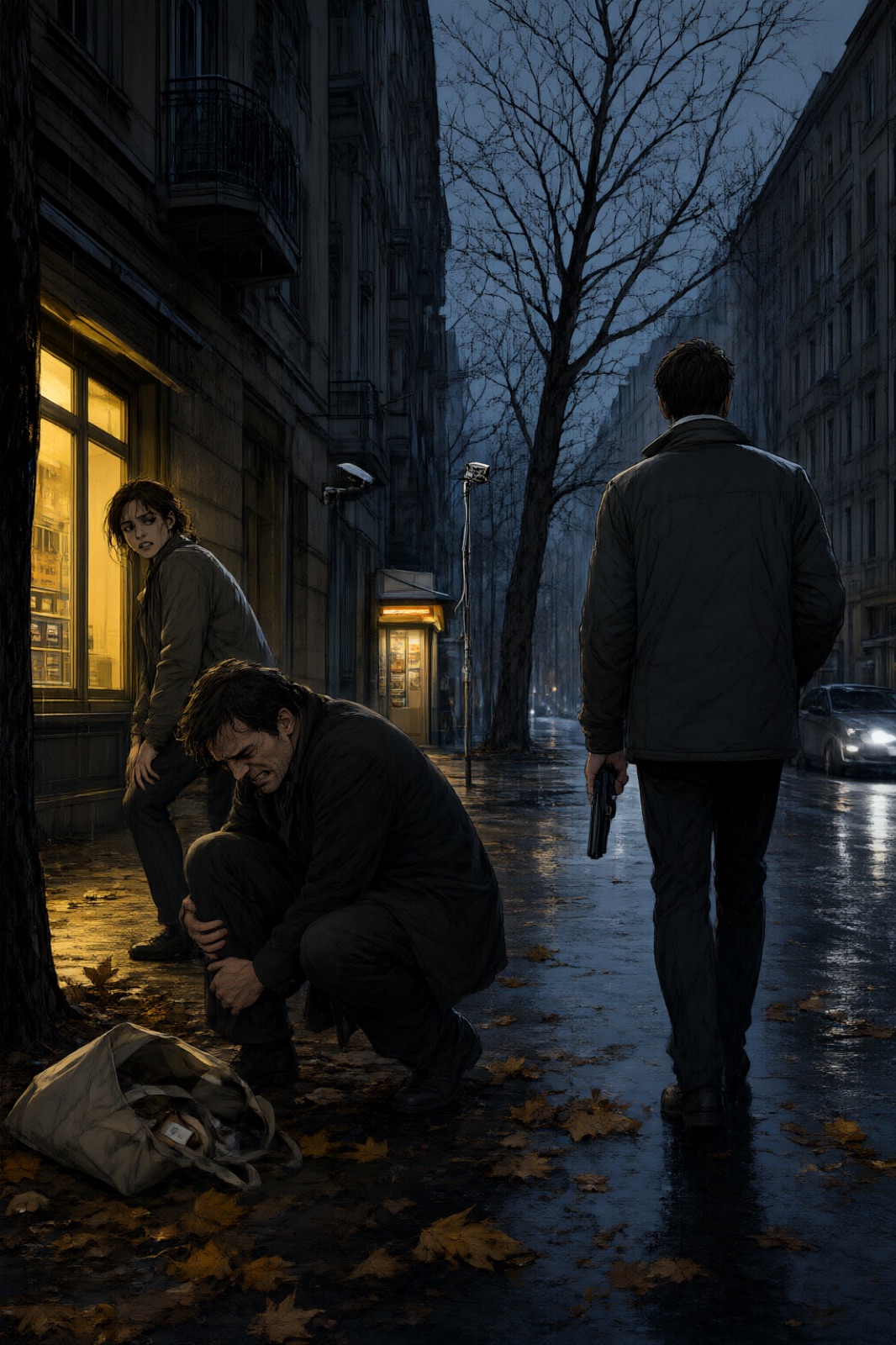
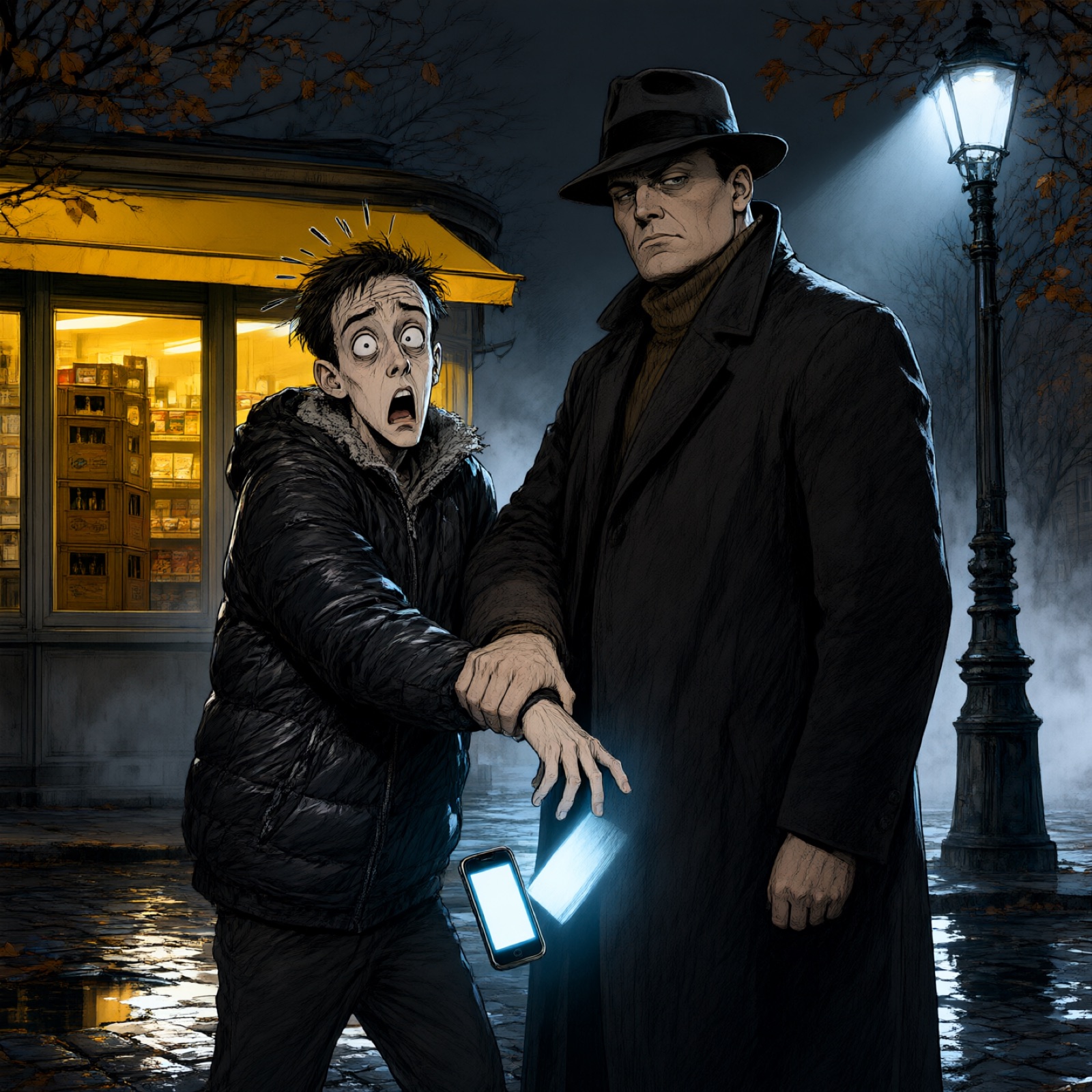
Müller’s a plainclothes officer. After his shift, the report says, he was walking down Goltzstraße when he saw a young bloke in the crowd getting too close to another man. Müller reached out and had the pickpocket by the wrist before the lad even clocked that there was a copper at his back. The 26-year-old squirmed, a second man legged it, and by the time the patrol car arrived Müller was holding the lad on the pavement like a parcel he wasn’t about to put down.
“So what’s the catch?” Kalle asks. “Why’s this landed on my desk?”
Leni slides her tablet across. “Because the lad nicked the wrong phone.”
The phone’s an older model, scratched all over, and it doesn’t hold a single personal contact. What it holds is four messenger groups with names that sound like shipping lists: “Goods North”, “Depot West”, “Handover 3”. Kalle taps through the chat logs and whistles through his teeth.
“That’s no pickpocket’s phone. That’s a fence’s phone, that is.”
Photos of watches that ought to still be sitting in shop windows. Serial numbers of laptops, sorted like a price list. Abbreviations for drop points — a station locker, a back courtyard in Neukölln, a boot lid at a petrol station. And at the top of every group the same sender, a contact called only “Fatty”, firing off short instructions: “Thursday, two units, same spot.”
“Routine turns into a network,” Kalle says. “I like it.”
Leni takes the tablet back. “Then we start with the lad. He’s kindly dumped all this on our desk, after all.”
The lad’s name is Timo Bergmann, he’s twenty-six, and he sits in the interview room like someone who’s only just twigged that he’s nicked not a phone but a whole heap of trouble. He’s thin, has the hands of a man who’s never done a day’s heavy work, and he starts talking before anyone even asks him a question.
“I only wanted the phone. Honest. I didn’t look at whose it was. The bloke had a jacket with an open pocket, and I thought he was a tourist. Swear to God.”
Leni sits down opposite him, calm, hands folded. “Mr Bergmann, we’re not here about the phone. We’re here about what’s on the phone.”
Timo goes pale. “What’s on it?”
“That’s what we’re asking ourselves.” Kalle leans against the wall, arms crossed. “Go on, then: what did the man you lifted it from look like?”
Timo chews his lip. “Not as tall as you. Dark jacket, one with a hood. Cap, pulled down low. He was staring at his own phone the whole time — no, at another one, a cheap prepaid, one of those old brick phones. That’s why I even noticed him. He stood there like he’d been ordered to, pocket open, like he was waiting for me.”
Kalle and Leni exchange a look. A man with two phones, an open jacket pocket, a work phone full of fencing chats. The man wasn’t a tourist. The man was a courier.
“And the second man?” Leni asks. “The one who ran off?”
Timo shrugs. “Dunno. He wasn’t mine. I thought he was coming to help me, then he scarpered. Maybe he only wanted the phone too.”
Kalle nods slowly. The second man is the open question. An accomplice? A second courier? Or just someone who could run faster.
“Mr Bergmann,” Leni says, “you help us, and we won’t forget that you cooperated. But for that you have to remember properly. Where exactly was the man with the cap standing?”
Timo thinks. He remembers it was on the corner by Akazienstraße, in front of the corner shop with the broken neon tube. That the man looked nervous, not like someone waiting for the U-Bahn, but like someone waiting for a phone call.
“The corner shop,” Kalle says to Leni once they’re outside. “I know a bloke there.”
The corner shop belongs to Uncle Ali, and Uncle Ali knows everyone who does their rounds of Goltzstraße after dark. He’s a round man with a grey moustache and the sharpest eyes in the whole neighbourhood. He sees everything without ever looking curious — an art you pick up in thirty years behind a till.
When Kalle and Leni walk in, a bell rings, and Ali looks up like a man who knows full well these two haven’t come to buy beer.
“The lad nicked the wrong phone outside your shop,” Kalle says, no messing.
Ali dries his hands on a rag that used to be white. “Pickpockets. They’re sat here every evening. What am I supposed to see?”
“The man in the cap. Second phone. Nervous. Opposite you, on the corner.”
Ali sighs. “Kalle. You know how it works round here. If I start describing faces, I’m the next one people talk about. I’ve got a shop, I’ve got regulars, I’ve got a family. I see nothing.”
Leni steps closer. “Mr Ali. Last year you had a problem with the trade office. The second till. The cold store without refrigeration. You know what happens if that gets reopened.”
Ali freezes. His hands stop folding the rag. That’s the kind of pressure he understands. No threat, just a reminder of who still owes whom.
“I’ll tell you something,” he mutters at last, without looking up. “But you were never here.”
He describes the man in the cap: mid-thirties, a courier jacket, a stride like a man with appointments. The man’s name is Erkan, Ali says. He works for someone everyone just calls Fatty. And Fatty never shifts the goods himself, never touches them at all. Fatty only does the paperwork — invoices, orders, where everything’s meant to go.
“And where do I find Fatty?” Kalle asks.
“You don’t. But his shop’s on Hauptstraße. ‘Buying and selling of electronics.’ Looks like junk, but it’s a set of golden scales. Goods go in with no papers and come out looking like they’ve just rolled off the line.”
Kalle raps the counter twice. “If that checks out, you were never here. If it don’t, I’ll be back — and I’ll bring paperwork with me.”
Ali just nods and turns back to his fridge. His information is a service, not a favour. And both sides know it.
The shop on Hauptstraße belongs, according to the trade register, to one Dirk Dorn. The passport photo shows a broad man with a short neck and calm eyes that study you like an accountant checking a balance sheet. Nothing on the criminal record — nothing beyond a youthful offence, anyway. Dorn is clean. Too clean.
“Fatty Dorn,” Kalle says, laying the photo on the desk. “The man runs stolen goods like a haulage firm. And here’s the interesting bit: he never touches the stuff. He has other people do the touching.”
Leni has pulled the phone’s chat logs onto the computer and is working her way through the groups. The structure is startlingly tidy: deliveries with dates and unit counts, drop points that read like bus stops on a route, and a buyer who’s always just called “Frankfurt” and takes the larger batches. The “Depot West” group even has the address: Kolonnenstraße, the old laundry. The ring is bigger than one stolen phone would suggest.
“If the phone belonged to a courier,” Leni says, “then the ring’s missing a link. And sooner or later a missing link notices it’s missing.”
“So what’s Fatty waiting for?”
“For Erkan to get in touch. And Erkan can’t get in touch, because his work phone’s in our evidence store. The second phone Timo saw is a prepaid with no messenger account tied to the ring — so he can’t warn Fatty.” Leni holds the phone up. “We can take the call in his place.”
Kalle looks at her. “You want to bring down a fencing ring with a stolen phone by pretending to be the courier?”
“I want Fatty to show us the way to the depot himself. He only writes short sentences. We can manage that.”
It’s the kind of plan Leni calls “structured” and Kalle calls “a bit barmy”. But he hasn’t got a better one.
The witness lives on the third floor, an old building with a creaking lift. Her name is Mrs Behrens, and she opens the door as if she’d been standing at the window waiting — which she probably had. She’s one of those residents who keeps an eye on the neighbourhood like a guard dog, except she always looks out at exactly the moment the important thing’s already gone.
“I saw the young man,” she says, the moment Kalle and Leni are in the hall. “The one in the green jacket. He pulled something out of another man’s pocket, right under my window.”
Leni raises an eyebrow. “Green jacket?”
“Yes. Dark green. A puffer.”
Kalle glances at Leni. Timo Bergmann was wearing a black jacket. It’s in the arrest report. But Mrs Behrens is sure — she saw it with her own eyes, she’d swear on it.
“And the other man?” Leni asks patiently. “The one in the cap?”
Mrs Behrens wavers. “The cap was on the lad. I think. Or the other one. Anyway, one of them ran off and the other one was on the ground. I couldn’t see any more, the street light’s broken right there.”
She’s not being difficult, just unreliable — the classic eighty per cent. The core holds: there were two men, one ran off, one stayed down. The rest gets checked against the arrest report. Leni notes it down calmly and thanks her politely.
In the stairwell, Kalle says: “Green jacket. Thing came in a colour that never existed.”
“That’s why we don’t take witness statements unverified,” Leni says. “But the core was right: the man in the cap ran off and the lad stayed down. That matches Timo’s version. Two men, one got away.”
“And the one who got away,” Kalle says, “is either Erkan or a second courier. Either way, the ring knows by now that a phone’s missing.”
They don’t have much time left.
Leni writes the message that afternoon. Not from the evidence phone — through Erkan’s messenger account, whose session she’s pulled off the seized handset onto a force laptop. Short, in the tone of the rest of the chats, not a word too many: “Fatty. Phone gone, everything out, police have it. Need new orders.”
The reply comes twenty minutes later. “Depot West. Tonight. Bring the list.”
No suspicion. No follow-up question. Fatty is used to being obeyed, and he’s not used to being lied to. That’s exactly the moment a system that’s worked for years starts to creak.
Depot West is a back courtyard on Kolonnenstraße, an old laundry with boarded-up windows and a roller shutter that looks like it hasn’t gone up in years. Kalle and Leni wait with a squad from the division in two unmarked cars further down the street. Leni carries a courier rucksack with no list inside it — just an empty notebook and a transmitter.
Fatty arrives on foot. No car, no company. He’s broad, walks slowly, and even in the evening light he looks like a man who’s never run anywhere, because he’s never had reason to. He opens the shutter without looking round.
Kalle and Leni go in after him.
The courtyard smells of dust and old washing powder. Dorn stands in front of rows of shelves stacked with boxes — phones, laptops, tablets in their wrapping, all neatly labelled as if it were an Amazon warehouse rather than a fence’s treasure trove. He turns when he hears the footsteps, and for a split second his face shows genuine surprise. Then calm comes down over it like a shutter.
“You’re not Erkan,” he says. “Where’s the list?”
Leni pulls the empty notebook out of the rucksack and holds it up. “Here. All in here.”
Dorn takes a step towards her — and Kalle steps between them, warrant card up. “Rieger. And this is Weber. You’re nicked, Mr Dorn. For handling stolen goods. And for just about everything else sitting in those boxes.”
Dorn raises his hands, slowly, no panic. “I don’t touch the goods. I just organise. I’ve never hurt anyone.”
Leni presses the button on the transmitter in her hand. Two cars pull up at the gate; four officers come through the courtyard and secure the exit behind the shelves. Dorn watches them without moving.
“They all say that.” Kalle nods towards the shelves. “But that’s a warehouse full of stolen gear and you’re stood in the middle of it. So let’s talk.”
In the interview room, hours later, Dorn is composed as a man reading out his accounts. He talks about the pickpocket crews who bring him the phones, the burglars who deliver the laptops, the middleman in Frankfurt who pushes the larger batches across the border. He speaks about his “system” with a tenderness that would almost be touching if it weren’t so cold.
“I built it like a haulage firm,” he says. “Every item has a number, every handover a record. Nothing runs without me. The lads can steal, but organise they can’t.”
“And the lad who nicked your phone,” Leni says. “He knew nothing about any of this. He just put his hand in the wrong pocket.”
Dorn smiles, tired. “That was my mistake. Not his. I gave Erkan a work phone and told him to be careful. He wasn’t. And a pickpocket lifting a courier’s phone — that happens to me exactly once.”
Kalle leans back. “You know what I find funny, Mr Dorn? You talk about a stolen phone like you’re the victim here.”
“I am the victim,” Dorn says, seriously. “My entire business fell into the hands of two people tonight who don’t even know what a handover receipt is.”
Leni closes the file. “We’ll add that to the charge sheet, then, Mr Dorn. Causing a public nuisance.”
It’s late by the time Kalle and Leni get back to the office. The coffee is now so old it’s guaranteed not to please anyone. Leni puts two fresh mugs on the desk.
“Erkan was picked up tonight too,” she says. “The man in the cap. He was on his way to the station, headed for Frankfurt. The ring’s shut.”
Kalle nods and drinks. “And the lad? Timo?”
“Small fry. But he cooperated, and without his phone we’d never have reached Dorn. The court will give him credit for it. Maybe he gets a suspended sentence.”
“Maybe he learns something from it,” Kalle says. “And maybe he keeps to his own pockets.”
Leni doesn’t smile, but her eyes do. “Good job today.”
Kalle stares out of the window. Outside, the autumn fog is settling over the rooftops of Schöneberg, and somewhere down below a corner shop’s bell is still ringing, a late shop that’s still open. “Müller,” he says at last. “He’s owed a crate. Without his nose for it, that phone’d be in Frankfurt by now.”
Leni nods. “And the open question is still the middleman. ‘Frankfurt’ is only a contact name. Behind it stands someone who takes the larger batches. We haven’t got him yet.”
Kalle finishes his coffee and sets the mug down. “Right you are, then. The next ring’s already waiting.”
Notice: All persons, places and actions in this story are entirely invented. It is inspired by a public police report but does not depict any real events, persons or situations. Further information: Legal Notice.