He Who Brakes, Loses
The young man sat on the wooden bench in the station corridor, holding his helmet in both hands like a bowl he wasn’t allowed to drop, with a bump on his forehead slowly blooming in all the colours of a sunset. Kalle stood in front of him, looked him over briefly and said: „You’ll be Erik Sandmann, then. The one with the bike."
„Yes," said the young man. „And with the bump. Sorry for turning up like this. The lads at the station round the corner said I should come here. Grievous assault, they said."
„They were right about that," said Leni, sitting behind the desk with a notepad. „Have a seat, Mr Sandmann. And tell us from the start. You’re the injured party – you don’t have to apologise."
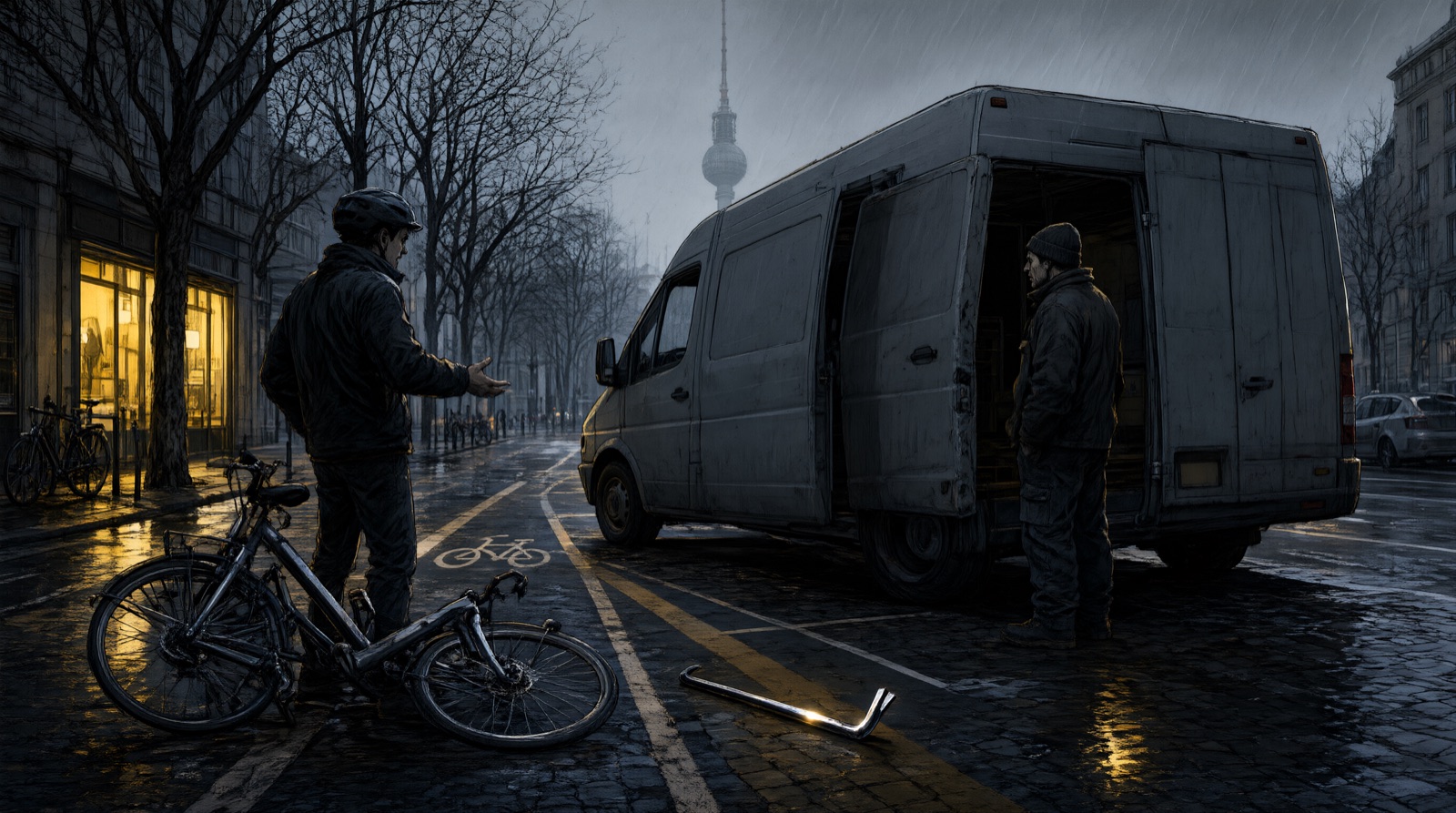
Erik Sandmann, 22, photography student and, by his own account, a Berlin cyclist for three years, told his story without hedging. „Yesterday lunchtime, just after one, I was on the cycle lane on Zinngießerstraße heading towards the town hall. A van pulled onto my lane from the left – no indicator, no shoulder check, just across. I had to brake hard. If I’d been half a metre faster, he’d have taken me with him while lifting a crate of drinks."
„The driver changes lanes and endangers a cyclist," repeated Kalle, leaning against the table. „And then?"
„Then I caught up with him – he was stopped at the lights. I rang my bell, friendly, and said that the lane change maybe wasn’t his finest move. He responded by shouting at me through the open window. His passenger joined in. ‘Lycra lout’, ‘daft helmet-head’, words like that. I said I’d take note of it and report it to the police. That’s when the driver got out."
„In the middle of the road?" asked Leni.
„By the taxi rank, just before the junction. He got out to park his van properly, and both of them came at me. The driver had an iron bar in his hand – one of those site rods. I don’t know if he fetched it from the van or grabbed it on the way. Either way: the passenger grabbed my rucksack, I went down with the bike, and the driver laid the bar across my forehead – here." Sandmann touched the bump. „Then they got back in and drove off. People shouted, but nobody stepped in."
Kalle nodded slowly. „Did you get the plate?"
„Yes. B–X 4317. I memorised it. It was on the back of the van, as if he wanted to hand me his business card."
„Colour? Make?"
„Grey, the whole thing. One of those tradesman vans, box body, a bit of rust over the rear wheel. The firm, I think – there was something with ‘Transporte’ on the door and a number, that’s all I saw." Sandmann hesitated. „I’ve never filed a report before. Am I now the bloke who makes a fuss over a right-of-way slip?"
„Mr Sandmann," said Leni, „you were struck with an iron bar for commenting on a driving error. That’s not a triviality, that’s a crime. You’re not making a fuss – you’re making sure a fuss doesn’t happen again."
Kalle nodded. „Right then. The committee lads, the crime-scene people and us – we’ll start at the taxi rank."
The taxi rank on Zinngießerstraße looked at quarter past two the way taxi ranks in Berlin always look: a yellow sign, a paved bay, three cars whose drivers were on the phone or reading the paper with the window down. Leni had her eye on the camera of the ice-cream parlour opposite, while Kalle talked to a taxi driver who was visibly wishing he were somewhere else.
„Listen, I saw nothing," said the driver, a grey-bearded man in a cap with a freight logo on it. „I was watching my passengers."
„You’ve watched passengers all day, maybe," said Kalle, friendly. „But here’s the thing: the ice-cream parlour has a camera. And the camera sees everything. We only need to check whether you were sitting at the window with your phone at your ear at 13:07 – or whether you were actually looking out at the street past the cyclist. As I said: the camera."
The taxi driver was quiet for a moment. Then he said: „Young fella fell off his bike. Two blokes got out of a grey van. One of them had something long in his hand. That’s all I saw, because I had to make a call after that."
„Something long – a bar? A pipe? An aerial?"
„I don’t know," said the driver. „It was long, it was dark, it happened fast. I’ll be off now."
„You weren’t off, though," said Kalle. „You were parked here. Still – thank you for helping us with all the friendliness of the cab trade. We’ll be in touch if the camera has questions."
From the taxi rank they went to the kiosk across the street, where a woman was watering the display with a coffee cup in each hand. „I was at the lights when the racket started," she said readily. „It was a blue van, big, with a box body. The two of them shot out like they’d been fired. The boy tipped over with his bike – I thought he’d simply fallen on the cobbles, and I thought, those bloody stones – and then the bloke with the bar…"
„Hold on," said Leni. „You say the van was blue. Absolutely sure about blue?"
„Well," said the woman. „It was dark. Blue or grey, in that haze. I was watching the people, not the paint."
„Can you describe the men? The one with the bar?"
„The one was big, broad, a tradesman type. Blue overalls, grey jacket. The other was shorter, thinner, dark cap. They got into the van and drove off – towards the town hall. If I’m honest, I should have paid more attention to the colour. But what do you know on an afternoon like that?"
„More than you think," said Leni, friendly, and made a note: the direction was right. The core of the statement was right. Only the colour was wrong – ‘blue’ instead of ‘grey’. Eighty percent right, she thought. That’s more than you can expect from most witnesses. But the camera of the ice-cream parlour did not feel obliged to be wrong.
The camera delivered what witnesses didn’t: a grey van whose door lettering – „Schmidt Baustellen & Transporte, Tel. 0152/…" – was confirmed by the man who had sold the registration to the vehicle owner. Jörg Schmidt, 47, resident of Mitte, self-employed craftsman, keeper of the vehicle B–X 4317, and, after three prior cases of road-endangerment and insult, an old acquaintance of the local district court. „The Transporter," said Kalle, looking at the file, „when the road is busy, it belongs to him. And when it’s empty, too."
„But we need more than door lettering," said Leni. „The victim only saw the men briefly, the witness sees blue instead of grey, and the taxi driver sees nothing at all. We need someone who knows the van from everyday life. Someone who’s heard things on the way past the building site."
„You mean Bernd," said Kalle. „corner shop-Bernd. On Torstraße. He knows everyone in Mitte who holds a tool."
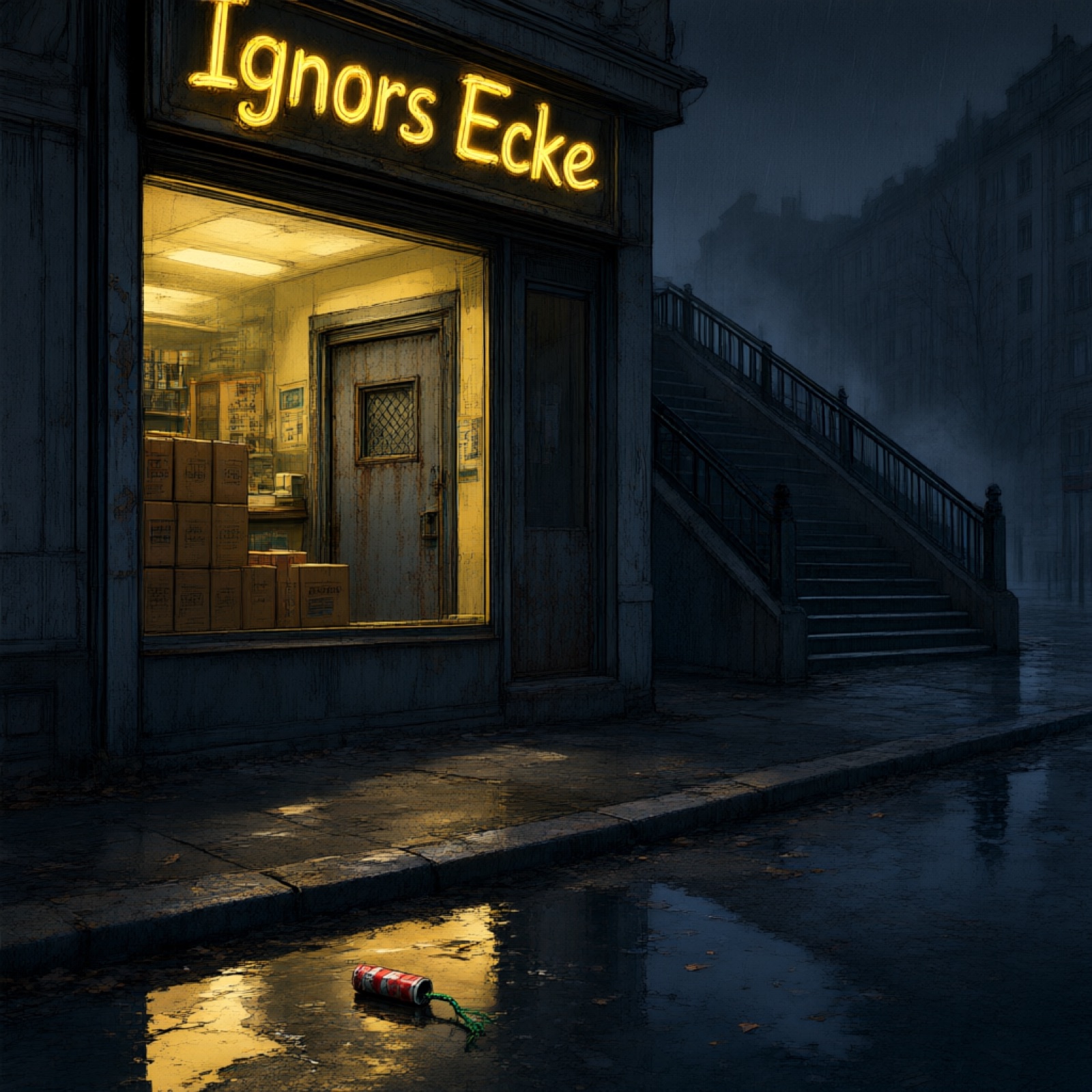
corner shop-Bernd stood behind his counter that evening, a cigarette in the corner of his mouth, the ceiling light so dim that the energy drinks looked like soldiers in a trench. He saw Kalle coming and turned demonstratively to the coffee machine. „I know nothing," he said, without turning round. „I never know nothing. I’m just the king of the donation market."
„Bernd," said Kalle. „Three months ago I made sure your electricity debts didn’t cost you your licence to sell. You owe me for that. And I’m here to collect."
„You don’t pay that back by talking," said Bernd, but he turned round after all. „What do you want to know?"
„Schmidt. Baustellen & Transporte. Jörg Schmidt, the bloke with the grey van."
Bernd’s face didn’t change, but his voice got quieter. „The Transporter. Go careful with him, Kalle. He’s known in the neighbourhood like a spotted dog – except this dog bites. He lays the bar across a cyclist, he’s got no sense of proportion left at all. You want someone who saw it and will talk: that’s his passenger. Herbert Brandt’s the name, he works the site for him now and then. And Herbert’s got a heart of gold – but a nervous one, ever since Jörg showed him his fingers last year after he talked about an accident. Three times a week he gets coffee and Snickers from me, and when he talks, he doesn’t talk loud." Bernd stubbed out the cigarette. „That’s all I’m saying. And you know the deal: Bernd said, Bernd never said nothing to nobody."
„Bernd said, Bernd never said nothing," repeated Kalle. „Thanks, Bernd."
„Quid pro quo," said Bernd, and hummed to himself.
Herbert Brandt, 51, with a face that looked as though it had seen many an unfair building site and a voice far too quiet for his frame, sat in the station the next morning and drank the coffee Leni had put in front of him as if it were medicine. Kalle hadn’t brought him in for an interview, but for a chat – with an envelope on the table that remained unopened.
„Mr Brandt," said Leni, „you were the passenger with Jörg Schmidt yesterday lunchtime. We have the camera from the ice-cream parlour, we have statements from two witnesses, and we have the registration. You’re not the suspect. You’re someone who made a mistake – namely, watching while a 22-year-old was struck with a bar. And you now have the choice: to stand by it – or to stand by what the camera shows."
Herbert Brandt looked into his coffee for a long while. Then he said, in his quiet voice: „He overtook the cyclist as if he wasn’t there. The boy rang his bell, nothing more. And then Jörg went off like he always does. The bar was lying in the loading edge at the back – he picked it up without looking. I told him it was enough, but you don’t know Jörg like I do. Once he starts, he only stops when the air’s gone out of him."
„You were there when he struck?"
„I tried to hold him back," said Brandt. „I mean: I tried. He shoved me aside and went for the boy. That’s all I can say. I can’t say more, or he’ll…"
„He’ll find out," said Kalle calmly, „that you were here. But the prosecutor will find out too – only about him, not against you. Mr Brandt, you have twenty minutes to decide whether you testify as a witness, or whether we have to lead you through that ice-cream-parlour camera as a participant."
Herbert Brandt finished his coffee, put the cup down and looked at Kalle. „I’ll testify," he said. „I don’t want this anymore. Jörg is a good craftsman, but a bad man when someone’s faster than him. And that lad – he was just faster on the bike. Drive me home, and I’ll say what I don’t want to watch anymore."
„Then let’s go and get Jörg Schmidt," said Kalle, towards the door. „From the building site on Zinngießerstraße, where he’s just putting up the barrier."
The arrest was unspectacular, as arrests in Berlin usually are when you don’t experience them on television. Jörg Schmidt stood on the building site, holding a crowbar in his hand and explaining to the officers that he had „merely defended himself against cyclists" who „ride without lights at night", and that he knew „nothing about any bar". The bar lay in the loading edge, the camera of the ice-cream parlour had been watching, and Herbert Brandt sat in the station writing his statement. „The Transporter," said Kalle afterwards to Leni, pulling off his gloves, „has now got himself an enforced break. And the cyclist can ride to uni again without helmet jokes."
„Good work today," said Leni.
Kalle nodded. That was all. He held the door open, and together they walked back towards the station through the Mitte autumn afternoon, in which the van had finally ended up where it belonged: in better company, the law-abiding kind.
Note: All characters, places and events in this story are fictional. It was inspired by a public police report but does not depict real events, persons or circumstances. More: Legal notice.